

A project-based resume serves students, freelancers, and career changers best when traditional job titles understate what they actually built or delivered. The immediate action is to select your two strongest projects, quantify their outcomes with real numbers or defensible scope markers, and structure each entry so a recruiter can assess impact in under ten seconds. The sections that follow detail exactly how to write, format, and tailor those entries for both automated screening and human review.
TL;DR:
- Focusing on two to four relevant projects and quantifying their impact with numbers or scope markers enhances credibility for early-career and freelance candidates.
- Structuring each project entry with PAR or STAR frameworks clarifies your role, actions taken, and measurable results, improving both ATS compatibility and recruiter understanding.
- For those with limited employment history or industry pivots, placing project details in a dedicated section or under relevant education enriches your credibility and emphasizes transferable skills.
- Conducting a final review by reading project bullets aloud ensures you can defend each claim during interviews, reducing the risk of overstatement or ambiguity.
- Linking project artifacts such as reports, code samples, or client emails to your resume supports evidence-backed claims and distinguishes your application in skill-focused hiring.
Table of Contents
- What is a project-based resume and when should you use one?
- Where should project entries go: a dedicated section or under your job history?
- How do you write a project entry using PAR or STAR?
- What formatting keeps a project resume readable by both software and humans?
- Copy-ready project entries for a student, a freelancer, and a career changer
- Common mistakes and red flags that get project resumes rejected
- Final checklist before you tailor and send a project resume
- How an evidence-led portfolio complements a project-based resume
- Why evidence-backed resumes are becoming the standard, not the exception
- Publish your projects as verifiable evidence, not just resume bullets
- Sources
- FAQ
What is a project-based resume and when should you use one?
A project-based resume organizes professional experience around discrete initiatives and their measurable outcomes rather than around job titles or chronological tenure. Instead of listing “Marketing Coordinator, 2023 to 2025” with generic duty bullets, this format foregrounds specific work: a campaign launched, a system migrated, a client deliverable shipped, each paired with a result.
This structure outperforms a conventional chronological format in several recurring situations. Students with limited paid work history can use capstone projects, coursework, and hackathons to demonstrate applied skill where employment history offers little. Freelancers and contractors, whose engagements are naturally project-shaped, can present client work with far more clarity than a traditional job history allows. Career changers benefit because a project section lets them surface relevant transferable work (a data analysis side project, a volunteer-led initiative) without forcing an unrelated job title into the spotlight.
The approach also aligns with how employers now evaluate candidates. Recruiters increasingly want to see specific skills paired with contextual examples rather than a bare list of competencies, and a project entry is the natural vehicle for that pairing.
Consider this format when:
- You have fewer than two years of relevant full-time employment.
- Your strongest evidence of skill sits in freelance, academic, or volunteer work rather than a job title.
- You are pivoting industries and need to lead with transferable, outcome-driven work instead of an unrelated employment history.
- The target role (product, engineering, design, consulting) is itself evaluated on shipped deliverables rather than tenure.
Where should project entries go: a dedicated section or under your job history?
Placement depends on how much traditional experience you already have and how directly your projects connect to a job title or degree.
A dedicated “Projects” section works best for early-career candidates and freelancers, since it lets you group your strongest work by relevance rather than burying it inside a thin employment history. This section typically sits near the top of the resume, right after a summary or skills block, so it gets seen before a recruiter’s attention drifts.
Established professionals with a solid job history generally do better nesting projects under the relevant employer or, for recent graduates, under an education entry. A class project tied directly to a degree reads more credibly next to the coursework that produced it than floating alone. University career centers commonly draw this same distinction: place academic projects under education when they are class assignments, and in a standalone section when they demonstrate independent initiative.
A hybrid pattern often works well: a short standalone “Selected Projects” section for the two or three most impressive pieces, with smaller supporting project mentions folded into the relevant job entries. Useful section titles for skimmability include:
- “Selected Projects” for a small, curated set of standout work.
- “Freelance Projects” when engagements are client-based and short-term.
- “Relevant Coursework and Projects” for students still building a track record.
- “Technical Projects” for engineering, data, or product roles evaluated on shipped work.
How do you write a project entry using PAR or STAR?
Two frameworks dominate project-entry writing, and both push toward the same discipline: context, action, and measurable result. The P-A-R (Project-Action-Result) or S-T-A-R (Situation-Task-Action-Result) framework structures each entry so a reader understands what you built, what you did, and what changed because of it.
PAR compresses this into three moves: state the project, describe the action you took, and report the result. STAR adds a distinct “task” step, useful when your specific responsibility within a larger team effort needs clarifying. Either framework captures the same essentials: what the project was, your role and specific actions, and a result with a number attached wherever possible.
Follow these steps to turn a project into a resume-ready entry:
- Name the project in a few words and give one clause of context (client, team size, timeline, or business problem).
- State your specific role, especially on team projects, so a reader knows what you owned versus what the team owned.
- List the two or three actions that mattered most, opening each with a strong active verb.
- Close with a measurable result: a percentage, a dollar figure, a time saved, or a scope marker if exact numbers are sensitive.
- Scan the entry for role clarity: could a stranger tell what you personally did, not just what the team accomplished?
Exact figures are not always available, particularly for freelance or confidential client work. In that case, relative scope markers convey impact without breaching confidentiality: a “mid-six-figure budget,” a “team of eight,” or a “reduced cycle time by roughly a fifth” all communicate scale honestly without disclosing proprietary numbers.
Keywords, tools, and certifications belong inside the action and result clauses themselves, not bolted on as an afterthought. If a job posting mentions Figma, Python, or PMP certification, weave the matching term into the sentence describing what you actually did with it, since that placement serves both the human reader and the applicant tracking system scanning for exact matches. This kind of keyword placement is worth planning deliberately before you finalize the entry.
Action verbs deserve the same care. Starting each bullet with a distinct, active verb (built, negotiated, migrated, audited) rather than repeating “worked on” or “responsible for” improves both readability and recruiter impression.
Pro Tip: Write your project entries as PAR first, then check whether adding a distinct “task” clause (the STAR version) clarifies your individual role on a team project; if it doesn’t add clarity, keep the shorter PAR form.
What formatting keeps a project resume readable by both software and humans?
Applicant tracking systems and human recruiters reward the same underlying discipline: clean structure, standard labels, and no visual clutter.
Avoid tables, text boxes, headers and footers, and decorative graphics, since parsing software frequently fails to read content placed inside them correctly. Standard fonts, standard section headings, and the employer’s requested file format remain the safest choice; when an application portal does not specify, a PDF generally preserves formatting more reliably than a Word document, though you should follow explicit instructions when they exist.
One in three employers report that specific, contextual skill examples influence their assessment of a candidate more than a general skills list, which is exactly what a well-formatted project entry provides over a bare bullet list of competencies.
Practical rules that keep a project resume skimmable:
- Use a short Skills or Tools line near the top, then reinforce those same terms inside project bullets rather than relying on the list alone.
- Keep each project entry to two or three bullets; a fourth bullet usually signals the entry needs tightening, not lengthening.
- Order projects by relevance to the target role first, recency second, since a scanning recruiter reads top to bottom and rarely reaches the bottom third.
- Keep the resume to one page for early-career candidates and up to two pages for those with extensive project history.
- Reserve bold formatting for the metric or outcome inside a bullet, not the entire line.
Copy-ready project entries for a student, a freelancer, and a career changer
These three examples show how the same PAR structure adapts to different levels of experience and evidence.
- Student capstone project. “Capstone: Campus Food Waste Tracker (Senior Project, Computer Science). Built a mobile app with a five-person team to log dining hall food waste; owned the backend data pipeline and reporting dashboard. Reduced manual waste-logging time for dining staff by an estimated third over the semester pilot.” This entry works under an Education heading since it is directly tied to coursework, and it names a specific personal contribution (backend pipeline) rather than crediting the whole team.
- Freelance client project. “Freelance Web Redesign, regional retail client. Redesigned a five-page e-commerce site in Figma and rebuilt it in Webflow to improve mobile load speed and checkout flow. Client reported a mid-double-digit increase in mobile session duration after launch.” This entry names the tools (Figma, Webflow) explicitly for ATS matching and uses a scope marker instead of an exact, possibly confidential, revenue figure.
- Career-changer internal project. “Internal Process Audit, previous employer (retail operations, transitioning to data analysis). Volunteered to analyze six months of inventory data in Excel and Python after noticing recurring stockouts; presented findings to store management. Analysis contributed to a revised reorder schedule that store managers adopted the following quarter.” This entry works well in a standalone “Selected Projects” section since the job title itself (a retail role) would otherwise obscure the analytical work being highlighted.
To tailor any of these to a specific posting, swap the tool names for whatever the job description names explicitly, and adjust the result clause to match the outcome category the employer seems to prioritize, whether that is speed, revenue, retention, or accuracy.
Common mistakes and red flags that get project resumes rejected
Several recurring errors undermine otherwise strong project entries, and most are fixable with a single editing pass.
- Vague outcomes. “Helped improve efficiency” tells a recruiter nothing; replace it with a number, a percentage, or a scope marker.
- Inflated language. Calling yourself the “lead architect” of a project you contributed to as one of five engineers is the kind of overstatement that collapses under a follow-up interview question.
- Missing role clarity. On team projects, failing to state what you personally owned leaves a recruiter guessing whether you did the work or merely observed it.
- Irrelevant technical detail. Naming every library or tool touched during a project buries the one or two that actually matter to the target role.
- ATS-unfriendly formatting. A project entry trapped inside a text box or table may never reach a recruiter’s screen at all, regardless of how well it is written.
Fixing these is mostly a matter of substitution: swap a passive or inflated verb for a precise active one, add a scope clause where a number is missing, and delete any tool or detail that does not connect to the target role.
Recruiters and hiring managers who read a strong project bullet will often probe it directly in an interview, asking what specifically you did, what the biggest obstacle was, and how you measured the result you claimed. Preparing a short, evidence-backed answer for each bullet before the interview, not during it, prevents a confident resume claim from falling apart under a follow-up question.
Pro Tip: Before submitting, read each project bullet aloud and ask “could I defend this exact wording in an interview?” If the answer is no, the bullet needs editing now, not damage control later.
Final checklist before you tailor and send a project resume
A short, repeatable process before every submission catches most errors that a single read-through misses.
- Choose your two to four strongest, most relevant projects rather than including everything you have ever worked on.
- Quantify each result with a real number or a defensible scope marker.
- Add a short Skills or Tools line, keyword-matched to the posting where honest.
- Proofread for verb-tense consistency and role clarity on every team project.
- Export in the file format the application explicitly requests, PDF by default otherwise.
- Confirm the resume fits one page for early-career applicants, two at most otherwise.
The tailoring workflow itself is short: scan the job posting for its top three or four required skills, swap in one or two project bullets that most directly match them, update the Skills line to mirror the posting’s own terms, then export. This kind of targeted tailoring rather than a full rewrite is usually enough to move a resume from generic to relevant.
| Step | What to check | Why it matters |
|---|---|---|
| Project selection | Top 2 to 4 most relevant projects chosen | Focuses recruiter attention on strongest evidence |
| Quantification | Every result has a number or scope marker | Distinguishes claims from evidence |
| Keyword match | Skills line mirrors posting language | Improves ATS and recruiter relevance |
| File format | PDF or Word per application instructions | Avoids parsing failures |
Building a running bank of project stories, kept in a single document with the metrics and specifics for each, means every future tailoring pass starts from real material instead of memory.
How an evidence-led portfolio complements a project-based resume
A resume bullet can only assert a result. It cannot show the deliverable, the client message confirming the outcome, or the code that produced it, and that gap is exactly where a recruiter’s doubt about an inflated bullet tends to form. Linking each project claim to a real artifact removes that friction and gives a hiring manager something to verify instead of something to take on faith.
Useful artifacts to prepare alongside a project-based resume include:
- A design document or project brief showing scope and decisions made.
- A slide deck or report summarizing the final outcome for stakeholders.
- A test report, dashboard, or metrics export backing the quantified result.
- A code sample or repository link for technical work.
- A client email or message confirming a delivered outcome.
- Deployment notes or a changelog showing the work shipped, not just planned.
On the resume itself, these artifacts stay implicit, since a paper resume has no room to display them. An interactive portfolio built around linked evidence is where the artifact actually lives, letting a recruiter who wants more than a bullet point go find it directly rather than asking you to email a link mid-process.
Why evidence-backed resumes are becoming the standard, not the exception
Skills-based hiring has shifted what a resume is expected to prove. Employers now routinely ask for measurable outcomes tied to specific skills rather than a general list of competencies, which means a bullet claiming impact without a way to substantiate it is doing half the job it needs to do.

Some platforms are built around the observation that a resume claim and the evidence behind it are usually stored in different places: the bullet on the page, the deliverable in a Google Drive folder somewhere else entirely. An interactive portfolio that lets a recruiter’s questions reach the actual artifact, rather than a paraphrase of it, changes what “verified” means on a resume from a word to a workflow.
The candidates who benefit most from this shift are the ones this article was written for: students without a long job history, freelancers whose best evidence lives in scattered client files, and career changers whose most relevant work sits outside their official job title. For all three, the project itself, not the title, is the actual credential. Treat it that way on the page, and be ready to prove it beyond the page.
— Alloquy Team
Publish your projects as verifiable evidence, not just resume bullets
A project-based resume gets you the interview. What happens after that depends on whether you can back up the bullet with something real, and that is the specific gap Alloquy is built to close. Rather than asking a recruiter to trust a quantified claim on a page, you link the underlying documents (a design file, a client email, a deployment log) and let a custom AI assistant answer a recruiter’s follow-up questions directly from that evidence.
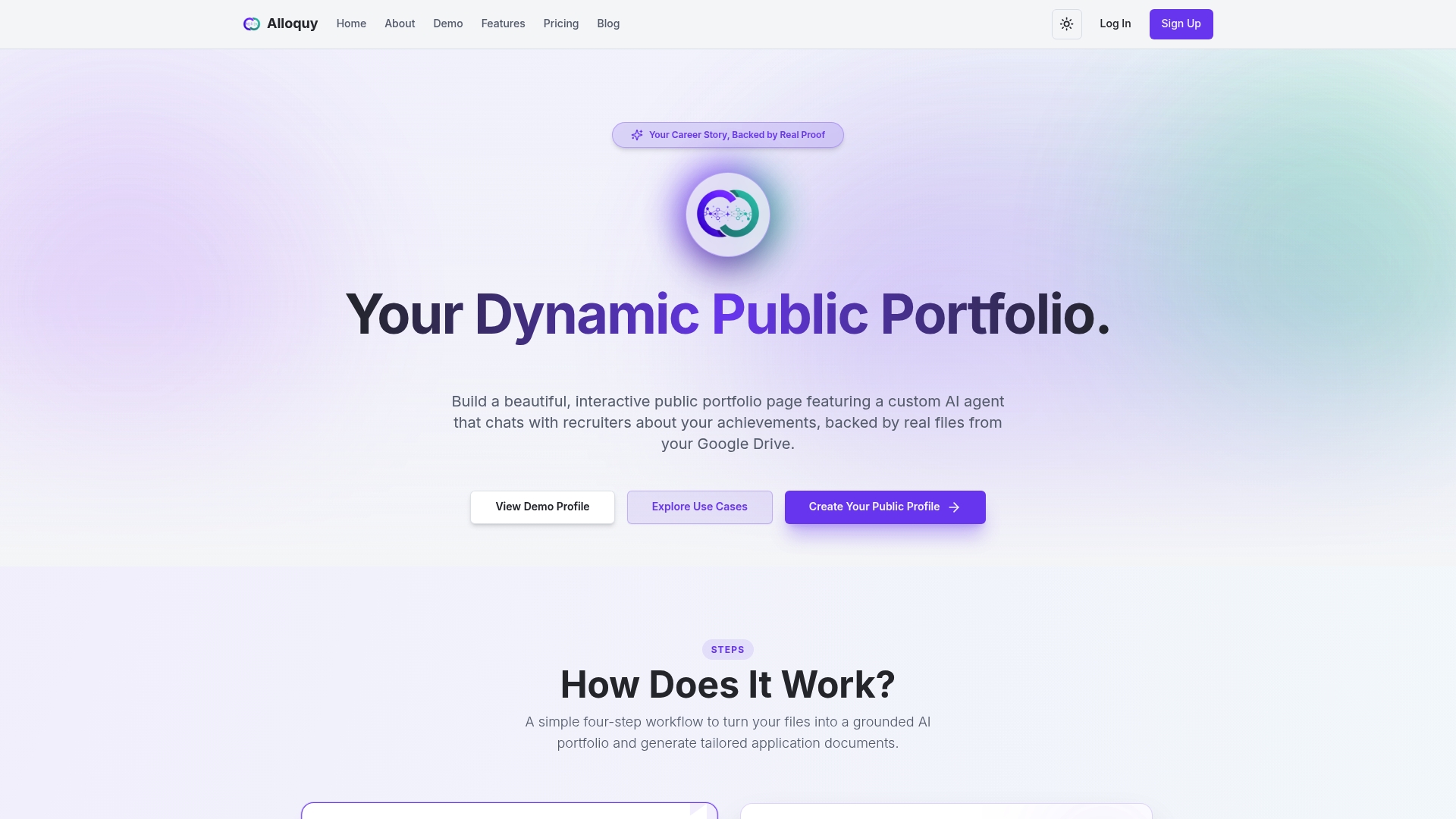
This approach helps students, freelancers, and career changers most, since these are exactly the profiles whose strongest proof of skill rarely fits neatly into a traditional employment history. Start with a free profile and publish three to six of the project artifacts you already have sitting in a Drive folder: a report, a deck, a code sample. From there, Alloquy can also generate tailored resumes and cover letters pulled from that same verified material, so your next application starts from evidence instead of a blank page.
Sources
This guide draws on frameworks and formatting rules published by university and professional career services. MIT’s Career Advising and Professional Development office supplies the PAR and STAR structuring guidance used throughout. UC Berkeley’s Career Center informs the ATS formatting rules, including font, heading, and file-format recommendations. The Project Management Institute contributes the scope-marker approach for quantifying confidential project details. NACE’s Job Outlook research supports the claim about employers valuing contextual skill examples. Readers evaluating HR and hiring perspectives more broadly may also find this comparison of HR software for e-commerce hiring teams useful for understanding how employers manage candidate screening.
- NACE Job Outlook 2026 spring update (research report)
- MIT CAPD guidance: writing about your skills
- PMI blog: How to build a resume that stands out for project roles
- Career Center - Berkeley: Resumes
FAQ
What is the proper format for a project-based resume?
A project-based resume groups experience around specific projects rather than job titles, with each entry structured using the PAR (Project, Action, Result) or STAR (Situation, Task, Action, Result) framework and a measurable outcome. It typically sits in a dedicated Projects section near the top of the resume for students and freelancers, or nested under relevant job or education entries for those with established work history.
What is a red flag on a resume?
Common red flags include vague, unquantified claims of impact, inflated titles or ownership of team work, and formatting like tables or graphics that applicant tracking systems struggle to parse. Missing role clarity on team projects is also a frequent concern, since it leaves recruiters unable to tell what a candidate personally contributed.
What are examples of projects on a resume?
Examples include a student capstone or coursework project, a freelance client deliverable such as a website redesign, and an internal workplace initiative like a process audit or data analysis effort taken on outside a formal job title. Each works best when written with a specific role, the actions taken, and a quantified or scope-marked result.
What are the 7 types of resumes?
Common resume types include chronological, functional (skills-based), combination, targeted, project-based, mini, and infographic or visual formats, though definitions and groupings vary across career resources. A project-based resume, the focus of this guide, organizes experience around discrete initiatives and their measurable outcomes rather than job titles or a simple skills list.