

Yes, use the STAR method selectively to turn your strongest achievements into concise, measurable resume bullets. Skip it for routine duties. Condense each story into a single line that opens with an action verb and closes with a result. Reserve full STAR treatment for two to four standout accomplishments per role, not every bullet on the page.
TL;DR:
- Most effective STAR bullets emphasize measurable outcomes, such as reducing processing time by 25% or increasing lead generation by 22%.
- Focus on incorporating specific metrics or scope, like handling 200 daily shipments or managing a team across four time zones, to strengthen achievements.
- Use strong action verbs and relevant keywords from the job posting while keeping the bullet to one clear, concise sentence.
- Prioritize two to four STAR-style accomplishments in recent or relevant roles to maintain resume clarity and impact.
- Verify claims by attaching supporting evidence or documentation, such as project decks or performance reviews, to build trust with recruiters.
Table of Contents
- What Is the STAR Method for a Resume?
- How Do You Turn a STAR Story into a Resume Bullet?
- Copy-Ready STAR Formulas and Before-and-After Examples
- How Do You Quantify Results When You Don’t Have Exact Numbers?
- Where Should STAR Bullets Go on Your Resume?
- What Mistakes Weaken a STAR Resume Bullet?
- STAR Method Resume Examples by Role and Career Stage
- Why Evidence Beats a Bullet Point Alone
- What This Article Gets Right That Most STAR Advice Misses
- Turn Your STAR Bullets into Verifiable Stories
- Sources
- FAQ
What Is the STAR Method for a Resume?
STAR stands for Situation, Task, Action, Result. It originated as an interview framework for answering behavioral questions like “Tell me about a time you solved a difficult problem,” and it works the same way on paper as it does out loud: it forces you to prove impact instead of listing responsibilities.
On a resume, you never write all four parts as separate sentences. Instead, you compress them into one bullet where the Action verb leads, the Situation and Task collapse into a short phrase of context, and the Result carries the proof. Resume notes that the method works well for resumes specifically because it’s flexible enough to shrink into one line without losing its persuasive structure, though it warns against overusing it until every bullet reads like a mini case study.
The reason STAR outperforms a plain duty list comes down to what each letter forces you to include:
- Situation anchors the bullet in a real context (a failing process, a missed deadline, an underperforming channel).
- Task clarifies what you were specifically responsible for solving.
- Action names the exact steps you took, using a strong verb.
- Result proves the outcome mattered, ideally with a number.
Skip any element that doesn’t add information. Most resume bullets need only a hint of Situation and Task before jumping straight to Action and Result.
How Do You Turn a STAR Story into a Resume Bullet?
Converting a full STAR story into one resume line is a compression exercise, not a rewriting exercise. Columbia’s career education office recommends drafting the whole story first, then cutting it down, because writing the long version surfaces details you’d otherwise forget to quantify.
Step 1: Read the job description and pick two or three priority skills. Before you write anything, identify which behaviors the posting actually cares about: cross-functional leadership, cost reduction, client retention, technical troubleshooting. Every STAR bullet you draft should map to one of these.
Step 2: Write a quick full STAR draft. Give yourself one to two sentences per element. Don’t worry about resume formatting yet. Just get the facts down: what was broken, what you owned, what you did, what changed.
Step 3: Condense using this formula.
- Shrink Situation and Task into a short phrase, often just a few words of context.
- Lead with a strong Action verb in past tense.
- Close with the Result, using a metric whenever one exists.
Run the finished bullet through this checklist before moving to the next one:
- Does it start with one clear action verb (not “responsible for”)?
- Does it end with a concrete result or defined scope?
- Does it include a keyword from the job posting?
- Is it one sentence, not two?
If a bullet fails any of these four checks, it needs another pass. TopResume’s formula for this exact compression is: action verb plus what you did plus context if needed plus measurable result.
Copy-Ready STAR Formulas and Before-and-After Examples
The formula behind every strong STAR bullet is short: Action verb + what you did + context (if needed) + measurable result or scope. Everything else is filler.
Here’s how that formula transforms generic duty statements into resume bullets that actually get read:
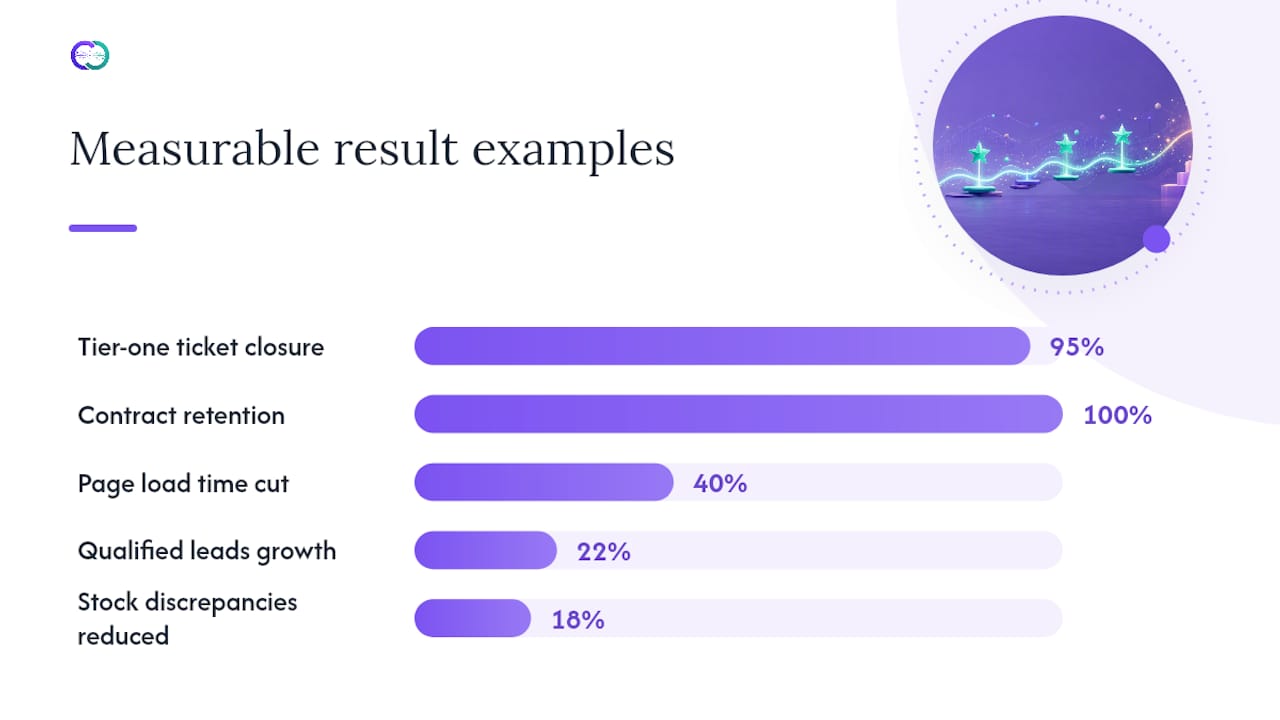
- Before (entry-level, retail/sales): “Responsible for helping customers on the floor.” After: “Resolved an average of 30 customer inquiries per shift, lifting department satisfaction scores by 15%.”
- Before (mid-level, software engineering): “Worked on backend performance issues.” After: “Diagnosed a memory leak in the checkout service and cut average page load time by 40%.”
- Before (senior, marketing): “Managed social media accounts.” After: “Rebuilt the paid social funnel across three platforms, growing qualified leads by 22% in one quarter.”
- Before (mid-level, operations): “Oversaw inventory tracking.” After: “Redesigned the inventory audit process for a 12-warehouse network, reducing stock discrepancies by 18%.”
- Before (entry-level, customer support): “Answered support tickets.” After: “Closed 95% of tier-one tickets within a two-hour SLA, up from a 68% baseline.”
- Before (senior, sales): “Handled key accounts.” After: “Negotiated renewal terms with a 10-account enterprise portfolio, retaining 100% of contracts through a pricing overhaul.”
Group your action verbs by function so you’re not defaulting to “managed” or “helped” for every bullet: sales calls for negotiated, closed, upsold; engineering calls for architected, debugged, deployed; marketing calls for launched, optimized, positioned; operations calls for streamlined (used sparingly), audited, restructured.
Pro Tip: Write the full STAR story first, even if it takes five sentences. You’ll remember the metric, the client name, or the exact scope far more accurately in that longer draft than if you try to compress on the first pass.
Keep verbs in past tense for previous roles and present tense only for a job you currently hold.
How Do You Quantify Results When You Don’t Have Exact Numbers?
Recruiters respond to numbers because a number proves the achievement is real, not padding. Indeed’s guidance on quantifying resume achievements lists percentage increases, dollars saved, time reduced, volume handled, and error reduction as the metric types that carry the most weight with hiring managers.
The metrics that consistently register with recruiters fall into six buckets:
- Percentage change (growth, reduction, improvement rate)
- Dollar amounts (revenue generated, costs cut, budget managed)
- Time saved or turnaround improved
- Volume handled (transactions, tickets, units, accounts)
- Error or defect reduction
- Adoption or engagement gains (users, sign-ups, retention)
If you genuinely don’t have a hard number, quantify scope instead: team size, project count, client roster, or geographic reach. “Managed a 10-person team across three regions” carries real weight without a single percentage in sight.
One rule matters more than any formula: never round a figure without a reason, and never guess.
Where Should STAR Bullets Go on Your Resume?
Density matters as much as wording. Overload every bullet with a full STAR story and the resume becomes exhausting to read.
- Use two to four STAR-style bullets for your most recent or most relevant role.
- Use fewer, shorter STAR bullets for older roles, since recruiters weight recent experience more heavily.
- Add one compact STAR-style line in your summary or profile section if you have a single standout accomplishment worth leading with.
- Reserve STAR treatment for project descriptions or a dedicated “selected achievements” block when your resume has one.
- Keep routine, non-differentiating duties as short, plain bullets. Not everything needs a Result attached.
The goal is contrast: when only your best accomplishments carry a metric, that metric stands out instead of blending into a wall of bullets that all sound equally impressive.
What Mistakes Weaken a STAR Resume Bullet?
The most common failure is telling the whole story instead of condensing it. A resume bullet with four clauses reads like a paragraph that wandered onto the wrong document. Cut it to one sentence.
The second failure is verb weakness. “Responsible for” and “helped with” tell a recruiter you managed a task without proving you did anything with it. Replace both phrases with a specific action verb and follow it with a number or defined scope.
The third failure is overuse. If every single bullet on the page follows an identical Action, Context, Result rhythm, the resume starts to feel formulaic and the strongest achievements lose their contrast against the routine ones. Career advisors note that STAR is a framing tool, not a rigid requirement for every line.
Run this checklist before finalizing:
- Strong, specific verb (no “responsible for,” “helped,” or “worked on”)
- Measurable outcome or clearly stated scope
- One tight sentence, not a paragraph
- At least one keyword pulled from the job posting
Pro Tip: If a bullet doesn’t change if you delete it, it probably shouldn’t be there. STAR bullets earn their place by being irreplaceable, not by filling space.
STAR Method Resume Examples by Role and Career Stage
Each example below shows the condensed line and what to swap in for your own facts.
- Entry-level, customer support: “Reduced average ticket resolution time by 25% by building a shared troubleshooting guide for common billing issues.” Swap the percentage and the specific tool for your own metrics.
- Mid-level, sales: “Closed $180,000 in new business across 40 accounts in a single fiscal quarter, exceeding quota by 30%.” Swap the dollar figure and quota percentage.
- Senior, engineering: “Led a five-engineer team through a database migration that cut query latency by 60% with zero downtime.” Swap the team size and the technical metric.
- Mid-level, marketing: “Launched a lifecycle email program that lifted repeat purchase rate by 14% over two quarters.” Swap the campaign type and lift percentage.
- Entry-level, operations: “Streamlined shipment tracking for a 200-order daily volume, cutting mislabeled packages by 90%.” Swap the volume and error metric.
- Senior, product management: “Directed the launch of a mobile feature adopted by 65% of active users within 90 days of release.” Swap the adoption figure and the timeframe.
- Mid-level, customer support (scope, not exact number): “Managed a 10-person support pod handling enterprise-tier accounts across four time zones.” This uses scope instead of a precise number when exact figures aren’t available.
- Entry-level, marketing: “Coordinated content production across three social platforms, growing organic reach by 22% in six months.” Swap the platform count and reach percentage.
Why Evidence Beats a Bullet Point Alone
STAR bullets solve one problem: they compress achievement into something a recruiter can scan in six seconds. They don’t solve a second problem, which is that a recruiter has no way to verify any of it. A resume claim and a fabricated one look identical on the page.
That gap is where linking supporting documents, work samples, or a short interactive record behind a claim changes the conversation. Alloquy’s approach to structuring achievements treats each STAR bullet as a headline with evidence attached, rather than a standalone assertion the recruiter has to take on faith. Alloquy’s team has spent time studying how resume tailoring and ATS keyword alignment actually influence recruiter behavior, and the pattern is consistent: specificity plus verification beats specificity alone.
The recruiter who reads “cut checkout latency by 40%” doesn’t need to trust you. They need thirty seconds to confirm it. Give them that, and the bullet stops being a claim and starts being a fact.
Pick your three strongest STAR bullets, gather the documents or data behind each one, and attach a single portfolio item that proves at least one claim on sight.
What This Article Gets Right That Most STAR Advice Misses
Most resume guides treat STAR as a formatting trick: memorize the acronym, fill in four blanks, done. That advice produces resumes where every bullet sounds identical, which defeats the entire purpose of using a persuasive framework in the first place.
The better read on STAR is that it’s a filtering tool before it’s a writing tool. Its real value is forcing you to ask “did this actually produce a measurable outcome?” before you spend a bullet on it. Most job duties fail that test, and that’s fine. Not every line on a resume needs to carry a Result.
Where conventional advice falls short is stopping at the bullet. A well-condensed STAR line is still just a claim on paper, and hiring managers increasingly discount claims they can’t verify quickly. The reader’s real priority should be picking the handful of accomplishments that can survive scrutiny, writing those tightly, and being ready to back them with something concrete the moment a recruiter asks.
— Alloquy Team
Turn Your STAR Bullets into Verifiable Stories
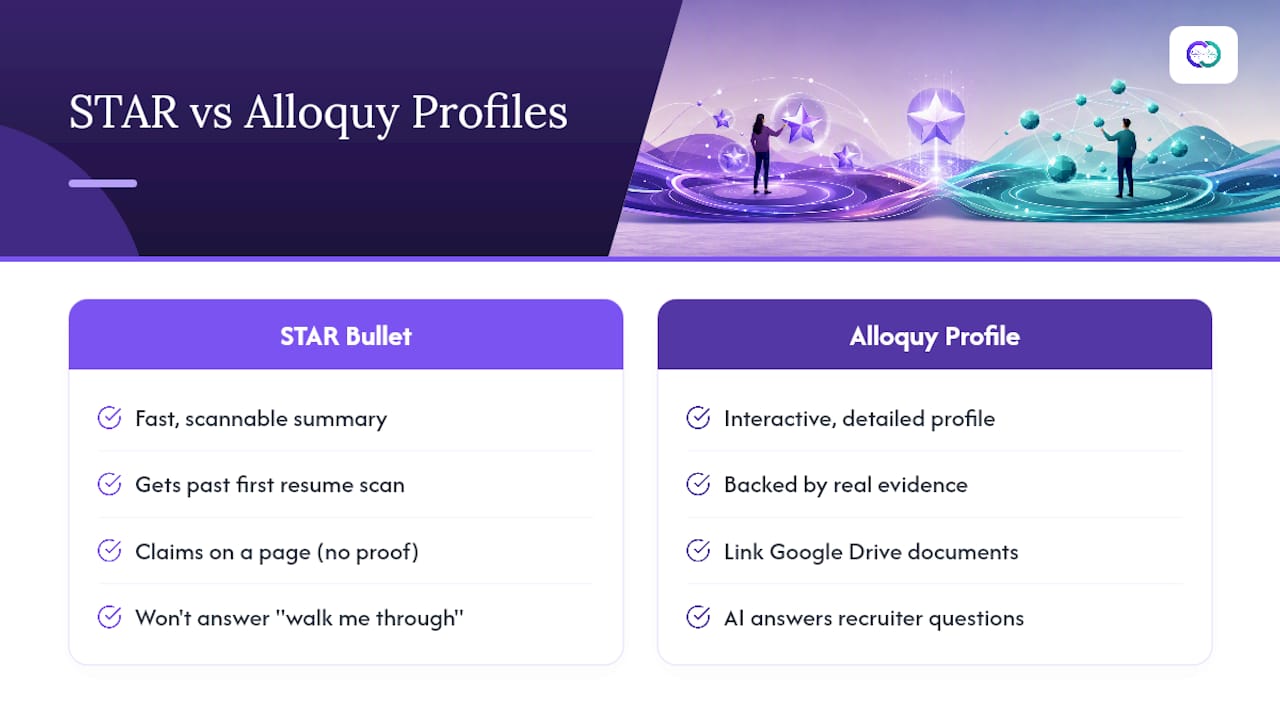
A well-written STAR bullet gets you past the first scan. It doesn’t answer the follow-up question a recruiter asks in the interview, which is usually “walk me through that.” Alloquy closes that gap by turning your best STAR accomplishments into an interactive profile backed by real evidence, not just a claim on a page.

You link the Google Drive documents behind your biggest wins, whether that’s a project deck, a performance review, or a client deliverable, and an AI assistant lets recruiters ask direct questions about your work and get answers grounded in that evidence. It complements your resume rather than replacing it: your STAR bullets stay the fast, scannable version, while your Alloquy profile becomes the detailed, interactive resume a recruiter can dig into before or after the first call. The platform can also generate tailored resumes and cover letters pulled from your verified data, so your STAR language and your supporting evidence stay consistent everywhere you apply.
If you want to see how it works for your own accomplishments, check the Alloquy pricing plans and start with the free tier.
Sources
For deeper guidance beyond this piece, Columbia’s career education office covers full before-and-after bullet rewrites. Resume.io’s STAR resume guide walks through formatting and when to skip the method entirely. For keyword alignment, review Alloquy’s ATS keyword playbook, and for aviation-specific resume formatting, FlightSchoolUSA’s pilot resume guide offers a useful technical-role model.
- How to quantify resume achievements | Indeed Career Guide
- Resumes with Impact: Creating Strong Bullet Points | Columbia Career Education
- Resume
- How to write a STAR method resume | TopResume
FAQ
What are five good skills to put on a resume?
The strongest skills to highlight depend on the role, but cross-functional collaboration, data analysis, client negotiation, project ownership, and technical troubleshooting are commonly sought across sales, engineering, marketing, and operations roles. Match your choices to the specific job posting rather than a generic list.
Is the STAR method outdated?
No, it’s still widely recommended for both interviews and resumes, but only when used selectively. Applying it to every single bullet makes a resume repetitive, so the current best practice is to reserve it for your two to four strongest achievements per role.
What’s a good example of a STAR answer condensed into a bullet?
Swap the team size, system name, and percentage for your own facts.
How do I match STAR bullets to a specific job description?
Pull two or three priority skills or keywords directly from the posting, then write your Action verb and context phrase using that same language. Tailoring your resume to the exact posting this way improves both recruiter and applicant tracking system matching.