

An interactive portfolio is an AI-powered, evidence-backed professional profile that recruiters can query in real time to verify your skills, project outcomes, and work provenance. The recommended first action is concrete: gather 3–5 verified work artifacts — project briefs, outcome metrics, and provenance links — and publish a recruiter-queryable profile before your next application cycle.
Before reading further, confirm you have these three items ready:
- At least three projects with documented outcomes (percentages, timelines, deliverables)
- Verifiable source links (Google Drive PDFs, timestamped screenshots, assessment reports)
- A short recruiter share note that directs hiring teams to your public query link
Key Takeaways
An AI-powered interactive portfolio built on verified evidence, process documentation, and a recruiter-queryable AI assistant is the most credible professional signal available in 2026 hiring.
| Point | Details |
|---|---|
| Resume trust has collapsed | Only ~33% of employers are very confident resumes reflect real skills; verified evidence fills that gap. |
| Process beats polish | Case studies that include failure-to-recovery narratives are harder for AI to fabricate and more persuasive to recruiters. |
| Verification drives decisions | 92% of consumers say a background check influences hiring; the same preference applies to portfolio credentials. |
| Machine-readability matters | ATS-safe URLs and structured metadata increase the chance agentic AI screening tools surface your profile. |
| Alloquy as the turnkey path | Alloquy links Drive evidence to a custom AI assistant, generates tailored resumes, and publishes a branded, recruiter-queryable profile. |
Table of Contents
- Why evidence-backed interactive portfolios matter in 2026 hiring
- What every recruiter-ready interactive portfolio must include
- How to build an interactive portfolio from evidence to publish
- How to make your portfolio discoverable and recruiter-queryable
- How verified credentials and provenance build recruiter trust
- How to measure portfolio performance and iterate
- Common mistakes that reduce portfolio credibility
- Why evidence-first portfolios are the future of hiring
- Alloquy turns your evidence into a recruiter-queryable profile
- Sources
- FAQ
Why evidence-backed interactive portfolios matter in 2026 hiring
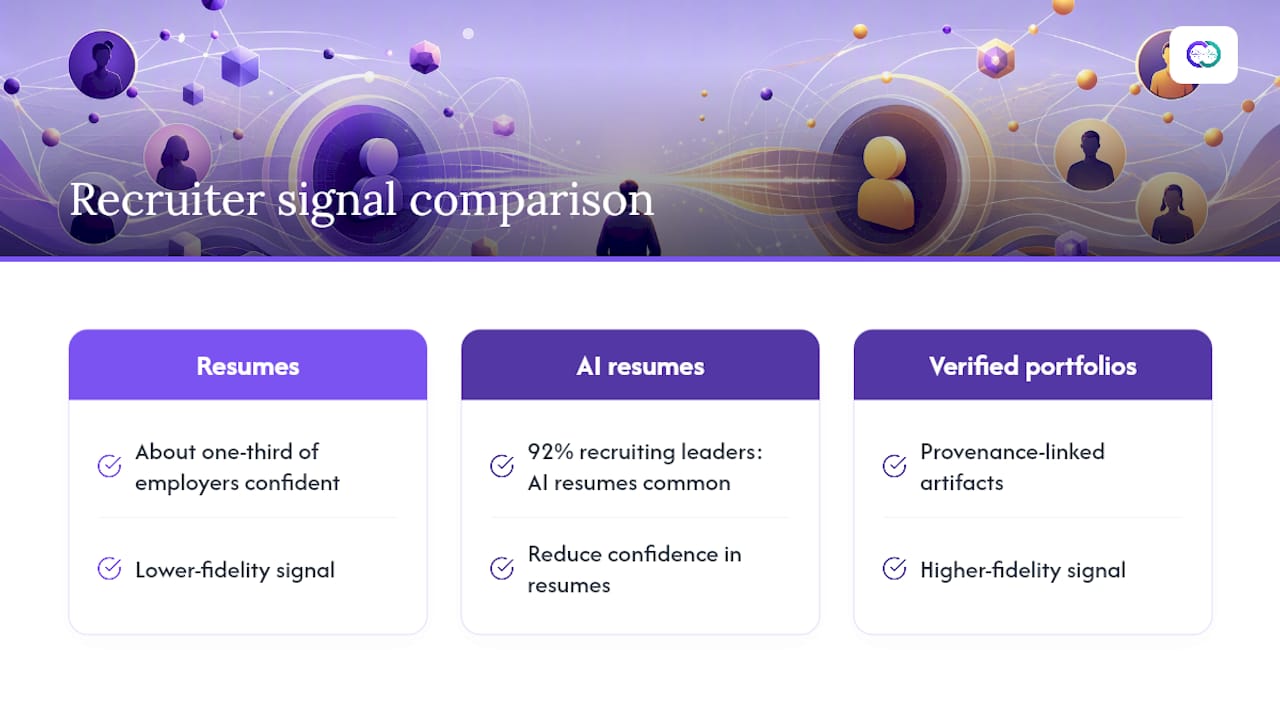
The resume’s authority as a hiring signal has collapsed. According to the 2026 Talent Acquisition Trends Study, only about one-third of employers say they are very confident that resumes reflect a candidate’s true skills, and 92% of recruiting leaders report that AI-generated resumes are now commonplace. That combination — inflated claims, AI polish, and eroded confidence — has pushed hiring teams toward higher-fidelity signals.
Stat: Many recruiting leaders say AI-generated resumes are now commonplace, while only a minority of employers express strong confidence that resumes reflect real skills.
Structured, job-relevant assessments and work simulations consistently outperform unstructured resume review for predicting job performance. The AI hiring shift affecting senior technical talent in 2026 has accelerated this preference: agentic AI screening tools now surface candidates whose profiles are structured, queryable, and evidence-linked rather than keyword-dense.
What every recruiter-ready interactive portfolio must include
A portfolio that passes recruiter scrutiny in 2026 is not a gallery of polished deliverables. It is a structured evidence system. Every component below earns its place by addressing a specific recruiter trust question.
- Verified evidence links and provenance. Attach Google Drive PDFs, timestamped screenshots, or third-party certificates to each project. Set granular access controls so sensitive artifacts are visible only to verified viewers.
- Interactive case studies. Structure each project as problem → approach → failure points → measurable outcome. Portfolios that surface process, including failure and recovery, are the most persuasive evidence because those narratives are difficult for generative AI to fabricate credibly.
- Explicit skill and proficiency labels. Assign a proficiency level to each claimed skill and document the validation method: work sample, third-party assessment, or peer endorsement. Transparency in the validation process is the key signal employers need per Aspen Institute analysis on validated skills.
- An AI Q&A assistant trained on your evidence. The assistant should answer recruiter queries by citing specific artifacts, not generating plausible-sounding summaries. Verified profile cards that connect skill claims to supporting evidence are the recommended response to the current trust crisis.
- Branded presentation and application asset generation. A tailored PDF resume and cover letter generated from verified data, plus ATS-compatible and LinkedIn-ready share links, complete the professional graph.
How to build an interactive portfolio from evidence to publish
Follow these six steps in order. Skipping evidence collection and jumping to design is the most common reason portfolios fail recruiter scrutiny.
- Collect evidence. Select 3–5 projects. For each, capture the deliverable, the outcome metric (percentage improvement, revenue impact, time saved), and the raw artifact (code repository, design file, report).
- Document process. Write a short case study per project. Include what failed, what changed as a result, and the measurable final outcome. This process layer is what AI-polished resumes cannot replicate.
- Attach provenance. Link each artifact to a verifiable source: a Drive PDF, a timestamped screenshot, or an assessment report. Set access controls before publishing. The professional verification stack guide covers how cloud storage metadata strengthens provenance claims.
- Label skills and validation methods. Assign a proficiency level (e.g., “Advanced — validated by work sample and peer review”) to each skill. Never claim a skill without a linked artifact.
- Configure the AI assistant. Ingest only cited evidence into the assistant’s context. Add guardrails so it declines to answer questions outside its evidence scope and cites the source artifact for every response. AI interviewing tools that probe examples against validated rubrics set the standard recruiters now expect from AI-assisted screening.
- Publish and share. Generate a tailored resume and cover letter from your verified data. Add an ATS-safe URL, a LinkedIn profile link, and a QR code for in-person outreach. Include a recruiter share note (see the next section).
Pro Tip: Before publishing, run three test queries through your AI assistant as if you were a recruiter: “What is your strongest project outcome?”, “Describe a failure and how you recovered,” and “What validates your claimed proficiency in [skill]?” If any answer lacks a cited artifact, add the evidence before going live.
How to make your portfolio discoverable and recruiter-queryable
Discoverability is a distribution problem, not a design problem. Agentic AI workflows like LinkedIn’s Hiring Assistant favor profiles that are structured and machine-readable, which means consistent labels, metadata, and source links increase the probability your profile surfaces in automated shortlists.
Practical sharing checklist:
- Public summary link: a clean URL pointing to your portfolio’s public-facing overview, safe to include in any application.
- Recruiter query link: a direct link to the AI assistant interface, shared only with hiring contacts after initial screening.
- ATS-safe URL format: plain text, no redirects, no session tokens. Paste it into the resume’s contact block and LinkedIn’s “Website” field.
- Resume and LinkedIn embed: place the portfolio URL immediately below your name in the resume header and in the LinkedIn “Featured” section.
- QR code: generate one for your portfolio’s public link and add it to printed materials or email signatures.
AI recruiting assistants update CRM records and summarize candidate context automatically, so a machine-readable portfolio link that resolves to structured data is more likely to be logged and acted on than a PDF attachment.
Pro Tip: Send your recruiter query link 24–48 hours before a scheduled interview with a one-line note indicating you have prepared an AI assistant trained on your project evidence to help recruiters prepare.
How verified credentials and provenance build recruiter trust
Verification is not a cosmetic addition. Checkr’s 2026 survey found that Most consumers say a background check influences hiring decisions. That preference for vetted, verified candidates extends directly to portfolio evidence.
Stat: 92% say a background check influences hiring decisions; verified credentials carry the same weight in portfolio contexts.
| Trust signal | What it proves | How to add it |
|---|---|---|
| Timestamped Drive document | Artifact existed before the application | Share a view-only Drive link with creation date visible |
| Third-party certificate | Skill validated by an external body | Embed the certificate URL or badge link |
| Background/ID verification badge | Identity and credential authenticity | Use a verification provider and display the badge on your profile |
| Transparent validation note | Explains how each skill claim was tested | Add a one-sentence validation method label per skill |
Privacy controls matter equally. Follow the proof-without-exposure framework for selective sharing: redact client names from artifacts, use expiring links for sensitive documents, and store all evidence in encrypted, access-controlled storage.
How to measure portfolio performance and iterate
Measurement converts a portfolio from a static asset into a feedback loop. Track these signals after each application cycle:
- Recruiter queries answered: volume and topic distribution from AI assistant logs reveal which skills attract the most scrutiny.
- Time-to-first-contact: compare application batches where you included the portfolio link versus those where you did not.
- Artifact click-through rate: UTM-tagged Drive links show which projects recruiters actually open.
- Interview-to-offer ratio: the downstream metric that confirms whether portfolio engagement translates to outcomes.
Run low-cost experiments on a two-week cadence: test two versions of your recruiter share note, swap in a new case study, or add one credential. For generative AI hiring timelines in H2 2026, most practitioners report meaningful engagement signals within 30–45 days of a well-configured publish. Free-tier platforms cover basic publishing; paid subscriptions typically unlock expanded AI query limits, additional evidence storage, and resume generation.
Common mistakes that reduce portfolio credibility
Most interactive portfolio failures trace to three specific errors. Each has a direct fix.
- Publishing polished artifacts without process. A finished design or a deployed app with no context reads as AI-generated output. Fix: add a failure-to-recovery note and at least one raw artifact (a draft, a rejected approach, a debugging log).
- Overloading the AI assistant with unsourced claims. An assistant that answers confidently without citing a specific artifact destroys trust faster than a blank portfolio. Fix: restrict the assistant’s context strictly to cited evidence and enable explainability logs so recruiters can see which document each answer draws from. Ethical AI career tool guidelines cover the guardrail configurations that keep assistant outputs credible.
- Sharing private documents without access controls. Sending an open Drive link that exposes client names or unreleased product details is a confidentiality breach. Fix: use expiring links, viewer-only permissions, and redacted versions for public-facing artifacts.
Pro Tip: Under pressure to inflate claims, the most durable defense is specificity. A recruiter who can query your AI assistant and receive a cited, artifact-backed answer to “What was the actual outcome of Project X?” will trust that answer more than any polished summary.
Why evidence-first portfolios are the future of hiring
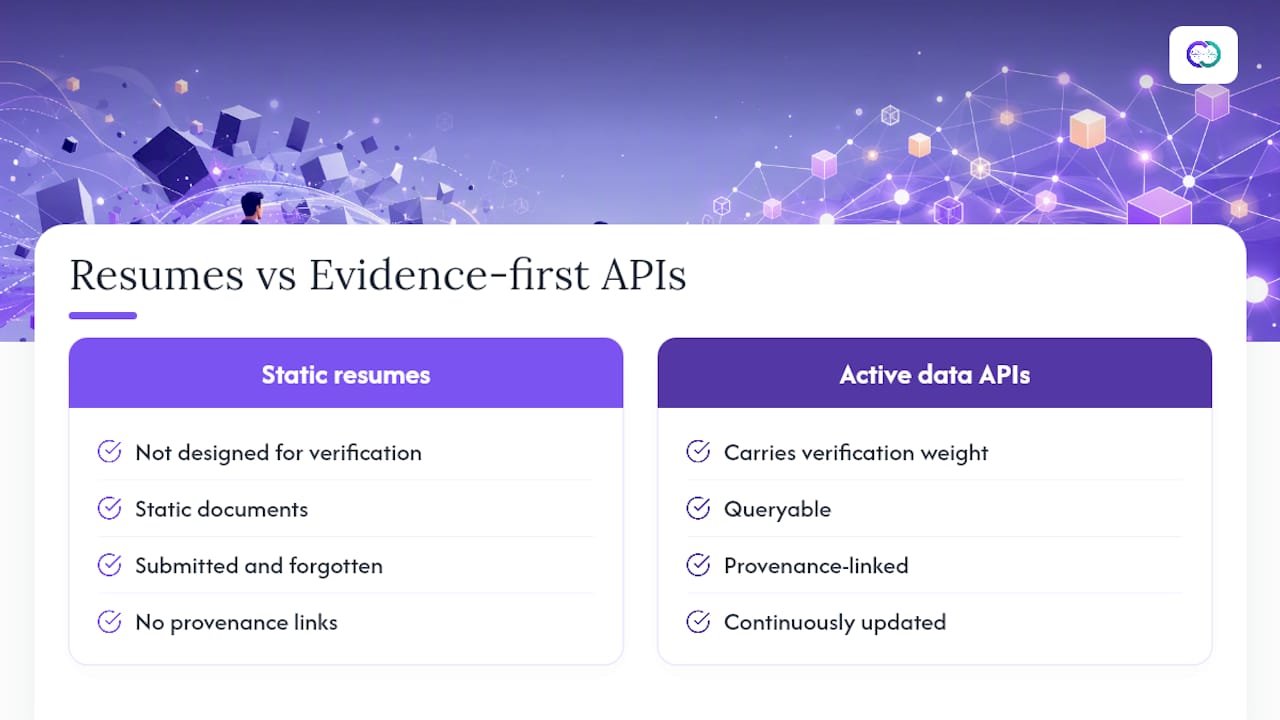
The 2026 hiring environment has exposed a structural flaw: resumes were never designed to carry the verification weight now placed on them. The professionals who adapt fastest are those who treat their career assets as active data APIs — queryable, provenance-linked, and continuously updated — rather than static documents submitted and forgotten. An AI assistant trained on verified evidence does not just answer recruiter questions; it demonstrates, in real time, the analytical rigor and transparency that distinguish genuine expertise from AI-polished performance.
Alloquy turns your evidence into a recruiter-queryable profile
Alloquy is built for exactly the workflow this guide describes. Link your Google Drive documents, structure your case studies, and Alloquy’s custom AI assistant handles recruiter queries by citing your actual artifacts — not generating plausible summaries. The platform covers every checklist item above: verified evidence linking, interactive case studies, explicit skill labels, branded presentation, and tailored resume and cover letter generation from your verified data.
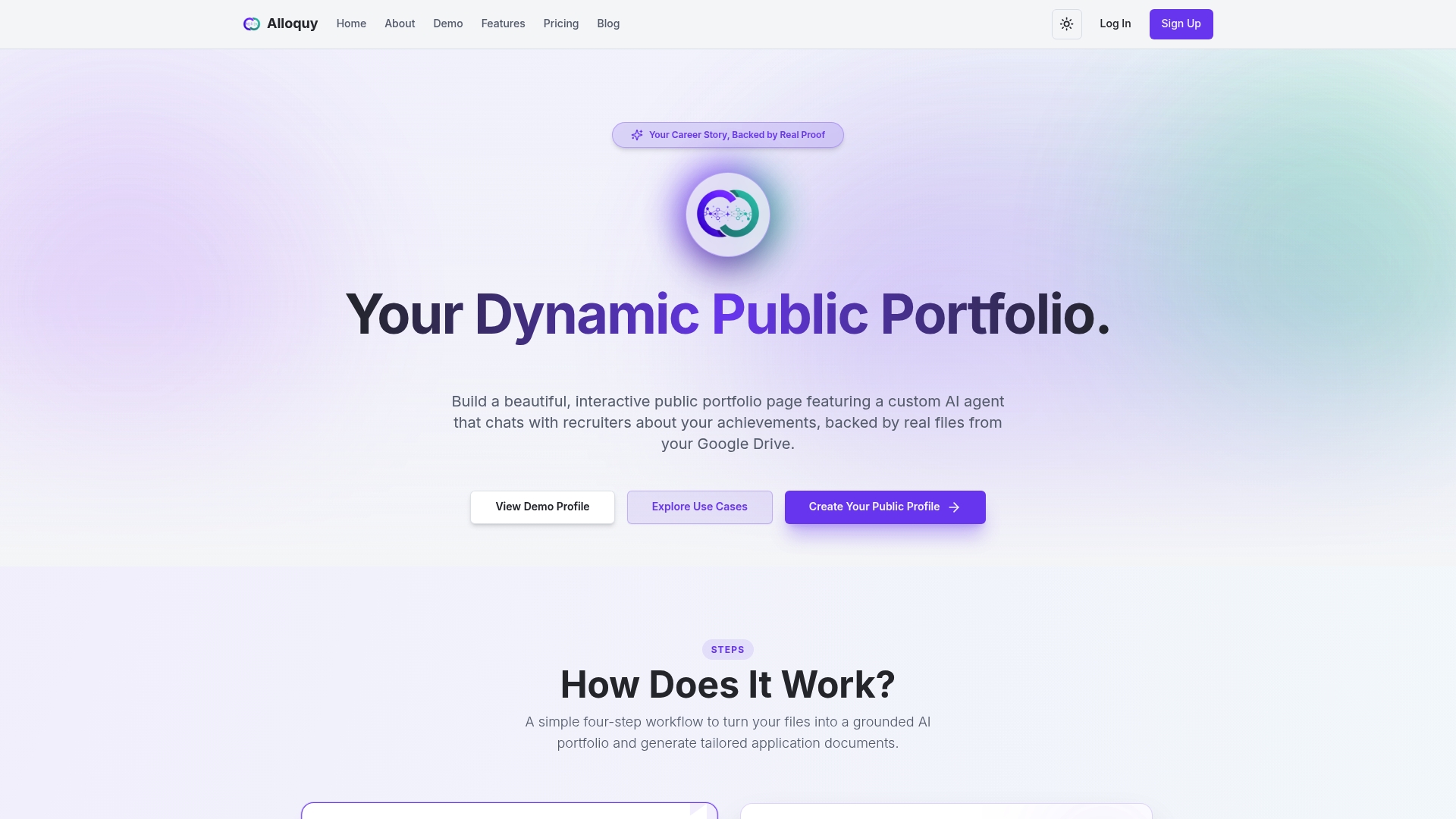
Free accounts support basic publishing. Paid plans expand AI query limits, evidence storage, and document generation capacity. Compare plan tiers and start building your recruiter-queryable profile today, or visit Alloquy to see the full feature set.
Sources
- AI is devaluing resumes, masking identity of top talent — HRE Executive
- Trust verified report 2026 — Checkr
- The resume was built for a different labor market — Hirevue
- The verification imperative in recruitment’s trust crisis — The Next Web
- AI has broken hiring — here’s how to fix it — Harvard Business Review
FAQ
What is an interactive portfolio in the context of hiring?
An interactive portfolio is an AI-powered professional profile that lets recruiters query verified work evidence directly, rather than reading a static resume. It includes case studies, provenance-linked artifacts, explicit skill labels, and an AI assistant trained on the candidate’s documented outcomes.
How many projects do you need to launch an interactive portfolio?
Three to five well-documented projects with verified outcome metrics and provenance links are sufficient for a credible launch. Depth of evidence per project matters more than the total number of entries.
Why do recruiters prefer verified portfolios over traditional resumes?
Only about one-third of employers are very confident that resumes reflect true skills, and 92% of recruiting leaders report AI-generated resumes are now commonplace, per the 2026 Talent Acquisition Trends Study. Verified portfolios with provenance-linked artifacts and process documentation provide the higher-fidelity signal hiring teams now require.
How does the AI assistant in a portfolio work?
The assistant is trained exclusively on the candidate’s cited evidence and answers recruiter queries by referencing specific artifacts, not generating unsourced summaries. Guardrails prevent it from responding outside its evidence scope, and explainability logs show recruiters which document each answer draws from.
Can Alloquy generate a tailored resume from portfolio evidence?
Yes. Alloquy generates tailored resumes and cover letters directly from the verified evidence and case studies stored in the platform, ensuring every claim in the application document is traceable to a cited artifact.