

Tailor your resume by mapping verifiable achievements to the job’s top three or four requirements, then updating your headline, summary, skills section, and the 3 to 5 most relevant work-history bullets to mirror that language. That single act of alignment, done consistently, is what separates a resume that gets opened from one that gets skipped.
Here’s the six-step version you can execute in one sitting:
- Pull the job description apart and flag its repeated keywords and top priorities
- Set your headline and title to match the language of the role you want
- Choose 3 to 5 bullets from your most relevant job and rewrite them around the JD’s priorities
- Fold role-specific keywords into your skills section, not just your summary
- Attach a number to at least half of your rewritten bullets
- Run a formatting pass so an applicant tracking system (ATS) can actually parse what you wrote
Pro Tip: Do steps 1 and 2 first, every time. If you only have five minutes, matching your title and skills to the posting delivers most of the ATS benefit on its own.
Done right, this raises your keyword match score and gives a recruiter what they need in the first pass. That’s the whole game.
Key Takeaways
Tailoring works because it aligns your resume’s top third and skills section with a specific job’s language, which is what both recruiters and ATS software scan for first.
| Point | Details |
|---|---|
| Match the top third | Recruiters scan for six data points in about 7.4 seconds, so front-load title, dates, and employer. |
| Rewrite 3 to 5 bullets | Use scope, then result, then method, and back every metric with real evidence. |
| Match ATS formatting | Skip columns, icons, and text boxes since they can cause parsers to drop your data. |
| Expect a real lift | Tailored resumes see 8 to 12% response rates versus 1 to 3% for generic ones. |
| Speed up repeat tailoring | Alloquy links verified evidence to your master resume so tailored drafts pull from proof, not memory. |
Table of Contents
- How to Tailor Resume Content So Recruiters Actually Read It
- Exactly What to Change, Step by Step
- Before and After: Turning a Flat Bullet Into a Tailored One
- Proofreading and Time Estimates You Can Plan Around
- Why Evidence Beats a Rewrite Every Time
- Cut Tailoring Time With Evidence Already Organized
- Sources
- FAQ
How to Tailor Resume Content So Recruiters Actually Read It
Recruiters spend an average of 7.4 seconds scanning a resume before deciding whether to keep reading, and nearly all of that attention lands on the top third of the page. During that window, they’re hunting for a short list of facts: your name, current title, employer, dates, and education, according to eye-tracking research on resume review behavior. Miss that window and the rest of your resume, no matter how strong, may never get read.
The ATS layer works alongside that human scan, not instead of it. Software scores your resume against the job posting’s language before a person ever opens the file, and the two systems reward the same behavior: mirroring the posting’s priorities near the top of the document. That’s why tailored resumes generate response rates of roughly 8 to 12% on cold applications, compared to just 1 to 3% for generic ones. A 4 to 6x lift is not a marginal edge.
- Front-load your top third with the six data points recruiters actually scan for
- Match your skills section language to the posting’s exact phrasing, not a paraphrase
- Save polish and personality for the interview, not the first pass
Exactly What to Change, Step by Step
Tailoring a resume isn’t a rewrite. It’s a targeted set of edits, done in a specific order, using evidence-based tailoring guidance that’s held up across career-services research for years.
1. Read the job description like a checklist. Highlight repeated words, required tools, and the two or three qualifications mentioned more than once. These are the posting’s real priorities, not the nice-to-haves buried in paragraph four.
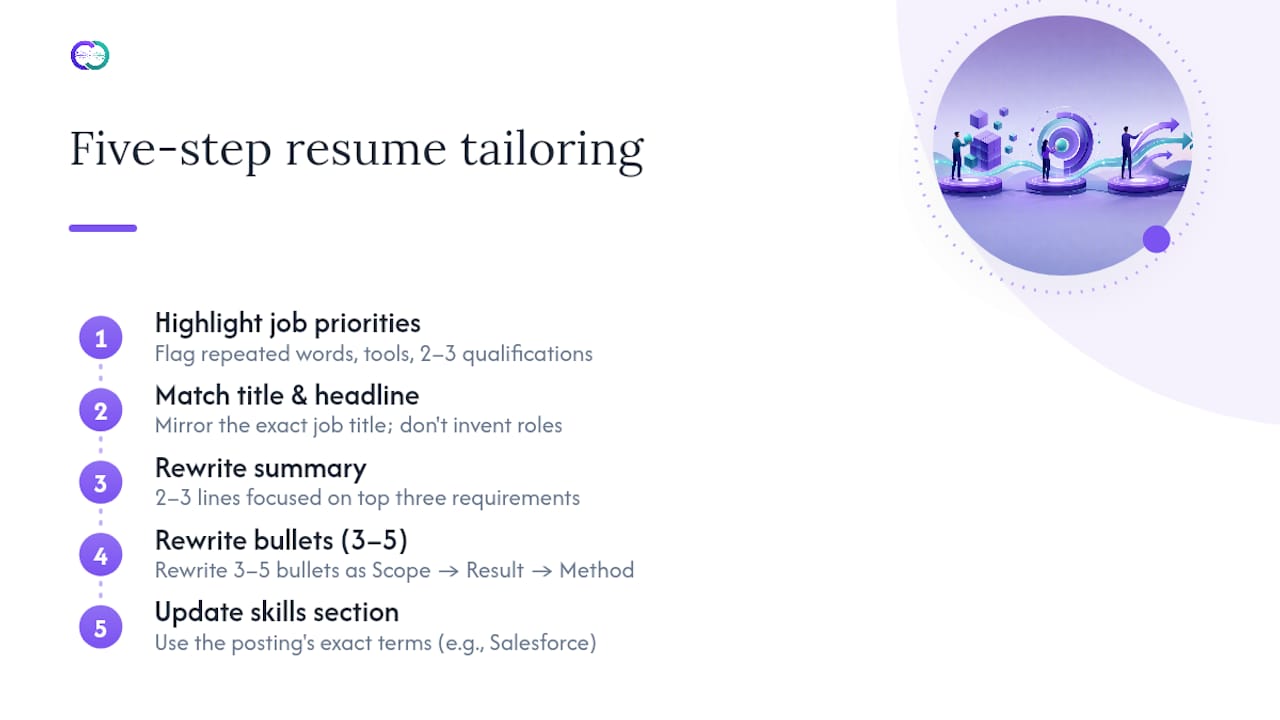
2. Match your title and headline to the role. If the posting says “Senior Data Analyst” and your current title is “Analytics Specialist II,” your resume headline should say “Senior Data Analyst” (assuming the work genuinely matches). Do: mirror the exact job title language. Don’t: invent a title you never held.
3. Rewrite your summary around the job’s top three requirements. Two to three lines, no more. Don’t let a bloated summary push your work history further down the page and out of the 7-second window.
4. Choose 3 to 5 bullets and rewrite them using a scope, then result, then method pattern. Example: “Managed a $200,000 marketing budget across four channels, increasing qualified leads 18% by rebuilding the attribution model.” Scope first, outcome second, method last.
5. Update your skills section with the posting’s exact terms. If the JD says “Salesforce” and you wrote “CRM software,” change it. ATS keyword matching rewards exact phrasing over synonyms.
6. Run an ATS formatting check. Two-column layouts, text boxes, icons, and photos routinely break ATS parsers, which can drop or miscategorize your data entirely. Stick to a single-column, text-first layout with clear date and title labels.
7. Proofread once more, out loud if possible. Small inconsistencies (mismatched date formats, verb tense drift) are the details a tired recruiter notices first.
“The safest approach is a single-column, text-first layout with clear labels for dates, titles, and employers.” That single formatting choice determines whether the rest of your tailoring effort even reaches a human reader.
Pro Tip: Use a tiered approach based on how much you want the job. Full tailoring for a dream role runs 30 to 45 minutes; partial tailoring for a strong match takes 12 to 15 minutes; minimum viable tailoring for volume applications takes 3 to 5 minutes and covers just the title, headline, and skills swap.
One warning worth repeating: stuffing keywords you can’t back up is a fast way to fail an interview even after you pass the ATS. If the posting wants “Python” and you’ve used it twice in a bootcamp project, say that honestly rather than listing it beside five years of daily use you never had.
Before and After: Turning a Flat Bullet Into a Tailored One
Picture a posting for a “Customer Success Manager” that lists three priorities: reducing churn, managing enterprise accounts, and running quarterly business reviews.
| Version | Bullet |
|---|---|
| Before | Responsible for managing client relationships and handling account issues |
| After | Reduced enterprise account churn by restructuring quarterly business reviews for an enterprise account portfolio |
The “after” version works because it answers the exact question the recruiter’s scan is built to ask: does this person’s evidence match my top requirement? “Before” answers no question at all.
The rewrite pulls three things straight from the posting: churn, enterprise accounts, and quarterly reviews. It also adds a number, which is where most tailored bullets fall short. The only real risk here is overclaiming. Only use a metric you can defend in an interview, because a hiring manager will ask how you got it.
Proofreading and Time Estimates You Can Plan Around
Before you submit, run a fast pass: dates consistent across every job, verb tense parallel throughout, at least one metric per rewritten bullet, and no layout element (tables, icons, headers in text boxes) that could confuse an ATS parser.
Time-wise, expect:
- Full tailoring for a top-choice role: 30 to 45 minutes
- Partial tailoring for a solid match: 12 to 15 minutes
- Minimum viable tailoring for volume applications: 3 to 5 minutes
Pro Tip: Batch similar postings together and work from one master resume with every bullet you’ve ever written. AI-assisted drafting paired with a short human review can shrink even full tailoring sessions once you’ve built that master document.
Why Evidence Beats a Rewrite Every Time
Tailoring works best when it’s grounded in facts you can actually prove, not phrasing you’ve guessed at. A resume that claims impact without a verifiable trail behind it is a bet a recruiter has no reason to take. That’s the real gap between candidates who tailor well and those who just reshuffle adjectives.

Repeat applicants benefit most from having their evidence, projects, metrics, writing samples, organized once and ready to link into new bullets on demand. Alloquy’s interactive portfolio features were built around exactly that idea. Tailoring gets your resume into the room. Networking and interview preparation are still what win the job.
Cut Tailoring Time With Evidence Already Organized
Alloquy is the alternative to rebuilding your resume from scratch for every application. Instead of digging through old files to find the metric that proves a claim, you link your Google Drive documents once, and your verified projects, results, and writing samples stay ready to pull from every time you tailor a new bullet.
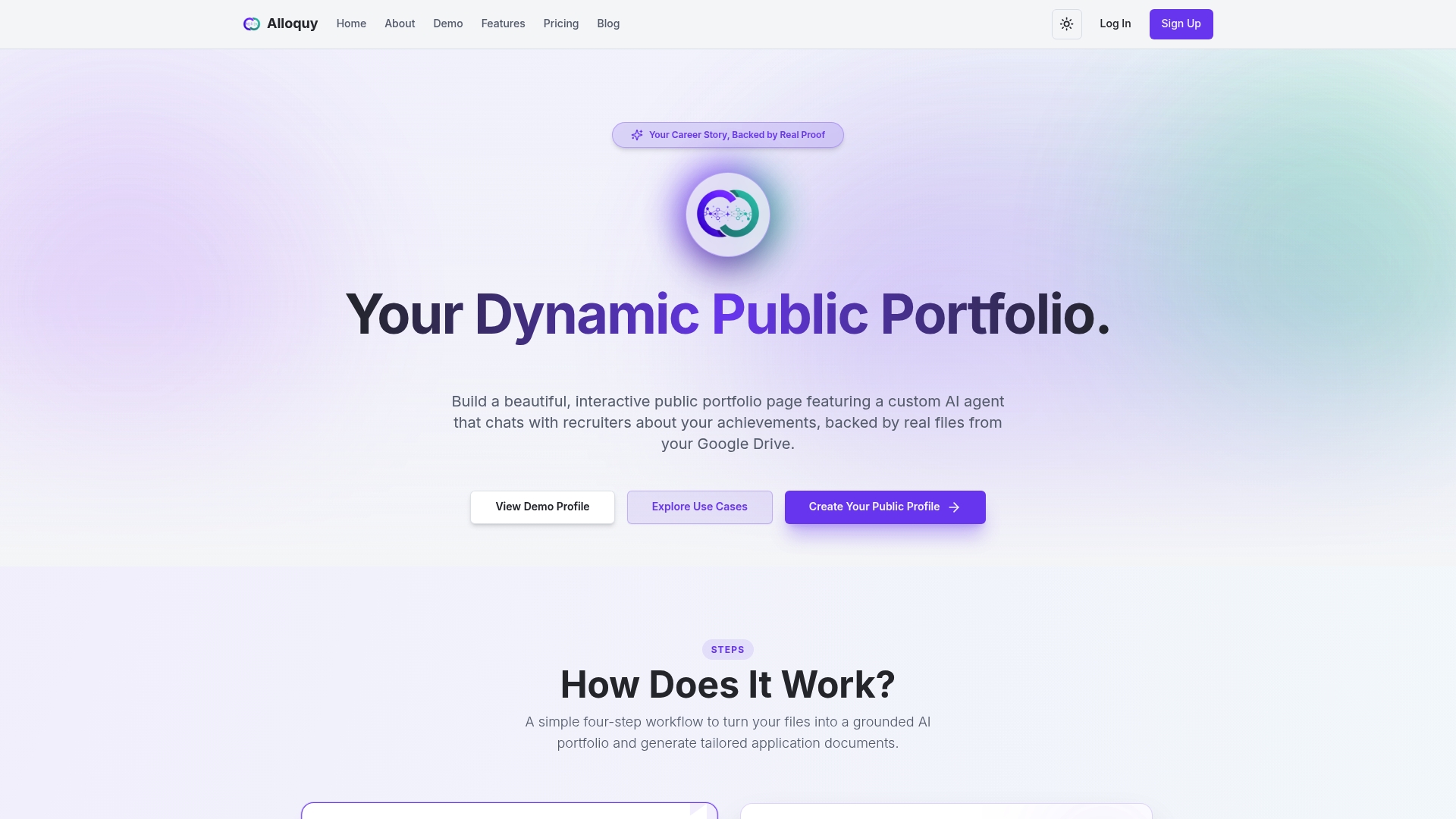
Three features map directly onto the tailoring workflow above:
- Master resume with linked evidence: every achievement stays connected to its source document, so you’re never guessing at a number
- AI-generated tailored documents: produce a resume draft aligned to a specific posting in minutes, not 30
- Recruiter-facing AI assistant: lets a hiring manager verify your claims directly instead of taking your word for it
For someone applying to multiple roles a week, that setup can save 10 to 30 minutes per application. Check the Alloquy pricing page to see which plan fits your search.
Sources
FAQ
What is the 7-second rule in resume screening?
It refers to research showing recruiters spend an average of 7.4 seconds on an initial resume scan, focusing almost entirely on the top third of the page.
Does tailoring your resume actually work?
Yes. Tailored resumes see response rates of roughly 8 to 12% compared to 1 to 3% for generic versions sent to the same types of roles.
What are the “3 F’s” of resume writing?
Definitions vary across career coaches, so there’s no single agreed-upon standard. Most versions focus on being factual, focused, and formatted for easy scanning, which lines up with what ATS parsers and recruiters both reward.
How long should tailoring a resume take?
It depends on how much you want the role: full tailoring runs 30 to 45 minutes, partial tailoring 12 to 15 minutes, and minimum viable tailoring 3 to 5 minutes for volume applications.
Can a tool speed up repeat tailoring?
Yes. Platforms that keep verified evidence, projects, metrics, writing samples, linked and organized let you generate a tailored draft in minutes instead of rebuilding bullets from scratch each time, which is exactly what Alloquy’s portfolio approach is built to do.