

A project retrospective portfolio is an evidence-backed case study built for hiring decisions: it states a headline outcome, links to verifiable artifacts, and walks through the reasoning behind a real decision. The single highest-leverage move is adding that headline outcome now, with one link to supporting evidence, before writing anything else.
TL;DR:
- Only include projects with measurable outcomes, real decision points, and shareable artifacts that clearly demonstrate your impact and reasoning.
- Build each case study around a structured format, starting with the outcome, followed by context, your role, options considered, execution, and reflection for clarity and consistency.
- Use an evidence folder to securely store artifacts, document permission, and redact sensitive information before publishing, ensuring every claim is backed by verifiable proof.
- Design case studies with one visual per section, functional links to evidence, short paragraphs, and outcome-first headlines to facilitate quick review by recruiters.
- Convert static case studies into interactive, AI-accessible profiles linked to your evidence folder to enable recruiters to verify claims and ask follow-up questions efficiently.
Table of Contents
- Why Recruiters Value Retrospective Case Studies
- How Do You Pick the Right Projects?
- The Case Study Template Recruiters Actually Read
- Building the Evidence Pack and Permission Workflow
- Presentation Rules That Match How Recruiters Scan
- Templates and a Pre-Publish Checklist
- Why Interactive Evidence Changes Recruiter Behavior
- Turn Your Case Studies Into Something Recruiters Can Query
- Sources
- FAQ
Why Recruiters Value Retrospective Case Studies
Recruiters do not read portfolios the way candidates write them. Most jobseekers build case studies for other practitioners in their field. Recruiters and hiring managers need something different: clear, structured evidence of decision-making and measurable impact they can evaluate in minutes, often without deep technical background in the candidate’s specialty.
That gap explains why polished deliverables so often fail to convert into interviews. A beautiful final screenshot tells a reviewer nothing about judgment. What moves a screener is proof of a decision made under constraint, backed by a result.
A retrospective portfolio closes that gap when it includes:
- A quantified result or a defensible proxy when hard numbers are not publishable
- A visible decision point, showing what you chose and what you passed on
- At least one artifact, such as a document, screenshot, or approval, tied directly to the claim
- Language a non-specialist reviewer can parse without a glossary
Case studies that quantify their impact with before/after benchmarks read as more credible than narrative-only accounts, even to reviewers outside the discipline.
How Do You Pick the Right Projects?
Not every project belongs in a retrospective portfolio, and including a weak one dilutes the strong ones around it. Two to four strong, current case studies outperform a longer list of thin ones, largely because recruiter attention is finite and curation signals judgment on its own.
Run each candidate project through this rubric before committing time to writing it up:
- Measurable outcome or proxy exists. If you cannot cite a number, can you cite a comparable signal, such as adoption rate, cycle time, or stakeholder sign-off?
- You owned a real decision. Group work counts only if you can isolate the specific choice that was yours and explain why you made it.
- A shareable artifact survives. A slide deck, a redacted spec, or an analytics export you are permitted to show, not just a description of one.
- It adds variety, not overlap. A fourth similar UI project teaches a reviewer nothing new about your range.
Student projects and early-career work are salvageable when the outcome was small but the reasoning was sound. If permissions block real artifacts entirely, a clearly labeled illustrative walkthrough, built from an anonymized or fictionalized version of the situation, is an honest fallback. Skip anything where you cannot describe a single decision you personally made.
The Case Study Template Recruiters Actually Read
A dependable structure across roles runs headline outcome, context, problem, process, solution, outcome, and reflection, with the outcome stated twice: once in the headline for skimmers, once in detail near the end for reviewers who go deeper.
Build each case study in this order:
- Headline outcome. Pattern: “Cut onboarding time by 40% by redesigning the intake flow” or “Recovered a stalled migration and shipped two weeks early.” State the result, not the activity.
- 30-second summary. One paragraph, three or four sentences, covering what the project was, your role, and the result.
- Context and constraints. One short paragraph on the environment: budget, deadline, team size, legacy systems, whatever actually shaped the decisions.
- Your role, stated precisely. “Led the redesign” and “contributed wireframes to the redesign” are different claims. Say which one is true.
- Options considered. Name at least one alternative you rejected and why. This section separates strategic thinkers from task executors.
- Execution highlights. One artifact per major claim. A metric with no supporting screenshot or document reads as an assertion, not evidence.
- Outcome, quantified or proxied. State the number, or the closest defensible substitute if the real figure is confidential.
- Reflection. What you would change, and what you learned about the process, not just the tool.
Pro Tip: Write the headline outcome last, after you have drafted the full case study. It is much easier to compress a result into one sharp sentence once you have already worked out what actually mattered.
Interview frameworks used by companies including Meta follow a nearly identical arc: situation, problem, solution, impact, lessons, which is a strong sign this structure holds up under scrutiny, not just on paper.

Building the Evidence Pack and Permission Workflow
Every claim in a retrospective portfolio needs a home in an evidence folder, and every artifact in that folder needs a documented permission trail before it goes public. Run permission and redaction checks before publishing, and keep the approval record even after the case study is live.
Build the folder in this order:
- Collect raw material first: kickoff notes, deliverables, sign-off emails, screenshots, and any analytics exports tied to the outcome.
- Ask permission from whoever owns the confidentiality, whether that is a manager, a client, or a former employer, and specify exactly what you plan to publish.
- Redact identifying details: client names, internal tool names, exact revenue figures, anything the permission grant excludes.
- Map each claim in the write-up to exactly one artifact in the folder. If a claim has no artifact, cut the claim or soften it to a description of process.
- If permission is denied outright, publish a labeled illustrative walkthrough instead of a real case, and keep the private folder ready to answer follow-up questions in an interview.
A documented metric beats a described one. Case studies that pair a quantified result with a before/after benchmark read as more credible to reviewers than narrative claims alone, according to Nielsen Norman Group’s research on quantifying case studies.
Presentation Rules That Match How Recruiters Scan
The heading carries the outcome, not the project name.
Design each case study around these constraints:
- One strong visual per section, showing a real before/after state where possible, with a caption short enough to read in three seconds.
- Interactive proof over static description: link directly to evidence, embed a redacted file, or attach a brief video walkthrough rather than describing what the file contains.
- Short paragraphs, bolded metrics, and identical formatting across every case study in the portfolio, so a reviewer moving between them does not have to reorient each time.
- Outcome-first structure applies across portfolio examples built for hiring managers, regardless of discipline.
Measurable outcomes tied to user experience improvements also give non-specialist stakeholders, such as HR screeners or hiring committees outside the core discipline, a business-relevant reason to keep reading past the first paragraph.
Templates and a Pre-Publish Checklist
Two copy-ready starting points, adaptable to most disciplines:
| Template piece | Design example | Engineering example |
|---|---|---|
| Headline | “Redesigned onboarding, cut drop-off by 18%” | “Rebuilt the API layer, cut latency from 800ms to 150ms” |
| 30-second summary | Led the redesign of a three-step signup flow for a subscription product, working with one PM and two engineers over six weeks | Owned the migration of a legacy monolith’s billing service to a separate microservice over one quarter |
| Key artifact | Before/after Figma flow, analytics export | Architecture diagram, load-test results |
Before publishing any case study, confirm each item:
- Evidence folder built, with one artifact mapped to every claim in the write-up
- Written or recorded permission on file for every artifact shown publicly
- Client names, internal tools, and sensitive figures redacted or replaced with proxies
- Visuals are legible at thumbnail size, with captions pointing back to the evidence
- A working contact link or query path sits at the bottom of the case for follow-up questions
A fuller walkthrough of this structure, with more worked examples, lives in Alloquy’s portfolio case study guide.
Why Interactive Evidence Changes Recruiter Behavior
Static case studies ask recruiters to trust a narrative. Interactive, evidence-linked retrospectives let them verify it directly, through embedded artifacts or a query to an AI assistant grounded in your actual documents rather than a paraphrase of them. That shift reduces the friction that causes a qualified candidate to get skipped in a fast screen.
— Alloquy Team
Turn Your Case Studies Into Something Recruiters Can Query
A written case study still asks a recruiter to take your word for the outcome. Alloquy is built around the opposite premise: link your Google Drive documents to a project, and a custom AI assistant answers recruiter questions using the verified files you actually attached, not a summary you wrote and hoped would hold up under scrutiny.
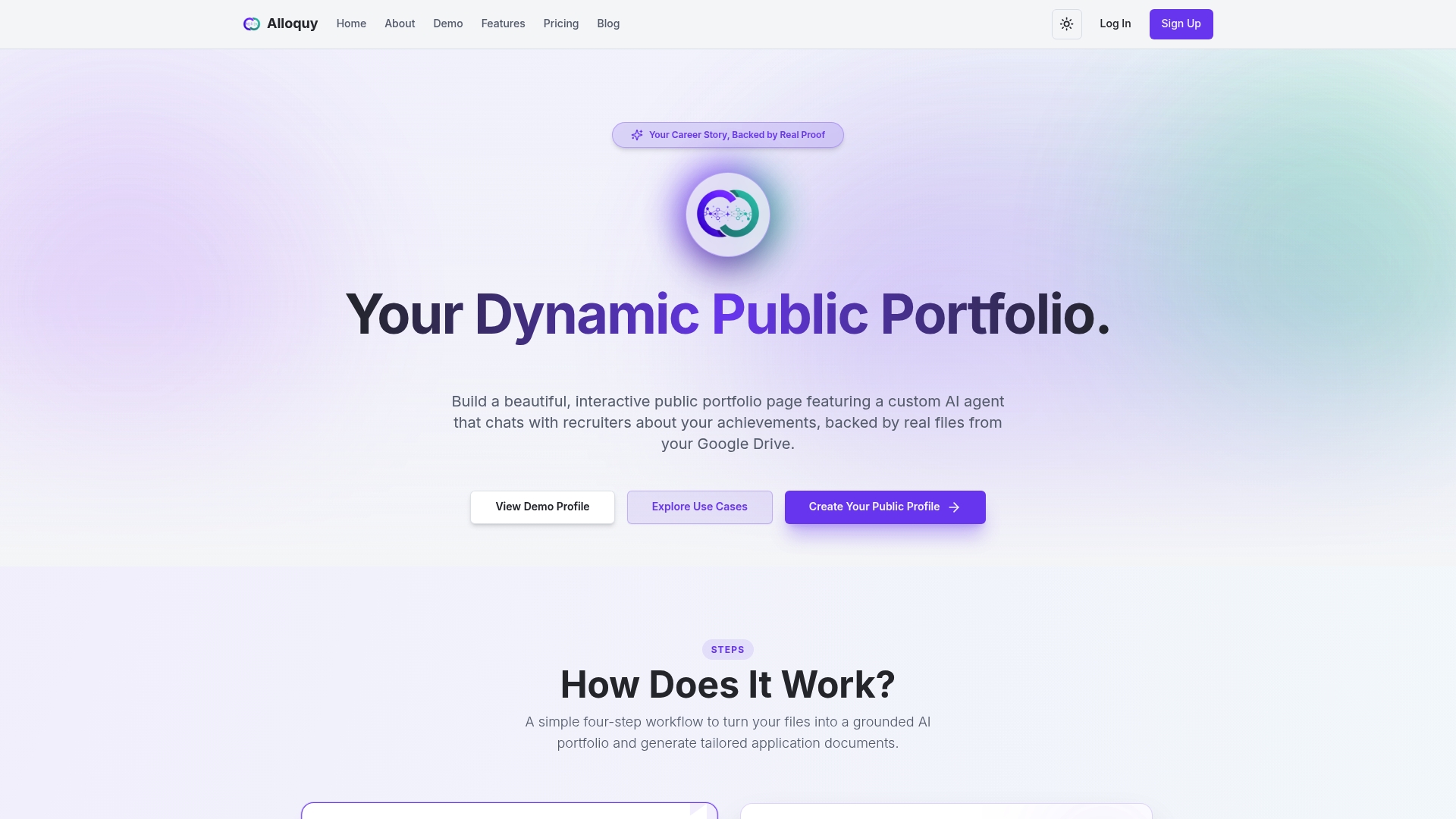
That matters most in the evidence and permission workflow covered above. Alloquy’s structure keeps redaction and access control in your hands: you choose what gets linked, what stays private, and what the AI assistant is allowed to reference when a recruiter asks a follow-up question your written case study never anticipated. Customizable branding and tailored application documents come with the same profile, generated from the verified material rather than from a generic template.
Set up a free profile and link your first project’s evidence folder to see how a recruiter-facing query actually behaves before you decide whether to expand into paid plan features.
Sources
For deeper templates and hiring context, see Nielsen Norman Group’s UX hiring insights, TailorCV’s case study template, and Alloquy’s guide to interactive case studies.
- UX hiring insights | Nielsen Norman Group
- How to Write a Portfolio Case Study (Template + Examples) | TailorCV Blog
- Portfolio case evidence, not hype — AI Expert
FAQ
What Is a Project Retrospective Portfolio?
It is a short, evidence-backed case study that opens with a headline outcome and links to verifiable artifacts such as approvals, screenshots, or analytics exports. Unlike a static resume line, it documents the decision behind the result, not just the result itself.
How Many Case Studies Should I Include?
Most guidance points to two to four strong, current case studies rather than a longer list of thin ones. Recruiters have limited time per profile, so curation signals judgment as much as the content itself does.
What If I Cannot Share Real Metrics or Files?
Publish a clearly labeled illustrative walkthrough built from an anonymized or fictionalized version of the situation, and keep your real evidence folder private but ready for follow-up questions. This approach is a recognized fallback when permission or confidentiality blocks real artifacts.
Does Alloquy Cost Anything to Start?
Alloquy offers a free profile with limited functionality to build and publish your first evidence-linked case study. Paid plan pricing for expanded features is listed on Alloquy’s site.
How Do I Redact Sensitive Information Safely?
Remove client names, internal tool names, and exact confidential figures, and replace them with proxies or ranges when permission does not cover exact disclosure. Keep a written record of what each approver agreed to show, since that record protects you if a claim is questioned later.