

A portfolio case study must prove you solved a real problem, show the decision points that mattered, and demonstrate measurable or directional impact. Hiring managers are not reading for entertainment — they are scanning for evidence of judgment. Give them three things immediately:
- One-sentence thesis: what you proved and why it mattered (“I redesigned the onboarding flow, significantly reducing drop-off and support tickets shortly after launch”)
- Three evidence anchors: the problem you inherited, the key decision you made, and the outcome you can defend
- Scannable TL;DR header: role, project name, and primary result — paired with 4–10 hero mockup screens that establish visual context before the reader reads a word
If your case study cannot pass that three-point check in the first scroll, it is not ready to publish.
Key Takeaways
A strong portfolio case study proves judgment through visible decisions, a measurement method stated before the number, and 4–10 hero screens that establish visual context before the reader reads a word.
| Point | Details |
|---|---|
| Lead with a one-sentence thesis | State what you proved and why it mattered in the first visible line of the case study. |
| Use the 5-part structure | Problem, research, trade-offs, solution, and results with learnings — in that order, with scannable headings. |
| Show 4–10 hero screens | Industry guidance recommends this range to give visual context without overwhelming the viewer. |
| State method before metric | Present baseline, measurement tool, and timeframe before the result figure to make numbers credible. |
| Alloquy adds verifiability | Alloquy’s AI assistant lets recruiters query evidence behind your case studies in real time, beyond what static pages can show. |
Table of Contents
- Why case studies outperform project galleries
- What a strong case study structure looks like
- How to choose and present your visual assets
- How to write the narrative without designsplaining
- How to include competitive research without brand-bashing
- Metrics, impact, and what to redact
- Tools and hosting options for publishing case studies
- Production checklist: ship a case study in 1–3 days
- A short worked example you can model
- What publishing case studies actually teaches you
- Your case studies, made interactive and verifiable
- Sources
- FAQ
Why case studies outperform project galleries
A gallery shows craft. A portfolio case study shows judgment. Hiring managers scan for impact and decision-making first, process second — and a well-structured case study converts design craft into hireable evidence that a gallery of final screens never can.
The format also signals professional seriousness. On mobile, where many recruiters first encounter a portfolio, a case study with clear headings and a tight narrative reads as considered and deliberate. A grid of Dribbble shots reads as decoration. The structural choice itself communicates something about how you think.
What a strong case study structure looks like
The UX Case Study Template That Got 200+ Designers Hired confirms that a 5-part structure aligns with how hiring managers actually read portfolios, increasing interview rates when headings are scannable and each section earns its place. Here is the template, with suggested word counts:
- Problem and stakes (75–100 words). Open with the user harm or business constraint you were handed. Hook formula: “[User group] couldn’t [do X] because [constraint]. That cost [company/users] [consequence].” Pair with a before-state screenshot or research snapshot.
- Research and constraints (100–150 words). Summarize what you learned and what limited your options. Include an annotated research artifact or a competitor audit screenshot. Avoid listing every method — name only the findings that changed your direction.
- Key trade-offs and decisions (100–150 words). This is the section most designers skip and the one that matters most. Name the option you rejected and why. One contested decision, explained, demonstrates defensible judgment faster than three paragraphs of process description.
- Solution snapshots (50–75 words of prose + visuals). Let the screens carry the weight. Write one sentence per screen explaining the decision it represents, not the feature it shows.
- Results and learnings (75–100 words). State the outcome, the measurement method, and one thing you would do differently. Baselines matter: “conversion improved” means nothing; “checkout conversion rose from 61% to 74% over six weeks, measured in Mixpanel” is evidence.
Research on portfolio sizing suggests a small set of high-quality case studies outperform a longer list of shallow ones — depth signals craft more reliably than volume.
How to choose and present your visual assets
Industry design mentors recommend several polished mockup screens (https://dribbble.com/resources/career/product-design-case-study) in a case study hero — enough to establish visual context without overwhelming the viewer. The specific screens you choose matter as much as the count.
| Screen type | What it proves | Placement |
|---|---|---|
| Final UI (key flow) | Craft and visual judgment | Hero / top of case study |
| Failed iteration | Intellectual honesty, iteration | Trade-offs section |
| Annotated research snapshot | Rigor, synthesis | Research section |
| Annotated competitor screenshot | Benchmark awareness | Competitive analysis section |
Caption standard: every caption must add a decision, metric, or constraint the image alone cannot convey. Captions that simply restate what the image shows waste the reader’s attention and signal shallow thinking. Write: “Removed the secondary CTA here after A/B testing showed it split attention without improving conversion” — not “Final checkout screen.”
Export specs: export hero images at 1400px wide minimum, use WebP for web (compress to under 150 KB per image), and always include descriptive alt text for accessibility. For PDF versions, export at 144 DPI minimum to maintain sharpness on retina displays.
Strong visual storytelling in a case study means every image advances the argument — not just illustrates it.
How to write the narrative without designsplaining
A strong case study leads with tension and keeps the narrative under roughly 800 words. Every sentence should support your hiring argument, not document your process for its own sake.
Pronoun discipline: use “I” for personal decisions and leadership; use “we” for team activity. “We ran usability tests” is accurate. “I synthesized the findings into three design constraints” is what gets you hired.
Dos and don’ts:
- Do name the decision and what tipped it; don’t explain what a persona is
- Do show a failed iteration and what it taught you; don’t list every tool you used
- Do state the measurement method before the number; don’t lead with a percentage that has no baseline
- Do write in plain, direct sentences; don’t use passive constructions to avoid ownership
Micro-edit checklist: cut any sentence that does not show a decision, insight, or consequence. If a sentence could appear in any designer’s case study without modification, delete it.
Pro Tip: Read your case study aloud. Every sentence where you slow down or lose the thread is a sentence that needs cutting or rewriting.
How to include competitive research without brand-bashing
Competitive benchmarks belong in a case study when they directly shaped a design constraint or opportunity. The goal is not to critique competitors — it is to show that your direction was informed, not arbitrary.
- Capture annotated screenshots that highlight a specific UX gap or convention your research identified
- Synthesize findings into 1–3 clear constraints: “All three competitors buried the error state below the fold, creating a recovery dead-end for users who mistyped”
- Use a paragraph template: “Competitor analysis revealed [pattern]. That told us [implication]. We decided to [direction] because [rationale].”
- Never name a competitor to disparage them — frame every observation as a market signal, not a verdict
The role of UI design in development handoffs is a useful frame here: competitive screenshots annotated with technical constraints (not just visual ones) demonstrate cross-functional awareness that senior hiring managers value.
Metrics, impact, and what to redact
Visible decisions, named trade-offs, and presenting the measurement method before numbers are what separate an interview-ready case study from a passable one. Present impact in this order: baseline → method → result → timeframe.
When exact numbers are under NDA, use directional language with context: “Checkout errors dropped significantly over the eight weeks following launch, based on session recordings in FullStory.” That is more credible than a vague claim and more honest than a fabricated figure.
Redaction guidelines:
- Replace specific revenue figures with percentage lifts or directional signals
- Blur or remove client logos and proprietary UI if not cleared for publication
- Use this consent prompt with clients or employers: “I’d like to include this project in my portfolio. I’ll redact [specific elements]. Can you confirm in writing that this is acceptable?”
For a deeper treatment of showing evidence without breaching confidentiality, the Alloquy guide on proof without exposure covers redaction frameworks designers can apply directly.
Tools and hosting options for publishing case studies
The right publishing format depends on your audience and how much control you need over presentation.
- Figma: build and export case study layouts as high-fidelity mockups; use Figma’s presentation mode for PDF exports
- Image optimization: use Squoosh or ImageOptim to compress exports before upload; target under 150 KB per WebP image
- Static site / CMS: Webflow and Framer give full layout control and load fast; best for designers who want a custom URL and branded experience
- Portfolio platforms: useful for discoverability but constrain layout; treat them as a secondary channel, not your primary case study home
- PDF: use for direct applications only — PDFs cannot be indexed, cannot be updated without re-sending, and lose interactive context
For multi-format asset production, prepare a web version, a PDF version, and a slide-deck version of each case study from the same source file to avoid rework.
Alloquy’s interactive portfolio platform adds a layer none of these formats provide: a recruiter-facing AI assistant that can answer questions about your case studies in real time, drawing from linked evidence documents rather than static screenshots.
Production checklist: ship a case study in 1–3 days
- Day 1 — Draft and hero visuals. Write the 5-part structure in a Google Doc. Select and export 4–10 hero screens. Write all captions. Total time: 3–4 hours.
- Day 2 — Build and refine. Import into your CMS or portfolio platform. Add annotations to research and competitor screenshots. Run the micro-edit checklist: cut every sentence that shows no decision or consequence.
- Day 3 — QA, export, publish. Preview on mobile. Check all image filenames are descriptive (not “image-01.png”). Verify alt text on every image. Confirm client/employer permissions are documented. Export PDF version. Publish.
Minimum viable publish criteria: one-sentence thesis visible in the first scroll, at least one metric with a baseline and method, and mobile preview confirmed.
A short worked example you can model
Project: Expense report submission flow, mid-size SaaS company Role: Product designer (solo)
The cost was measurable in staff hours and in delayed reimbursements that eroded employee trust.
Research and constraints: Session recordings in Hotjar showed users dropping at step 3 of 5, consistently, when asked to upload receipts before entering amounts. Interviews with six employees confirmed the upload step felt like a commitment before they knew if the form would accept their entry.
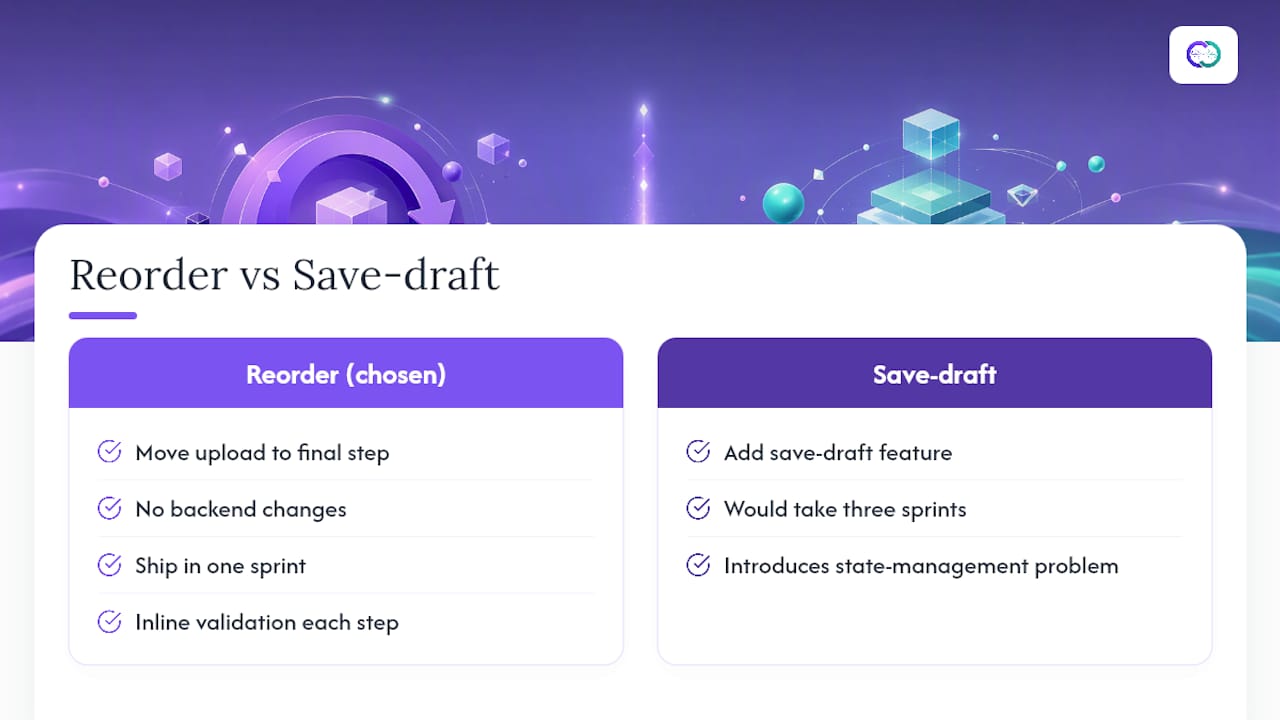
Key decision: The team debated reordering steps versus adding a save-draft feature. I recommended reordering — moving receipt upload to the final step — because it required no backend changes and could ship in one sprint. The save-draft option would have taken three sprints and introduced a new state-management problem.
Solution: Reordered the five-step flow so amount entry and categorization came first. Added inline validation at each step. [Hero mockup placeholder: swap in three screens showing the before flow, the revised step order, and the inline validation state.]
Results: Abandonment dropped significantly over a few weeks, measured with analytics tools. Finance team reported a marked reduction in manual follow-up emails in the same period. Learning: earlier user testing on the step order would have surfaced this in week one, not week six.
Adapt for your role: Product designers should emphasize the decision rationale. Visual designers should add a screen showing the typography and color decisions and why they served the use case. Researchers should foreground the session-recording insight and the interview synthesis method. For guidance on highlighting product impact when you are not the product owner, the Alloquy blog covers attribution strategies for designers in cross-functional teams.
What publishing case studies actually teaches you
The conventional advice is to show your best work. The more useful instruction is to show your most defensible work — the project where you can name every decision, explain every trade-off, and describe exactly how you measured the outcome.
Failed iterations increase credibility, not reduce it. A case study that shows a rejected direction and explains what the testing revealed demonstrates intellectual honesty that polished final screens cannot. Hiring managers have seen enough perfect portfolios to be skeptical of them.
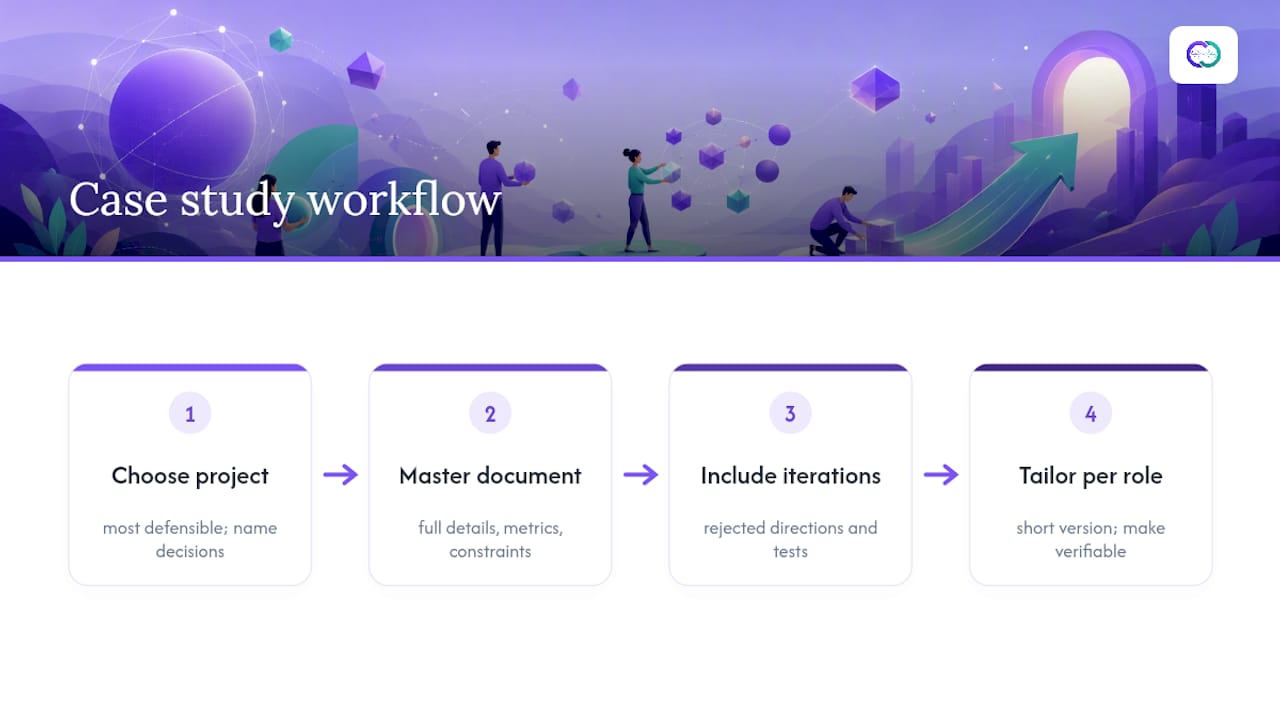
Keep a master case study document for each project — the full version with every detail, every metric, every constraint. From that master, produce a tailored short version for each role you apply to, cutting to the decisions and outcomes most relevant to that team’s context. For senior roles, the Alloquy guide on executive portfolio positioning addresses how attribution and scope framing shift at the VP level.
The Alloquy Team’s view: the next frontier for case studies is not better design — it is verifiability. A recruiter who can ask your portfolio a question and receive an evidence-backed answer is engaging with something fundamentally different from a static PDF.
Your case studies, made interactive and verifiable
Static case studies have a structural limit: a recruiter can read what you claim, but cannot interrogate the evidence behind it. Alloquy closes that gap.
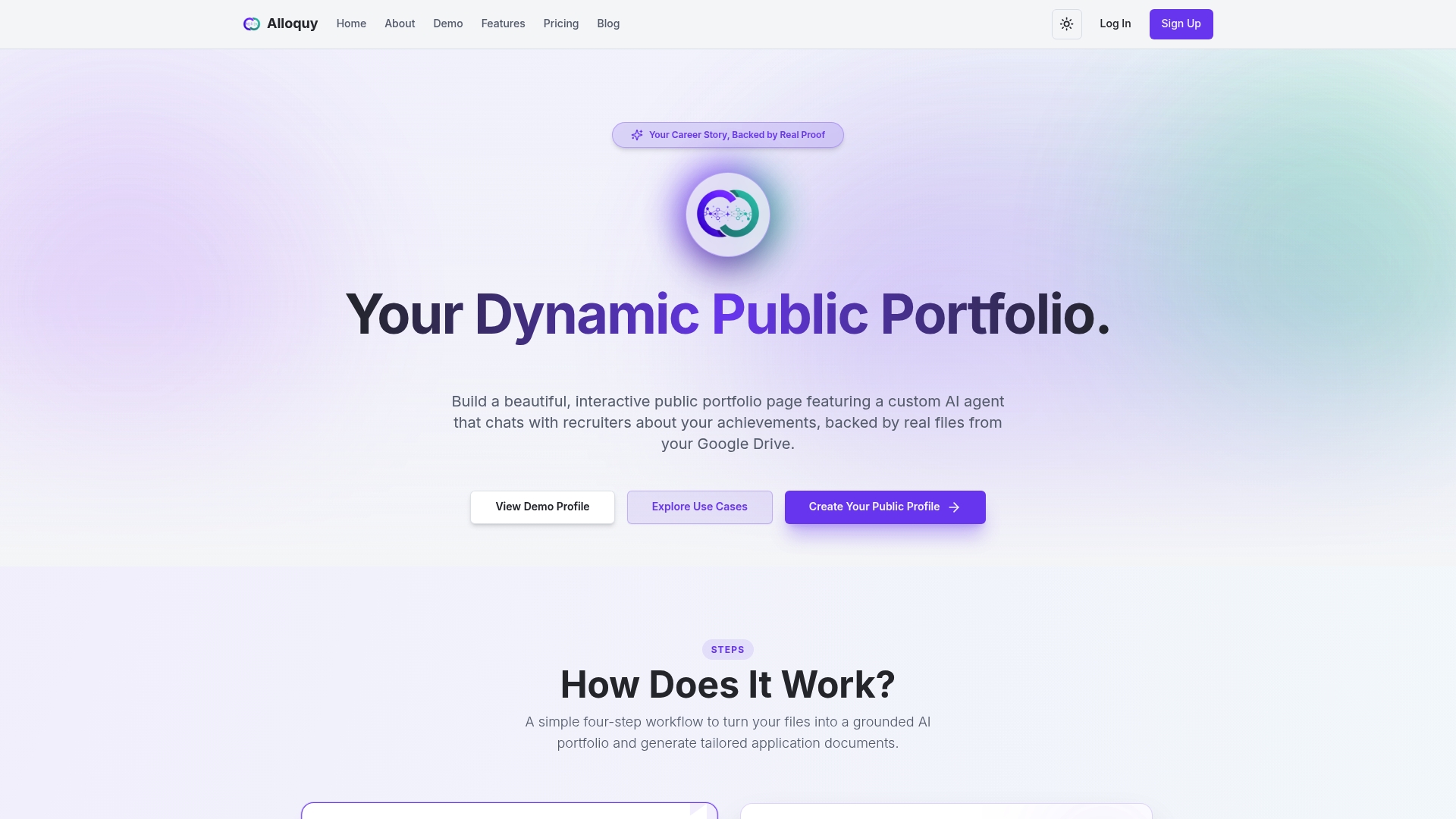
With Alloquy’s interactive portfolio platform, you link your Google Drive documents — briefs, research notes, metrics exports, approval emails — directly to your case study entries. Recruiters then query your AI assistant in real time: “What was the baseline before the redesign?” or “What was your specific contribution to the team outcome?” The assistant answers from verified evidence, not from whatever you remembered to write in the case study prose.
Alloquy also handles the confidentiality problem: you control which documents are linked and what the AI can surface, so sensitive client data stays protected while your contribution remains fully demonstrable. Tailored resume and cover letter generation from the same verified evidence base means your application documents stay consistent with your portfolio claims.
See Alloquy’s pricing and free tier to start building an interactive, evidence-backed portfolio today.
Sources
FAQ
What should a portfolio case study include?
A case study must include a one-sentence problem statement, your key decision and its rationale, 4–10 hero screens, and a result with a stated measurement method and baseline.
How long should a portfolio case study be?
Aim for under 800 words of prose, structured across five sections: problem, research, trade-offs, solution, and results. Visuals carry the rest.
Should I use “I” or “we” in a case study?
Use “I” for personal decisions and contributions; use “we” for team activity. The distinction signals ownership without misrepresenting collaboration.
How do I handle confidential client work in a case study?
Replace specific revenue figures with percentage lifts or directional signals, blur proprietary UI elements, and get written confirmation from the client or employer before publishing. The Alloquy platform lets you link verified evidence privately while keeping your public case study accurate.
How many case studies should a design portfolio contain?
Research on portfolio sizing points to a small set of high-quality case studies as the effective range — depth and defensibility matter more than volume.
Recommended
- How to Highlight Product Impact When You Aren’t a Product Manager | Alloquy Blog | Alloquy
- Why Multi-Format Resume Assets Are Key to Modern Job Search Success | Alloquy Blog | Alloquy
- Executive Career Portfolios: How VP & C-Suite Candidates Win Global Roles | Alloquy Blog | Alloquy
- The Death of Cover Letters: Why AI-Tailored Briefs Get 4x Response Rates | Alloquy Blog | Alloquy