

Publish testimonials in this exact pattern: relationship and project context, a one to two sentence quote naming a concrete outcome, formal attribution, and a linked piece of evidence a recruiter could actually open. That last element is the one most professionals skip, and it is the one that separates a persuasive endorsement from decorative praise. Before any of it goes live, get written permission from the person you are quoting and confirm the evidence file you plan to attach.
TL;DR:
- Using specific, project-based testimonials paired with verifiable evidence increases a recruiter’s ability to confirm claims quickly and confidently.
- Evidence types such as performance exports, signed deliverables, client emails, or public release notes better support testimonials than vague praise.
- Securing written permission and ensuring evidence is honest, traceable, and properly redacted is essential to remain compliant with legal and FTC guidelines.
- Structuring your testimonial requests with clear project context and outcomes helps referees produce usable and impactful quotes.
- Tools like Alloquy enhance verification by linking testimonials directly to supporting documents, reducing recruiter skepticism and speeding up the hiring process.
Table of Contents
- Portfolio Testimonials Examples for Six Common Referee Types
- Testimonial Request Templates and Publish-Ready Microcopy
- Linking Testimonials to Evidence Recruiters Actually Trust
- Permission, FTC Guidance, and the Legal Guardrails You Cannot Skip
- How to Brief a Referee So the Testimonial Is Usable
- Alloquy Team Perspective: Evidence Changes Recruiter Behavior
- Publish Verified Testimonials With Alloquy
- Sources
- FAQ
Portfolio Testimonials Examples for Six Common Referee Types
A testimonial without a name attached to a role and a timeframe reads as filler. Executive coaching guidance frames the fix simply: testimonials should demonstrate repeatable success, not generic enthusiasm. Below are six copy-ready patterns, each built around a different referee relationship, with a note on which evidence file makes the claim checkable.
- Manager, senior IC. “As Priya’s manager for two years on the payments platform team, I watched her cut checkout latency by rebuilding our caching layer.” Attach: the performance monitoring export showing the before-and-after latency figures.
- Client, contractor engagement. “We hired [Name] for a six-week brand overhaul in Q2 and their delivery let us launch two weeks ahead of schedule.” Attach: the signed statement of work plus the final deliverable file.
- Peer, cross-functional project. “I sat next to [Name] on the checkout redesign sprint; their component library is still the one three other teams reuse.” Attach: a screenshot of the shared component repository with commit history visible.
- Professor, academic capstone. “[Name] led the data visualization capstone in my seminar and produced the only dataset that survived peer replication.” Attach: the graded capstone report or a public release of the dataset.
- Contractor supervisor, junior contributor. “[Name] joined as a junior designer on our rebrand and independently shipped the icon system used across all four apps.” Attach: the design system file or public style guide link.
- Freelance client, qualitative outcome. “Working with [Name] on our onboarding flow, we finally had documentation our support team could actually follow.” Attach: the client acceptance email or a short project recap document.
Notice the variation: some quotes lean on a number, others lean on a specific artifact or a changed process. Both formats work, as long as each one names a project and points to something verifiable. A well-curated portfolio generally features three to six projects total, so reserve testimonials for the work you most want a recruiter to remember, and always secure permission before you publish a name, a logo, or a private metric.
Testimonial Request Templates and Publish-Ready Microcopy
Getting a usable quote starts with the ask. Send one of these three:
- Short ask. “Would you be willing to write two sentences about the [project name] work we did together? I’d love to name the outcome if you’re comfortable with that.”
- Fill-in-the-blank. “Mind confirming this is accurate? ‘I worked with [Name] on [project] from [date] to [date]. The result was [outcome].’ Edit freely.”
- Formal manager ask. “For my portfolio, I’m collecting brief endorsements from supervisors. Could you confirm my role on [project] and one measurable result, in three sentences or fewer?”
Once you have a quote, format it with one of these publish templates:
- Inline quote with context. Relationship line, quote, attribution, then a linked evidence file directly beneath.
- Anonymized quote with process note. “A product lead at a healthcare startup (name withheld by request)” followed by the quote and a note explaining why identifying details were removed.
- Long-form case callout. A short paragraph of context, the quote set off visually, and a linked case study for readers who want the full story.
Record consent with a line like: “[Name] approved this quote and the attached evidence for public use on [date].” Keep that record somewhere retrievable, not just in a deleted email thread.
Linking Testimonials to Evidence Recruiters Actually Trust
A quote is a claim. Evidence is what turns the claim into something a recruiter can verify without calling anyone. The strongest portfolios pair every testimonial with third-party validation such as performance reviews, certifications, or signed recommendations, not just the quote text sitting alone on a page.
Four evidence types carry the most weight:
- Analytics export showing a metric before and after your involvement, with dates visible.
- Signed deliverable such as a contract-approved design file or code merge record.
- Client acceptance email confirming the work was delivered and accepted.
- Public release notes or a shipped product page that independently confirms the work existed.
When a document contains confidential figures, redact rather than delete. Highlight the relevant excerpt, black out client names or dollar amounts you were not cleared to share, and label the file “redacted, verified by [your name].” Attach a short provenance note to each testimonial: file name, date, the providing party, and a line stating whether the referee is open to a brief verification call. One evidence-first framework is blunt about the alternative: never publish a fabricated or AI-generated metric you cannot document, because an unverifiable number does more damage than no number at all.
Pro Tip: Build a single “evidence sheet” per project, a labeled folder or slide with every source file, so when a recruiter asks “can you prove that,” you open one link instead of digging through six years of email.
Permission, FTC Guidance, and the Legal Guardrails You Cannot Skip
Get written permission before publishing anyone’s name, employer logo, or private performance data, and keep that permission somewhere you can produce it later. If a claim cannot be documented, do not publish it. Either link the supporting evidence directly or summarize only what is already public, such as a shipped feature or a published case study.
The Federal Trade Commission’s endorsement rules exist for exactly this situation: testimonials must reflect honest, substantiated opinions, and material connections or incentives behind an endorsement generally need disclosure. Run every testimonial through a three-item checklist before it goes live: permission on file, evidence linked or summarized honestly, and any relevant disclosure included. Public-sector applicants in particular should keep references on a separate document and confirm they are allowed to publish employer-owned work samples before doing so.

How to Brief a Referee So the Testimonial Is Usable
Most weak testimonials trace back to a vague ask, not a reluctant referee. Before you request one, remind the person of the project name, your specific role, the timeframe, and the one outcome you would like mentioned. That framing does most of the writing for them.
- Send an editable draft quote and the evidence file you intend to attach.
- Set a polite, specific deadline: “sometime in the next two weeks” beats an open-ended request.
- If a referee will not attach their name or a metric, offer the anonymized quote format instead.
- If they hesitate on public verification, offer a private call with a recruiter instead of a public number.
A structured recommendation naming the project, the outcome, and a defining trait persuades far more than generic praise, and giving your referee that structure up front makes the difference.
Alloquy Team Perspective: Evidence Changes Recruiter Behavior
Most portfolios ask a recruiter to take a claim on faith. Evidence-backed testimonials remove that leap. When a quote sits next to the actual deliverable, the recruiter’s verification step shrinks from a phone call and a guess to a thirty-second read. That speed matters more than polish. A recruiter moving through dozens of candidates will trust the profile that lets them check a claim over the one that only asserts it. We think that shift, from asking for trust to earning it with a linked artifact, is the actual advantage evidence-first portfolios have over traditional resumes.
— Alloquy Team
Publish Verified Testimonials With Alloquy
Alloquy connects your Google Drive documents directly to your public profile, so a testimonial you publish sits next to the actual deliverable, email, or export that backs it, and recruiters can query Alloquy’s AI assistant for grounded, contextual answers instead of taking your word for it. That’s a meaningfully different pitch than a static resume: recruiters get to verify, not just read.
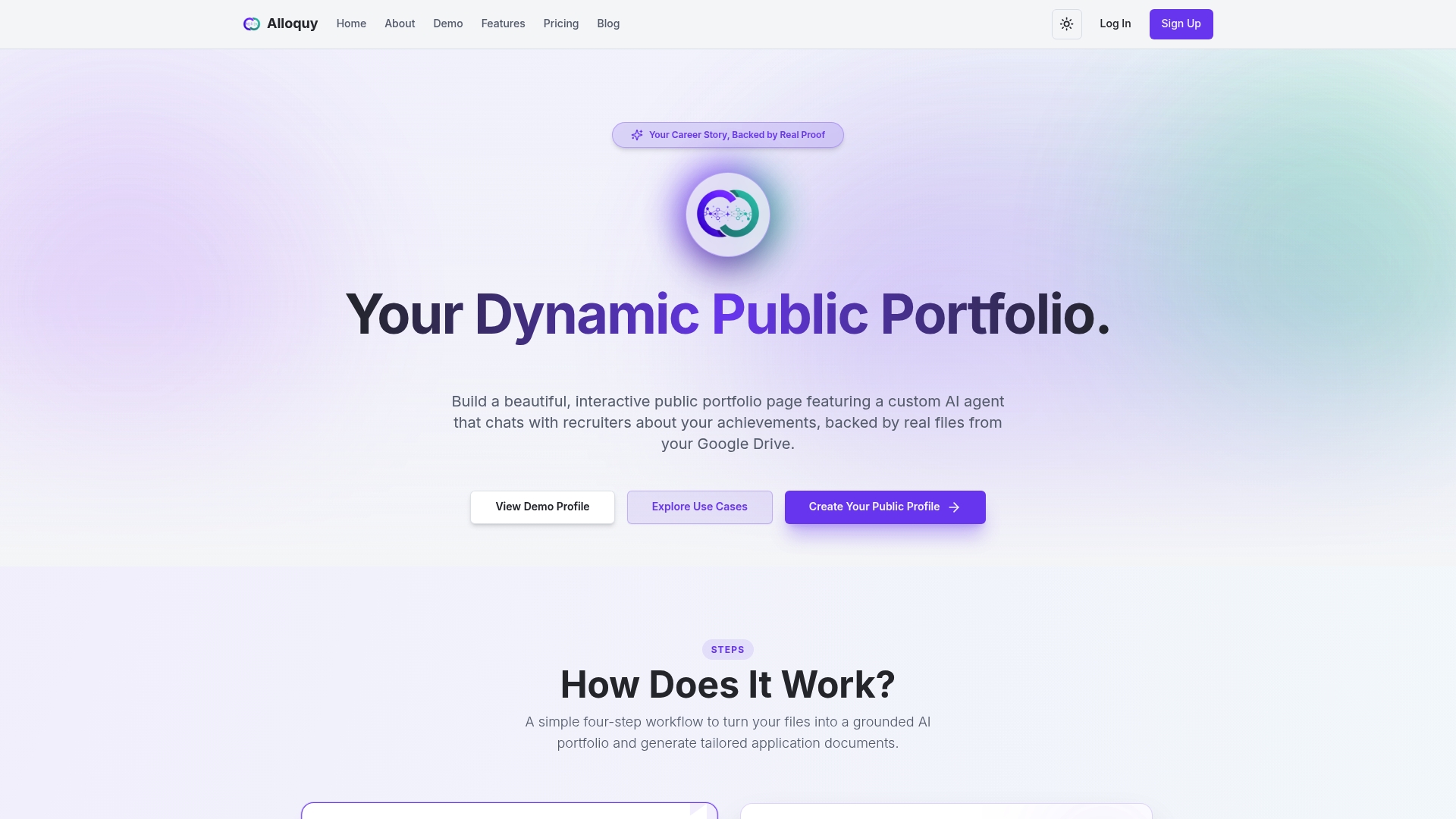
If you want to see it in practice, browse developer portfolio examples or UX portfolio examples that pair testimonials with linked evidence the way this guide describes. Setting up costs nothing to start: create a Free profile and link your first evidence-backed testimonial today, or visit Alloquy to see the full feature set, including customizable branding and AI-generated application documents drawn from your verified work.
Sources
For deeper detail on the practices covered here, consult Regis University’s portfolio-building guide on structuring featured projects and testimonials, Tulane’s career engagement guidance on showing repeatable success, Herzing University’s overview of third-party validation types, and AIExpert.ee’s evidence-over-hype framework for avoiding unverifiable claims. For broader context on social proof mechanics, see this social proof strategy overview.
- How to build a professional portfolio | Regis University
- Beyond the resume: using a portfolio to showcase your skills and experience | Tulane career engagement
- Aiexpert
- Building a portfolio that showcases your experience and education | Herzing University
FAQ
What Makes a Portfolio Testimonial Effective?
An effective testimonial names the project, the referee’s relationship to you, and one concrete outcome in one or two sentences, then links to evidence that supports the claim. Vague praise without a project name or a verifiable artifact rarely persuades a recruiter.
How Long Should a Testimonial Quote Be?
Two to three sentences is the sweet spot: enough to name the project and outcome, short enough to read in seconds. Written recommendations of three or more sentences carry more weight than one-line endorsements because they require real effort from the referee.
Can I Publish a Testimonial Without the Person’s Name?
Yes, if the referee prefers anonymity. Use a role-based description such as “a product lead at a healthcare startup” and add a short process note explaining that identifying details were withheld at the referee’s request, while still linking any evidence you are cleared to share.
What Should I Do if a Client Won’t Let Me Share Metrics?
Ask whether they will approve a qualitative quote instead, focused on process or working style rather than numbers, and offer a private verification call with a recruiter as an alternative to public data. Never publish a specific figure you weren’t explicitly cleared to share.
Does Alloquy Help With Testimonial Verification?
Alloquy links testimonials directly to the Google Drive documents that back them, letting recruiters query the AI assistant on a public profile for grounded, contextual answers instead of relying on unverified claims. Current pricing and plan details are available on the Alloquy site.