

Portfolio analytics tracking means monitoring views, time on page, scroll depth, clicks, and repeat visits on your interactive portfolio, then mapping those signals to specific job applications. The single best first move is publishing a unique, trackable link for each application and connecting it to a basic analytics dashboard today. Treat any “ATS versus human” classification as an estimate, not a verdict.
TL;DR:
- Tracking individual application links helps identify true recruiter engagement over general page views and distinguishes serious interest signals.
- A visit of over sixty seconds and scrolling past fifty percent of the page reliably indicate human interest rather than automated scans.
- Downloads of resumes or case studies signal high intent, especially when the download-to-view ratio is between 10% and 20%.
- Setting up per-application tracking with private links and event monitoring takes less than an hour and improves signal clarity.
- Combining views, time, scroll depth, and click data helps interpret recruiter intent more accurately than relying on any single metric.
Table of Contents
- What Portfolio Metrics Actually Signal Recruiter Interest?
- How Do You Set Up Portfolio Tracking Step by Step?
- What Do Common Metric Patterns Actually Mean?
- What Are the Limits of Portfolio Tracking Data?
- Why Evidence-Backed Portfolios Change the Recruiter Conversation
- Turn Your Portfolio Views Into Interview Requests
- Sources
- FAQ
What Portfolio Metrics Actually Signal Recruiter Interest?
Not every view means the same thing, and treating them as equal is the fastest way to misread your job search. A recruiter who spends ninety seconds scrolling through your case studies is telling you something entirely different than a bot that pings your page for half a second during an ATS parse.
The metrics worth tracking break into a short list, and each one answers a different question about intent.
- Total views and unique visitors: raw exposure, but the least diagnostic metric on its own.
- Average time on page: under five seconds usually means a bounce or an automated scan; over sixty seconds suggests a human reading closely.
- Scroll depth: reaching your project details or evidence section (typically past 50% of page height) beats a shallow scroll that stops at your headline.
- Click-to-contact rate: the percentage of viewers who click your email, LinkedIn, or contact form. This is your closest proxy for genuine conversion.
- Downloads: resume or case study PDF downloads are a strong high-intent signal because they require deliberate action.
- Repeat visits: the same visitor returning within days often means multiple stakeholders are reviewing you, or one recruiter is building a case internally.
- Video or demo completion: finishing an embedded walkthrough signals patience that a skim reader would not invest.
Adding analytics to a portfolio reveals who opens it, how long they stay, and which projects hold attention long enough to matter, which is exactly the data a static PDF resume can never give you.
Pro Tip: A healthy download-to-view ratio for digital resumes tends to fall between roughly 10% and 20%, according to analytics interpretation guides. If yours sits well below that, the issue is usually a weak hook on your landing section, not a lack of traffic.
How Do You Set Up Portfolio Tracking Step by Step?
Getting from zero to functioning per-application tracking takes under an hour if you follow a fixed sequence rather than improvising per job.
- Choose your tracking method. Use UTM parameters when you want granular campaign-style data inside Google Analytics. Use a private or unlisted link when you want cleaner, dedicated attribution for one specific job opportunity without any public traffic contamination.
- Generate the link. Build it with a UTM builder or your portfolio platform’s native per-application link feature, then place that exact link in your resume header, cover letter, and the application’s website field.
- Wire your analytics events. Set up basic event tracking for clicks, downloads, scroll-depth thresholds, and video plays, either through your platform’s built-in dashboard or a connected Google Analytics property.
- Keep a simple application log. Name each tracked link after the company and role (e.g., “Acme_ProductDesigner_Feb2026”) so a spike in views maps instantly back to a real opportunity instead of becoming a mystery number.
- Review weekly, not hourly. Checking metrics once a day at most keeps you from overreacting to a single stray visit.
Per-application private links produce meaningfully cleaner signal than a single public URL shared everywhere, because a public link mixes recruiter traffic with friends, LinkedIn scrollers, and your own repeated checks.
Pro Tip: Never post your master portfolio link on public social feeds while you’re actively job hunting. Every stray click dilutes the signal you need from the handful of links that actually matter. Reserve the public link for your general brand presence, and use fresh private links for every live application.
A QR code tied to a specific link works well on printed materials or a business card handed out at a networking event, and it inherits the same tracking benefits as any other unique URL.
What Do Common Metric Patterns Actually Mean?
Raw numbers are meaningless until you attach a cause to them. The value of portfolio analytics tracking comes entirely from pattern recognition, not from staring at a single day’s traffic spike.
- High views, zero contact clicks. Your hook or call-to-action is likely the problem, not your traffic. Recruiters are opening the page but not finding a compelling reason to reach out. Tighten your headline case study and make your contact button impossible to miss.
- Zero views entirely. Check link placement first. A dead link in an ATS-mangled resume field, or a link buried below the fold in a cover letter, will produce nothing no matter how strong your portfolio is.
- Repeated visits from the same source. This usually means multiple people at the same company are reviewing you, or one hiring manager is coming back to double-check a detail before a decision. This is your strongest cue to prepare for outreach or an interview request.
- A sudden spike after submission. Timing spikes right after you apply, or in the day before a scheduled interview, are useful markers for deciding when a short, low-pressure follow-up message is worth sending.
Interpretation frameworks consistently recommend setting a personal baseline across your first several applications before drawing conclusions from any one data point. Three views on your first submission tells you almost nothing; three views against an established average of fifteen tells you something went wrong with either the link or the pitch. Combining signals, rather than reacting to any single metric, is what separates a useful read from a false alarm.
What Are the Limits of Portfolio Tracking Data?
Link-based tracking has real boundaries, and pretending otherwise leads to bad decisions. Most tools distinguish ATS bot activity from human recruiter visits using indirect signals like user-agent strings, JavaScript execution, and referrer data rather than any confirmed server-side identity, so treat every classification as an estimate.
A few operational limits matter just as much as the technical ones:
- Trackers only register activity when someone actually clicks your link. A recruiter who downloads your PDF from an ATS without clicking through generates zero data.
- Avoid embedding active trackers inside PDF files themselves, since that behavior can read as invasive and creates privacy exposure with no reliable payoff.
- Minimize stored personal data on your own dashboards, and use private, unlisted links per application rather than one public URL shared everywhere.
Why Evidence-Backed Portfolios Change the Recruiter Conversation
Analytics tell you that someone engaged. They rarely tell you why. That gap is where Alloquy’s approach differs: linking verified Google Drive documents into a portfolio gives recruiters a queryable AI assistant that answers specific questions against real evidence, not marketing copy, while your dashboard still tracks the same views, time on page, and click behavior covered above.
The practical effect is speed. A recruiter who can ask your AI assistant a direct question about a project’s outcome, and get an answer grounded in a linked document, resolves doubt in minutes instead of waiting for a follow-up email. Verified evidence paired with real engagement data tends to compress the distance between a first view and a first interview request.
— Alloquy Team
Turn Your Portfolio Views Into Interview Requests
Wiring together UTM builders, a spreadsheet log, and a separate analytics dashboard works, but it takes ongoing manual upkeep that most active job seekers do not have time for during a search. Alloquy builds per-application tracking, evidence hosting, and a recruiter-facing AI assistant into one system, so the setup described above takes minutes instead of an afternoon of link management.
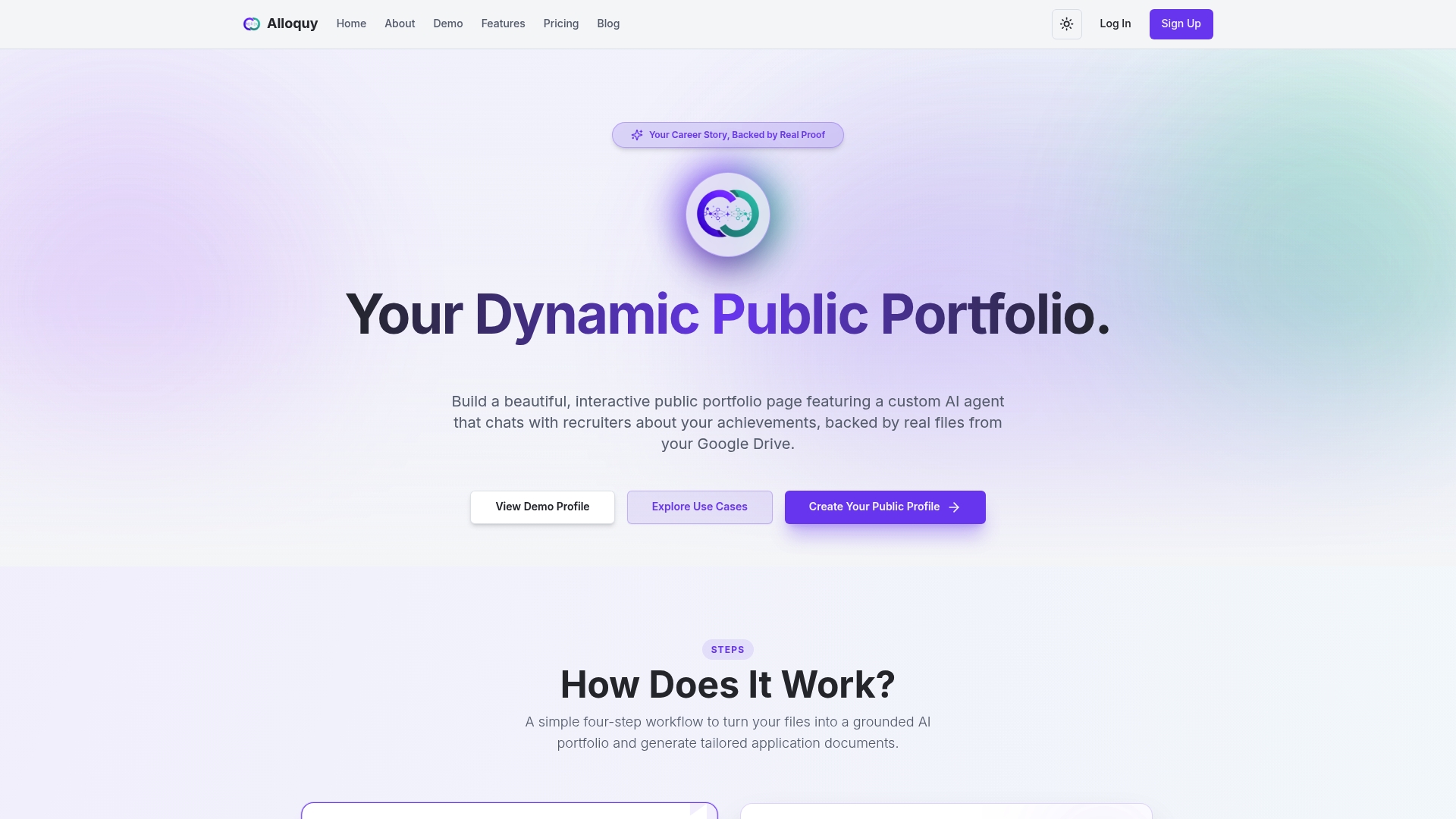
Every portfolio you publish through Alloquy comes with a built-in dashboard that shows views, time on page, and click activity without a separate analytics account. Your verified Google Drive evidence stays linked to the AI assistant recruiters query directly, and customizable themes let you match your personal brand instead of a generic template. If you’re ready to see what a per-application tracking link and a recruiter-queryable portfolio can do for your search, check the Alloquy pricing plans and set up your first tracked application today.
Sources
- How to Know What to Optimize in Your Portfolio 🔎
- Using Portfolio Analytics to Gauge Recruiter Interest | TailorCV Blog
- What is Resume View Tracking? A Complete Guide for Job Seekers (2026) | ResuTrack
FAQ
What is portfolio analytics tracking?
It is the practice of measuring engagement signals, such as views, time on page, scroll depth, and clicks, on an interactive portfolio and tying those signals to individual job applications.
How do I track which recruiter viewed my portfolio?
You cannot reliably identify a specific individual, but you can use a unique per-application link so any activity on that link maps to the company or role you applied to, rather than to your portfolio in general.
Can portfolio analytics tell the difference between a bot and a real recruiter?
Tools estimate this using signals like user-agent data and JavaScript execution, but the classification is probabilistic, not confirmed, so treat “human view” labels as a helpful estimate rather than fact.
What is a good download-to-view ratio for a portfolio?
A commonly cited healthy range for digital resumes and portfolios is roughly 10% to 20%; a ratio well below that usually points to a weak opening hook rather than a traffic problem.
Does Alloquy include built-in analytics tracking?
Yes, Alloquy pairs per-application tracking links with a built-in engagement dashboard and a recruiter-queryable AI assistant, so you can monitor views and evidence engagement without wiring a separate analytics tool.