

An impact-focused resume presents concise achievement bullets that pair a clear action with a measurable result, not a list of assigned duties. The single most important step is converting every responsibility into a one-line statement using a framework like STAR or PARQ, then quantifying the outcome with a percentage, dollar figure, or count. Templates and side-by-side examples follow below.
TL;DR:
- Impact statements must include quantifiable results, such as percentages, dollar amounts, or counts, to immediately attract recruiter attention during the initial scan.
- Using frameworks like STAR or PARQ can help craft concise, results-focused bullets that clearly demonstrate business impact without unnecessary detail.
- Replace vague duty phrases with strong action verbs tied to measurable outcomes, avoiding qualifiers like “responsible for” and ensuring tenses are correct for ongoing or completed roles.
- Tailoring bullets to match the language of each job posting and prioritizing recent, high-impact achievements improve relevance and verify credibility during interviews.
- Linking key impact bullets to supporting evidence, such as dashboards or reports, enhances trust and allows recruiters to verify claims without follow-up, especially in competitive candidate pools.
Table of Contents
- What an Impact-Focused Resume Actually Means
- Why Impact Statements Matter: Recruiter Attention and ATS Behavior
- Actionable Frameworks: STAR, PARQ, and the Compressed-STAR Method
- Action Verbs and the Language of Ownership
- Before and After: Turning Duties Into Measurable Wins
- Tailoring Bullets and Formatting for a Fast Scan
- How Evidence-Backed Portfolios Strengthen Impact Claims
- Tailoring Impact Statements to the Job Description
- Common Pitfalls to Avoid When Writing Impact Statements
- Prioritizing Impacts for Different Roles
- Weaving Impact Statements Through Every Resume Section
- Validating and Supporting Your Impact Claims
- The Gap Between Resume Advice and What Actually Gets Read
- Turn Your Strongest Bullet Into Verifiable Proof
- Sources
- FAQ
What an Impact-Focused Resume Actually Means
The phrase “results-oriented resume” gets thrown around loosely, but the underlying discipline has a name recruiters and career counselors actually use: the accomplishment record. The U.S. Securities and Exchange Commission’s own applicant guidance recommends structuring accomplishments with the STAR method and backing each one with a quantified metric, whether that’s a dollar amount, a percentage change, or a raw count. That’s the standard against which every bullet on your resume should be measured.
An achievement-based CV differs from a duty-based one in a single structural way: every line answers “so what happened because of this?” instead of “what was I assigned to do?” A duty-based line reads “Responsible for managing client accounts.” An impact statement reads “Managed 40 client accounts, retaining 94% through contract renewal.” Same job, radically different resume.
Why Impact Statements Matter: Recruiter Attention and ATS Behavior
Recruiters don’t read resumes. They scan them. Eye-tracking research from Boston University and TheLadders found that recruiters form an initial fit judgment in roughly 6 to 7 seconds, fixating on a narrow band of data points: name, current title, current company, and start/end dates, before their eyes ever settle on bullet content.
In 6 to 7 seconds, a recruiter has already decided whether your resume earns a second look, based mostly on a handful of fixation points near the top of the page.
That narrow window is exactly why generic duty statements get skimmed past. A quantified outcome, “$1.2M in new pipeline” or “reduced churn by 18%”, breaks the scan pattern because it reads as a data point, not prose. It also helps once a human recruiter or applicant tracking system parses the document, since specific, keyword-adjacent phrasing ranks and reads more clearly than vague summaries. The payoff compounds: sharper bullets generate more interview invitations, and because each one is a mini case study, you walk into the interview with a ready-made story instead of scrambling to reconstruct what you actually did.
Actionable Frameworks: STAR, PARQ, and the Compressed-STAR Method
Three frameworks cover almost every situation you’ll face when converting a job duty into a results-focused resume line.
- STAR (Situation, Task, Action, Result) works best when brainstorming. Write out the full four-part story first, then trim.
- PARQ (Problem, Action, Result, Quantify) is a faster variant. Virginia Tech’s Career Center built PARQ specifically to force quantification as its own explicit step, rather than treating it as optional polish.
- Compressed-STAR is the resume-ready version of either method. Imply the Situation and Task in three to five words, then spend the rest of the line on Action plus an explicit, numbered Result.
A compressed-STAR bullet might start “Facing a 30% support backlog” (Situation/Task, five words), then pivot immediately to “built a triage rubric that cut average resolution time from 48 to 19 hours” (Action + Result). Notice the sentence never wastes space explaining who assigned the project or why it mattered organizationally. The number does that work.
Before a bullet makes the final cut, run it through this three-step check:
- Does it name an action verb, not a description of a role?
- Does it contain a number, or, when no number exists, a specific qualitative outcome?
- Would a stranger understand the business impact without needing the job title for context?
Pro Tip: If you can’t answer “so what?” after reading your own bullet out loud, the line isn’t finished. Add the missing metric or cut it, because a vague accomplishment statement does more harm than a short resume.
Action Verbs and the Language of Ownership
Verb choice signals whether you drove the outcome or merely participated in it. Career-services verb lists, including Kogod Career Development’s breakdown, group high-impact verbs by the kind of result they imply:
- Growth: generated, scaled, expanded, secured
- Efficiency: streamlined workflows into automated, consolidated, or restructured processes
- Cost control: reduced, cut, renegotiated, eliminated
- Leadership: led, mentored, spearheaded, coordinated
Tense matters more than most job seekers realize. Use past tense for completed roles (“Led a team of six”) and present tense only for a current, ongoing responsibility (“Lead a team of six”). Mixing tenses within one job entry reads as sloppy, and recruiters notice.
Cut “responsible for,” “assisted with,” and “helped with” entirely. Those phrases describe proximity to work, not ownership of an outcome, and they almost never carry a verb strong enough to pair with a number. Compare “Assisted with onboarding new hires” against “Redesigned the onboarding process, cutting new-hire ramp time by 25%.” The second version pairs a strong verb with a metric, and that pairing is what makes a bullet read as credible rather than aspirational.
Before and After: Turning Duties Into Measurable Wins
Seeing the transformation across different functions makes the pattern easier to copy into your own draft.
- Ops: “Managed inventory” becomes “Cut inventory carrying costs by 22% by renegotiating vendor terms across 14 suppliers.”
- Sales: “Responsible for client relationships” becomes “Grew territory revenue 31% year over year by expanding accounts within an existing $4M book.”
- Engineering: “Worked on backend systems” becomes “Rebuilt a legacy API, cutting average response time from 800ms to 120ms.”
- Design: “Created marketing materials” becomes “Redesigned the onboarding flow, lifting activation rate from 41% to 58%.”
- Support: “Handled customer tickets” becomes “Resolved 96% of tickets within SLA across a 200-ticket weekly volume.”
Three templates cover almost every case you’ll encounter. Yale’s Office of Career Strategy confirms qualitative outcomes remain valid resume content when hard numbers genuinely aren’t available:
| Template | Structure | Example |
|---|---|---|
| Action-first | Action verb + task + measurable result | “Automated invoice reconciliation, saving 6 hours weekly” |
| Result-first | Lead with the number, then the action that produced it | “$180K recovered in unbilled hours by auditing 12 months of client invoices” |
| Qualitative variant | Action + task + specific, describable outcome (no hard number) | “Restructured team meetings, improving cross-department handoffs and reducing repeated status requests” |
Monster’s STAR-method guidance recommends drafting the full story first, then condensing. A four-sentence STAR story about redesigning a client dashboard compresses into one bullet (“Redesigned the client dashboard, reducing support tickets by 40% within two quarters”) and expands, when needed, into a two-sentence summary line for the top of the resume.
Tailoring Bullets and Formatting for a Fast Scan
Keep a master resume, a complete, unfiltered record of every accomplishment you’ve built across your career, and pull from it rather than writing from memory each time you apply. For any single application, select only the top three bullets per role that most directly match the language and priorities in that job description. A candidate applying for a data-heavy operations role and a stakeholder-facing operations role should surface different bullets from the same job history.
Formatting decisions matter as much as wording, since the same eye-tracking research showing 6 to 7 second scans also confirms that clean visual hierarchy directly shapes what a recruiter actually reads.
- Keep each bullet to 12 to 18 words. Longer lines get skimmed, not read.
- Put your strongest, most quantified bullet first under each job title.
- Use a readable font and consistent spacing rather than dense paragraph blocks.
- For ATS purposes, keep core metrics and job-description keywords in plain text, never inside a graphic, text box, or table the parser might skip.
How Evidence-Backed Portfolios Strengthen Impact Claims
A quantified bullet is only as credible as the reader’s willingness to take your word for it. Pairing a top-line claim like “$1.2M in new pipeline” with a linked artifact, a dashboard screenshot, a redacted report, a client testimonial, closes that credibility gap before a recruiter even has to ask.
This platform allows users to link Google Drive documents directly to individual achievements, so a recruiter querying the AI assistant about a specific bullet can get a grounded answer traced back to source evidence rather than an unverified claim.
This approach earns its place most in senior, technical, and competitive searches, where multiple candidates make near-identical quantified claims and reviewers are actively looking for a reason to trust one story over another. For an early-career or high-volume application cycle, a well-written plain resume still does the job. For a role where you’re one of five finalists making similar claims, an interactive resume built around verified evidence gives you a real point of differentiation.
Tailoring Impact Statements to the Job Description
A tailored resume for success starts with the job posting itself, not a generic template. Read the description for its own language: does it repeatedly say “cross-functional collaboration,” or does it say “stakeholder management”? Those phrases often describe the same skill, but ATS keyword matching and human skim-reading both reward the exact phrasing the employer used.
Once you’ve identified the posting’s priority language, go back to your master resume and re-rank your bullets. The number doesn’t change. Its priority on the page does.
Resist the temptation to rewrite every bullet from scratch for each application. That’s how job seekers burn entire evenings on a single resume draft. Instead, maintain three or four versions of your strongest accomplishments, each phrased with slightly different emphasis, and swap in whichever version best echoes the posting’s language. A tool like Alloquy’s structured achievement framework can help you track which phrasing of a given accomplishment you’ve used where, so tailoring doesn’t turn into an inconsistent patchwork across applications.
One caution: tailoring means re-ordering and re-emphasizing real accomplishments, not inventing new ones to match keywords. A metric that doesn’t hold up under a follow-up question does more damage in an interview than a slightly less impressive but truthful one.
Common Pitfalls to Avoid When Writing Impact Statements
The most frequent mistake is quantifying the wrong thing. A candidate writes “Managed a team of 12” as though headcount alone were an achievement. Headcount is context. The achievement is what that team produced under your leadership, retention rate, project delivery time, revenue generated, so the number needs to attach to an outcome, not a resource.
A second common error is stacking metrics without a verb doing real work. One bullet, one clear claim, one number.
Vague qualifiers cause a third problem. Words like “significantly,” “successfully,” and “effectively” sound confident but carry zero information. “Successfully improved processes” tells a reader nothing a skeptical recruiter can verify. Replace the qualifier with the actual figure, or with a specific, describable outcome if no figure exists.
Overclaiming rounds out the list. Recruiters have heard inflated numbers before, and a candidate who can’t defend a stated figure loses more trust than one who never quantified the claim in the first place. Precision, even modest precision, reads as more senior than exaggeration.
Prioritizing Impacts for Different Roles
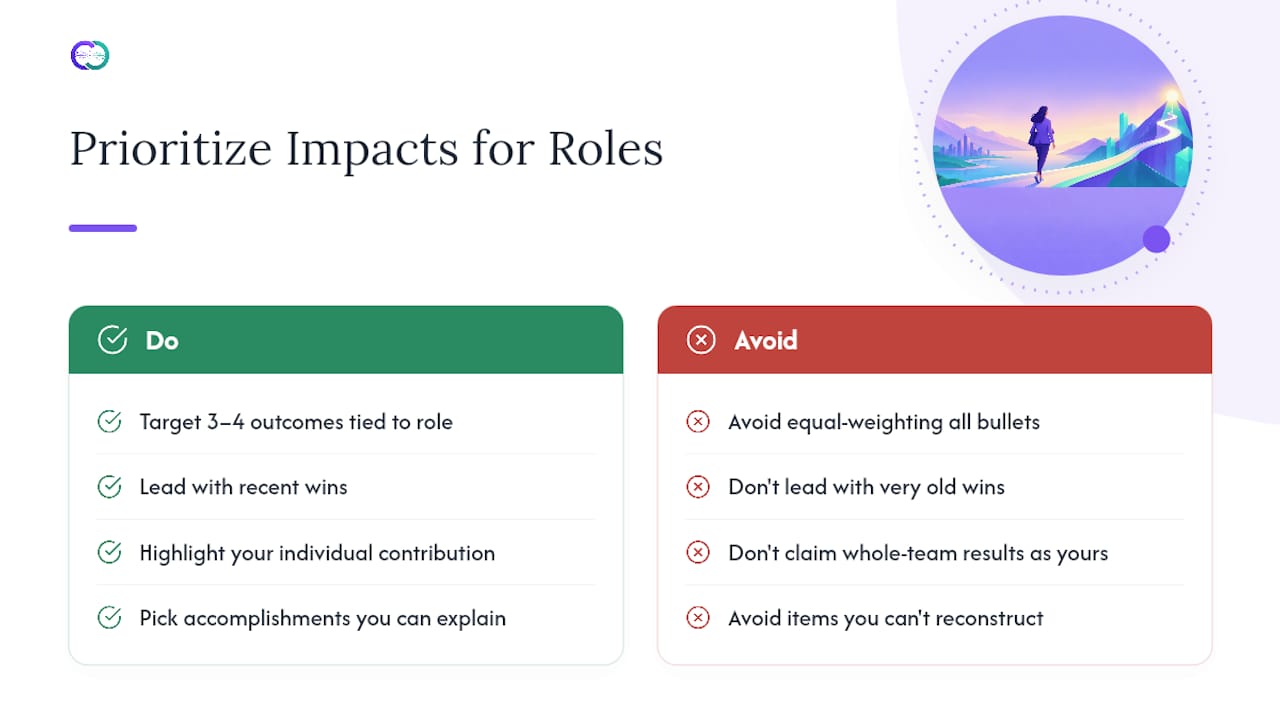
Not every accomplishment deserves equal real estate, and the right selection changes depending on what role you’re targeting. Start by identifying the three or four outcomes that most directly map to the core responsibility of the job posting, revenue generation for a sales role, system reliability for an infrastructure engineering role, retention for a customer success role.
Recency matters almost as much as relevance. An accomplishment from six years ago carries less weight than one from your current or most recent role, even if the older one produced a bigger number, because hiring managers weigh recent performance as a stronger predictor of what you’ll do next. Lead with recent wins and let older, still-relevant accomplishments support rather than headline the resume.
Scope of impact should also shape your selection. A bullet describing a result you drove independently often reads as stronger evidence of individual capability than one describing a result a large team achieved collectively, even when the second number is bigger. If your best accomplishments were team efforts, be specific about your individual contribution within that outcome rather than claiming the team’s total result as solely your own.
Finally, prioritize accomplishments you can speak to in depth during an interview. A bullet with an impressive number but a story you can’t fully reconstruct is a liability. The strongest impact statement is the one you could explain for five minutes if an interviewer asked you to walk through exactly how you achieved it.
Weaving Impact Statements Through Every Resume Section
Impact statements shouldn’t live only in your experience section. Your summary at the top of the resume should function as a compressed preview of your single strongest achievement, not a generic statement of career goals. A summary line like “Operations leader with a track record of cutting costs and improving delivery times” says nothing.
The experience section carries the bulk of your impact statements, three to five per role, prioritized by relevance and recency as covered above. Resist the urge to list every task you performed. A role with eight duties and one impact bullet reads weaker than a role with three tightly quantified accomplishments.
Your skills section plays a supporting role: it should reinforce, not duplicate, the language already proven in your experience bullets. If your experience section demonstrates SQL proficiency through a specific data project, listing “SQL” in your skills section confirms it rather than introducing an unsupported claim. Skills sections work best as a scannable keyword layer for ATS parsing, backed by evidence that already lives in the experience section above it.
Validating and Supporting Your Impact Claims
Every quantified bullet should survive a follow-up question, because that’s exactly what interviewers ask. Before finalizing a metric, trace it back to its source: a dashboard export, a quarterly report, a performance review, an email confirming a project’s completion date. If you can’t identify where a number came from, treat that as a signal to soften the claim to something you can actually defend.
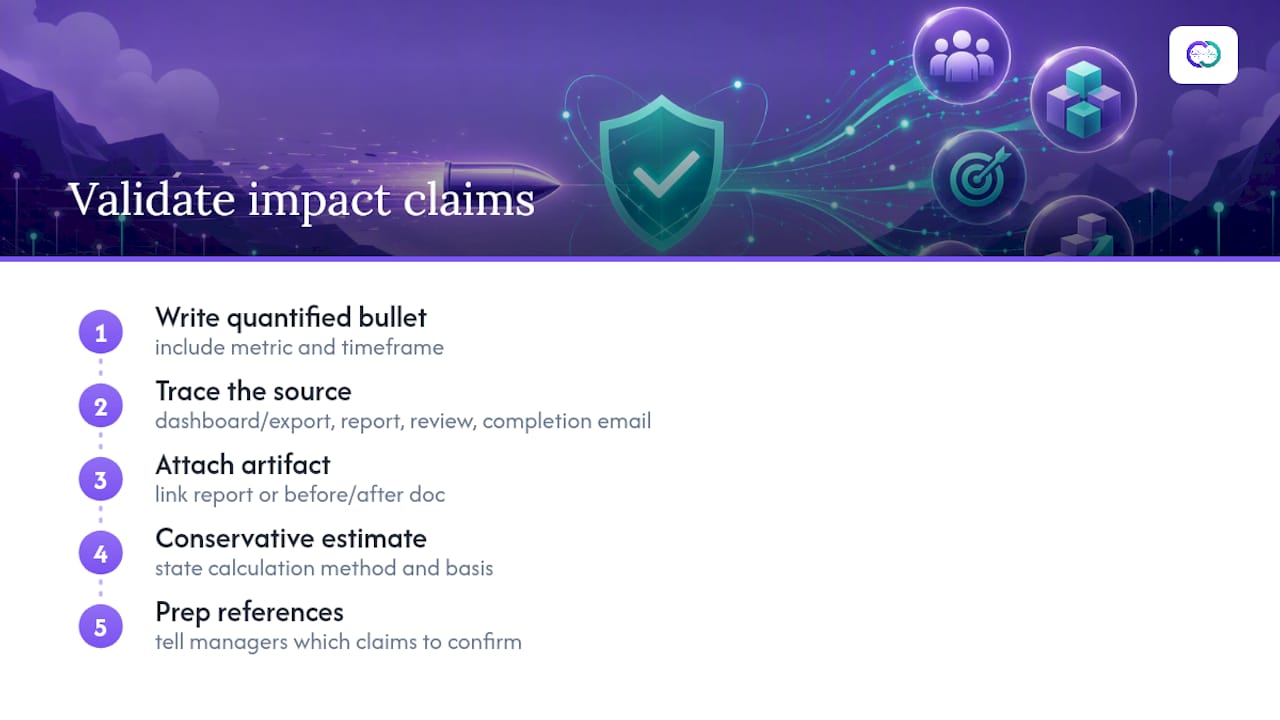
References remain one of the most underused validation tools. A former manager who can confirm a specific outcome in a reference call carries more weight than the number itself, particularly for accomplishments that sound large relative to your seniority at the time. Let your references know in advance which specific claims they might be asked to confirm, so their account lines up with what’s on the page.
For metrics you can’t fully document, quantify conservatively and stay ready to explain your calculation method. An accomplishment stated as “estimated $50K in annual savings, based on reduced manual processing time” is more defensible than a bare “$50K in savings” that implies precision you can’t back up.
This is also where a linked artifact does work a bulleted claim alone can’t. A before-and-after accomplishment example paired with the actual document that produced it removes the burden of proof from the interview entirely, because the evidence speaks before the question gets asked.
The Gap Between Resume Advice and What Actually Gets Read
Most resume advice treats quantification as decoration, a way to make a bullet sound more impressive rather than a way to make it more true. That framing gets the priority backwards. The number isn’t there to flatter the accomplishment. It’s there so a skeptical reader has something concrete to evaluate instead of trusting your adjectives.
The bigger gap, though, is between writing a strong bullet and being able to prove it. University career centers teach the STAR and PARQ frameworks well, but almost none of them address what happens after the interview invite arrives, when a hiring manager wants to see the dashboard, the report, or the actual deliverable behind the claim. A resume that stops at the bullet point is only half the argument.
The reader’s real priority should be sequencing: write the compressed-STAR bullet first, run it through the “so what?” test, then, for accomplishments carrying real weight in a competitive search, attach the evidence that lets a recruiter verify it without waiting for round two. Impact statements earn attention. Verified impact statements earn trust, and trust is what actually moves a candidate from the interview pile to the offer.
— Alloquy Team
Turn Your Strongest Bullet Into Verifiable Proof
The platform takes the impact bullets you just wrote and gives recruiters a way to check them without a follow-up email. By linking Google Drive documents to specific achievements, its AI assistant can answer recruiter questions about your work with grounded, evidence-backed context instead of leaving quantified claims to stand alone on the page.
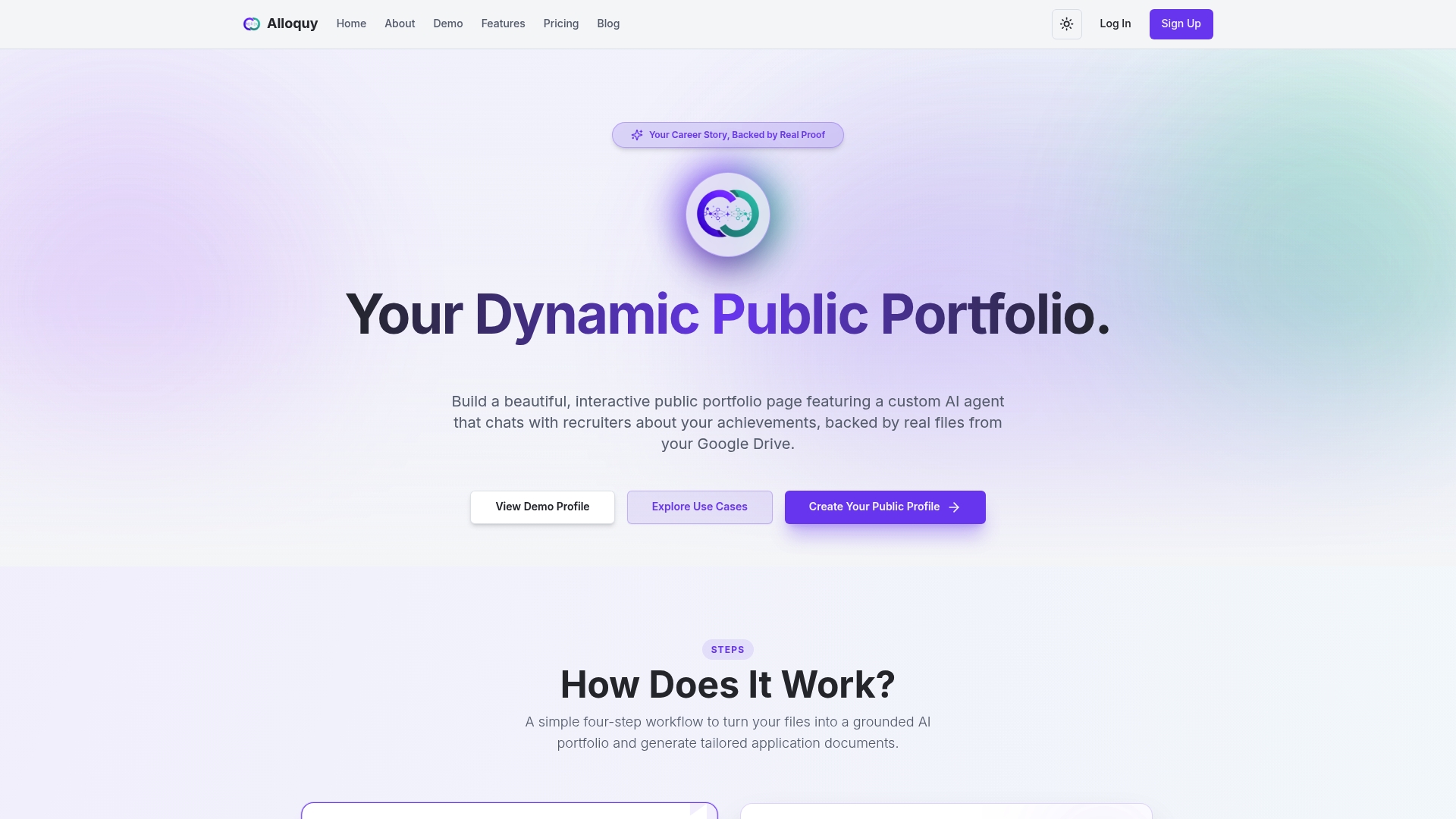
Start with your single strongest bullet, the one with the number you’re most confident defending, and connect it to the report, dashboard, or deliverable that proves it. Customizable branding lets your public profile match your personal presentation, and the free profile gives you enough room to test the approach before deciding whether to expand your evidence library. When you’re ready to see the full range of portfolio and branding options, Alloquy’s plans lay out what’s available beyond the free tier. Set up your profile at Alloquy and convert your best bullet into something a recruiter can actually verify.
Sources
- Writing an Effective Accomplishment Record | SEC
- Writing impactful resume bullets | Yale OCS
- How to write strong descriptions (PARQ) | Virginia Tech Career Center
- Eye-tracking study on recruiter resume review | BU / TheLadders
FAQ
What to say instead of “results-driven” on a resume?
Skip the label entirely and let a specific bullet prove it instead.
How do you say “focused on” in a resume?
Replace “focused on” with the action verb that describes what you actually did.
What is a red flag on a resume?
Common red flags include unexplained employment gaps, vague duty-based bullets with no measurable outcome, and inconsistent formatting that suggests careless preparation. Rounded or unsupportable metrics are also a red flag once a recruiter starts asking follow-up questions.
What is the 7-second rule for a resume?
Eye-tracking research found recruiters often form an initial fit judgment in about 6 to 7 seconds, scanning a narrow set of fixation points near the top of the page before reading in depth. That’s why your strongest, most quantified bullet needs to sit first under each job title, not buried third or fourth.
Does Alloquy cost anything to use?
Alloquy offers a free profile with core portfolio functionality. Additional plan details and pricing are available directly on Alloquy’s pricing page.