

An accomplishment statement is a resume line that proves impact instead of describing a duty. The reusable template is: Action verb + what you did + measurable result, or in expanded form, “Accomplished X (result), as measured by Y (metric), by doing Z (action).” A duty says “Managed social media accounts.” An accomplishment says, “Grew Instagram engagement 42% in six months by launching a weekly video series.”
TL;DR:
- Turning duties into measurable results can significantly boost a resume’s impact by clearly demonstrating performance rather than responsibilities.
- Using specific metrics like percentages, dollar figures, or counts makes accomplishments verifiable and credible to recruiters.
- Keeping a “brag document” helps log wins regularly, enabling more relevant and impactful achievement statements tailored to each job.
- Relevance to the target job is more important than impressiveness, so prioritize accomplishments that match the posting’s key skills and requirements.
- Supporting claims with evidence, such as dashboards or client feedback, strengthens credibility and prepares candidates for deeper interview discussions.
Table of Contents
- What Separates an Accomplishment Statement From a Duty
- How to Write Accomplishment Statements Step by Step
- Accomplishment Statement Examples by Role, With Before → After Rewrites
- Tailoring Accomplishment Statements to a Specific Job Posting
- Common Mistakes That Weaken Accomplishment Statements
- Why Verifiable Evidence Is Becoming the Real Differentiator
- Turn These Bullets Into a Portfolio Recruiters Can Question Directly
- Sources
- FAQ
What Separates an Accomplishment Statement From a Duty
A duty bullet describes what your job required. An accomplishment bullet describes what happened because you did the job well. Recruiters skim resumes in seconds, and a list of duties tells them what your title implies. It does not tell them whether you were good at it. Converting duties into quantified results is the single highest-leverage edit most resumes need, according to The Muse’s guidance on resume revamps.
The clearest framework for this comes from former Google VP of People Operations Laszlo Bock, who proposed a compact formula: “Accomplished [X] as measured by [Y] by doing [Z].” X is the outcome, Y is the metric that proves it, Z is the method you used to get there. Bock’s own example: “Increased average customer satisfaction scores for a 5-person team by 10% over 6 months by implementing a new customer response protocol,” as detailed in Business Insider’s breakdown of his advice.
A second useful lens is the STAR method (Situation/Task, Action, Result), condensed for bullet form. You skip the narrative setup and compress Situation and Task into a phrase of context, lead with the Action verb, and close with the Result. WGU’s career development resources frame this as the fastest way to turn an interview story into a one-line bullet without losing what made it compelling.
Metrics do not have to be financial. Useful categories include:
- Percentages: efficiency gains, error reduction, engagement growth
- Dollar figures: revenue generated, costs cut, budget managed
- Counts: people trained, clients onboarded, projects delivered
- Time: hours saved, turnaround reduced, deadlines beaten
Metric callout: if you only remember one rule, remember this: a bullet with zero numbers reads as a description; a bullet with one specific number reads as evidence.
How to Write Accomplishment Statements Step by Step
Most people don’t lack accomplishments. They lack a record of them. Here’s the workflow that fixes that.
- Keep a brag document. Log wins as they happen, with the metric attached while it’s still fresh. Idealist recommends tracking this continuously rather than trying to reconstruct a year of work the night before a resume deadline. A running brag document template can be as simple as a spreadsheet with columns for date, project, action, and result.
- Select the accomplishment that fits the target job, not the one you’re proudest of personally. Relevance beats impressiveness every time a recruiter scans a page.
- Draft with the formula. Start with an action verb, name what you did, attach the result. Then go back and quantify it, or add qualitative impact (“first team member to cross-train across two departments”) if a hard number genuinely isn’t available.
- Tighten the language. Cut filler words. Cut the subject “I.” Lead with the strongest word in the sentence.
- Run the final checklist: Does it start with a verb? Does it contain a number or a clear qualitative outcome? Does it give enough context to matter? Is it one line?
Pro Tip: Write the ugly, over-long first draft with every detail you remember, then edit it down. It’s far easier to cut a bloated sentence than to add missing context to a bullet you wrote too sparse the first time.
Accomplishment Statement Examples by Role, With Before → After Rewrites
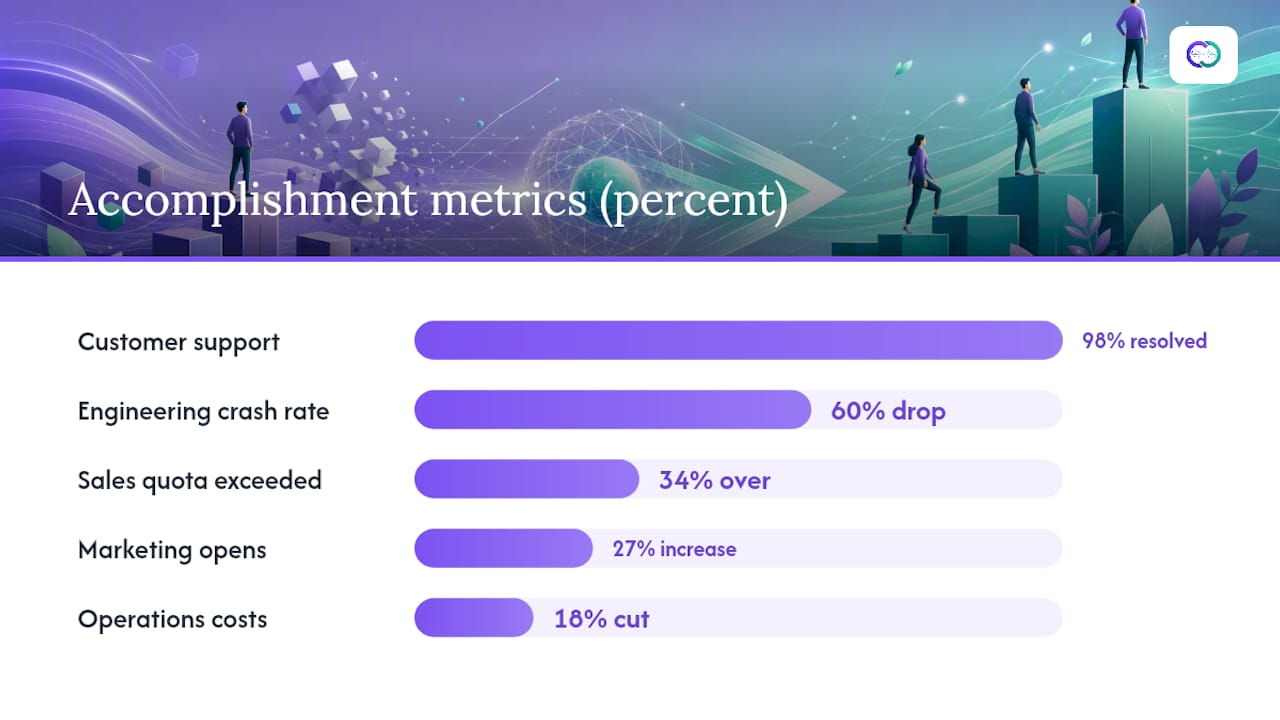
Below are categorized examples across common roles. Each pair shows the duty-only version first, then the rewritten accomplishment. Indeed’s collection of resume achievement prompts makes a useful point here: split your examples into quantitative (a hard number) and qualitative (a clear outcome without a number) so you always have a version to reach for.
Marketing
- Before: “Managed email marketing campaigns.”
- After: “Increased email open rates 27% by rebuilding subject line testing process across 12 monthly campaigns.”
- Before: “Ran the company blog.”
- After: “Grew organic blog traffic from 8,000 to 21,000 monthly visitors in one year through a targeted content calendar.”
Sales
- Before: “Responsible for client accounts.”
- After: “Retained 95% of a $2 million book of business over 18 months by restructuring quarterly check-in calls.”
- Before: “Sold products to customers.”
- After: “Exceeded quarterly sales quota by 34% for three consecutive quarters, the top performer on a 9-person team.”
Operations
- Before: “Oversaw inventory management.”
- After: “Cut inventory holding costs 18% by redesigning the reorder threshold system across four warehouses.”
- Before: “Handled vendor relationships.”
- After: “Renegotiated three vendor contracts, saving $45,000 annually without reducing service levels.”
Engineering
- Before: “Wrote code for the mobile app.”
- After: “Reduced app crash rate 60% by refactoring the checkout flow and adding automated error logging.” Engineers who don’t own product metrics directly can still frame contribution clearly, a distinction covered in Alloquy’s guide to highlighting product impact.
- Before: “Participated in code reviews.”
- After: “Cut average code review turnaround from 3 days to 1 day by introducing a same-day review rotation.”
Customer support
- Before: “Answered customer inquiries.”
- After: “Resolved 98% of support tickets within 24 hours, ranking first among 15 agents for response time.”
- Before: “Trained new hires.”
- After: “Onboarded 22 new support agents over one year, cutting average ramp time from six weeks to four.”
Education
- Before: “Taught high school biology.”
- After: “Raised average student test scores 15% by introducing weekly peer-tutoring sessions for struggling students.”
Nonprofit
- Before: “Coordinated volunteer events.”
- After: “Recruited and managed 60 volunteers for a fundraising gala that raised $75,000, a 20% increase over the prior year.”
Management
- Before: “Led a team of associates.”
- After: “Led a 5-person team that increased quarterly revenue 18% by implementing a new lead qualification process.” Naming your role inside a team result, rather than claiming the whole outcome, keeps the bullet credible rather than inflated.
| Category | Example metric type | When exact numbers aren’t available |
|---|---|---|
| Marketing | Percentage growth | Compare before/after volume qualitatively |
| Sales | Dollar value or quota percentage | Rank performance among peers |
| Operations | Cost or time savings | Use a relative reduction (“cut cycle time nearly in half”) |
| Engineering | Error rate or turnaround time | Describe scope (users affected, systems touched) |
| Management | Team size plus outcome percentage | Attribute your specific lever within the result |
Tailoring Accomplishment Statements to a Specific Job Posting
A strong bullet still misses if it answers the wrong question. Before you finalize a resume, scan the job posting for the three or four skills it repeats most, and mirror that language in your bullets, without forcing a keyword into a sentence where it doesn’t fit naturally.
- Pull the top skills and requirements directly from the posting’s language.
- Pick the 3 to 5 accomplishment statements that map most directly to those requirements.
- Move your strongest, most relevant bullet to the top of each job entry. Recruiters read top to bottom and often stop early.
- Curate ruthlessly. Ranking your bullets by relevance to this specific job, not by how impressive they sound in isolation, is what separates a targeted resume from a generic one, a point echoed in UMass Global’s advice on writing accomplishment statements.
The same bullet doubles as interview material. Take “Cut inventory holding costs 18% by redesigning the reorder threshold system” and expand it into a 30 to 60 second STAR story: Situation (“Our warehouse was overstocking slow-moving SKUs”), Task (“I was asked to find $30,000 in annual savings”), Action (“I built a new reorder threshold model based on 90-day sales velocity”), Result (“Cut holding costs 18%, saving roughly $52,000 annually”). One well-built bullet becomes both a resume line and an interview answer. An applicant tracking system also scans for these same keyword matches before a human ever does, which is one more reason mirroring the posting’s language pays off twice, as Filmijob’s overview of ATS behavior explains.
Common Mistakes That Weaken Accomplishment Statements
- Duty-only bullets. “Responsible for X” tells a recruiter your job title, not your performance. Fix it by adding the result that came from doing X well.
- Vague claims with no metric. “Improved efficiency significantly” is unverifiable filler. Fix it by estimating scope honestly, or by using a specific qualitative outcome (“first analyst to eliminate the manual reconciliation step”) when a hard number truly doesn’t exist.
- Unverifiable inflation. Claiming credit for a result you contributed to but didn’t own outright invites tough follow-up questions in an interview. Fix it by framing your specific role inside the larger outcome and keeping evidence on hand.
- Too many unrelated wins. Ten accomplishments crammed onto one resume dilute the two or three that actually matter for this job. Fix it by cutting anything that doesn’t map to the posting.
Pro Tip: If you can’t remember the exact number behind a win, don’t drop the bullet. Use a defensible range or a relative comparison instead of abandoning a genuinely strong accomplishment.
Why Verifiable Evidence Is Becoming the Real Differentiator
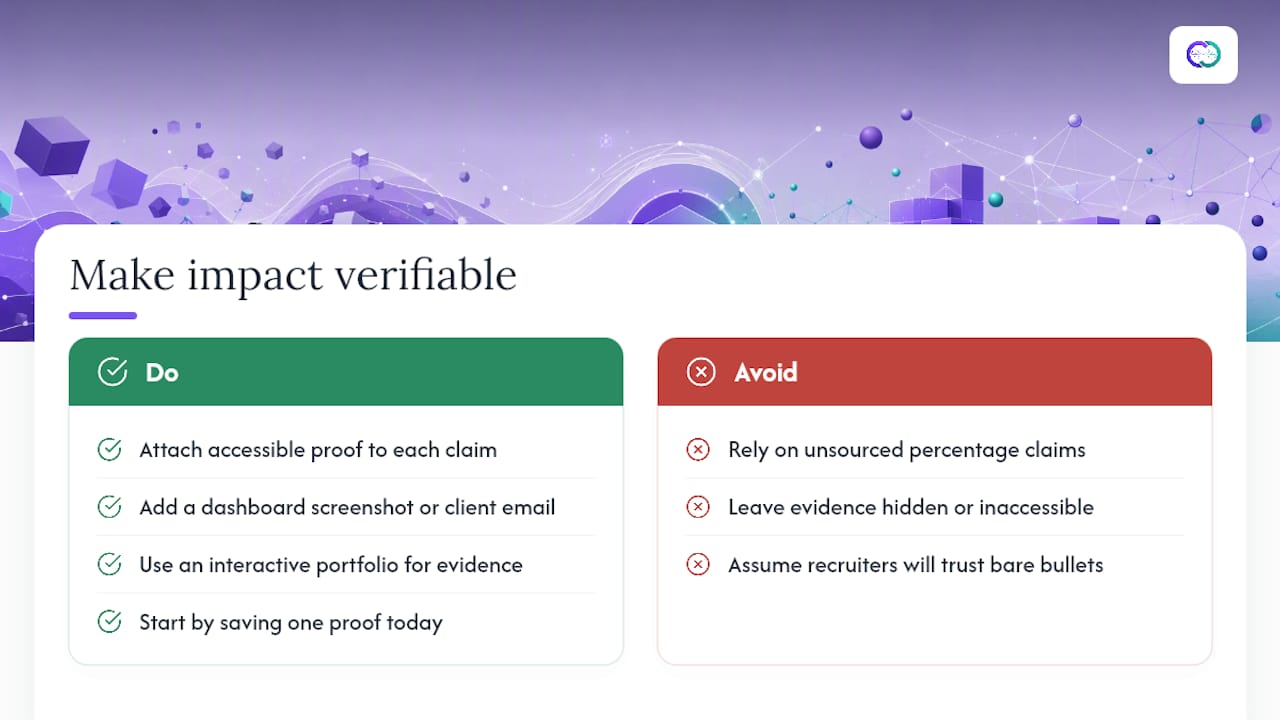
Recruiters have grown skeptical of resume bullets precisely because the formula is now public knowledge. Everyone knows to write “increased revenue 18%.” Fewer people can back that number up when asked. Hiring is shifting toward verifiable impact, where a strong statement paired with accessible proof, a dashboard screenshot, a client email, a sample deliverable, builds far more recruiter confidence than the sentence alone ever could.
That shift is exactly what an interactive portfolio is built to support: a public profile where evidence sits behind each claim and a recruiter’s AI query gets a sourced answer instead of a guess. Start small. Pick one accomplishment statement you wrote this week and save the actual proof behind it today.
— Alloquy Team
Turn These Bullets Into a Portfolio Recruiters Can Question Directly
A resume bullet is a claim. This is where that claim gets backed by evidence a recruiter can actually check.
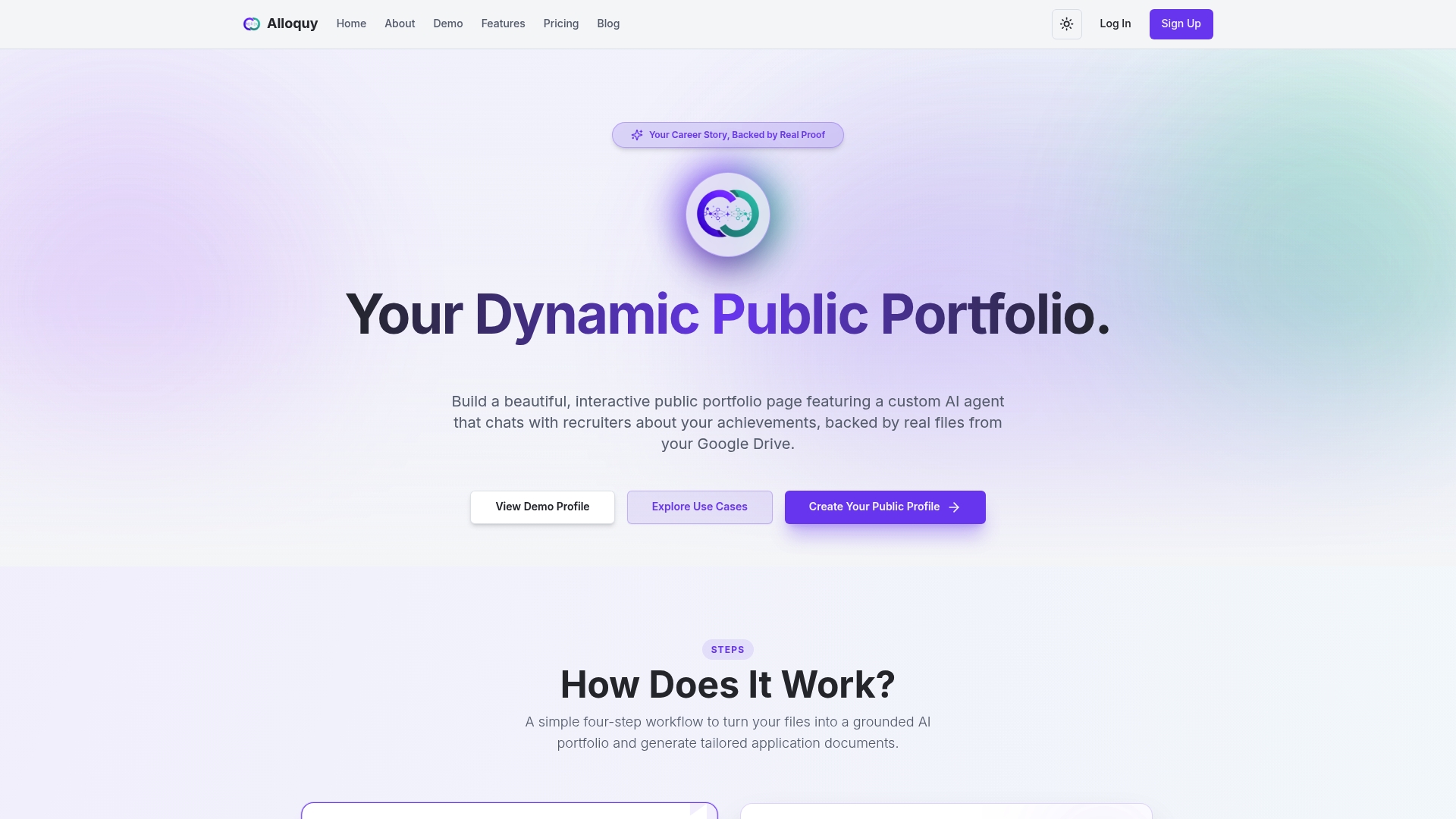
The platform can also generate tailored resumes and cover letters pulled from your verified achievements, so the work you put into writing sharp accomplishment statements doesn’t stop at one document. Every bullet you draft using the Bock formula or the STAR method can become reusable evidence inside a branded, interactive profile instead of a static PDF. If you want recruiters getting sourced answers instead of taking your word for it, check Alloquy’s plans and start linking evidence to the accomplishments you already have.
Sources
This guide draws on Laszlo Bock’s formula as reported by Business Insider, the duty-versus-accomplishment framing from The Muse, and STAR-based examples from WGU, UC Davis, and Indeed.
- Resume Revamp: How to Turn Your Duties Into Accomplishments
- Accomplishment Statements – Career & Professional Development | WGU
FAQ
What is a good accomplishment statement?
A good accomplishment statement leads with an action verb, states what you did, and closes with a measurable result, following the pattern “Accomplished X as measured by Y by doing Z.”
What are some good accomplishment examples?
Strong examples quantify the outcome, like “Increased email open rates 27% by rebuilding subject line testing across 12 campaigns” or “Cut inventory holding costs 18% by redesigning the reorder threshold system.”
What should I write in my top three achievements?
Choose the three accomplishments most relevant to the job posting’s stated priorities, each with a measurable result, and put the strongest one first since recruiters read top to bottom.