

A storytelling resume is a targeted, evidence-first resume that places a concise career thesis and measurable impact in the top third so both applicant tracking systems and a recruiter’s rapid scan see your fit immediately. Instead of stacking duty-based bullets under each job title, this format opens with a headline, a two-to-three-line career summary, and two or three impact bullets carrying real numbers, all positioned where the eye lands first.
The logic is straightforward. Recruiters spend an average of 7 to 7.4 seconds on an initial resume scan reading in an F-pattern that fixates on the top third of page one. If your strongest qualification sits at the bottom of a wall of bullet points, it may never get seen. A storytelling resume front-loads the proof.
Here is the top-third blueprint to build right now:
- Headline: your target title, matched to the language in the job posting.
- Career summary: two to three lines stating years of experience, one signature achievement with a number, and the role you’re targeting.
- Impact bullets: two or three lines, each with a metric, an action, and an outcome, not a task description.
Pro Tip: Keep every keyword an ATS would search for (tools, certifications, job titles) inside these top-third lines. You get both the machine match and the human read in the same real estate.
Key Takeaways
A storytelling resume works because it puts quantified impact and a clear career theme inside the recruiter’s actual field of view during a 7-second scan.
| Point | Details |
|---|---|
| Front-load the top third | Place your headline, summary, and strongest metrics where the F-pattern scan actually lands. |
| Rewrite duties as outcomes | Use the metric, action, outcome pattern to replace task descriptions with results. |
| Keep ATS keywords intact | Preserve exact terms from the job posting even as you shift bullets into narrative form. |
| Match spend to complexity | Reserve professional writers ($100 to $3,500+) for pivots, gaps, or executive positioning. |
| Back claims with evidence | A platform like Alloquy lets recruiters verify your resume’s claims through linked documents and AI-assisted Q&A. |
Table of Contents
- What Is a Storytelling Resume and When Should You Use One?
- How Do You Build the Core Elements of a Narrative Resume?
- What Is the 6-Step Process for Rewriting Duty Bullets Into a Story?
- What Do Before-and-After Storytelling Resume Examples Look Like?
- How Does the 7-Second Rule Shape Where You Place Information?
- Should You Write Your Own Storytelling Resume or Hire a Writer?
- How Can an Interactive Portfolio Back Up Your Resume’s Claims?
- What the Research Actually Supports
- Turn Your Resume’s Best Lines Into Provable Evidence
- Sources
- FAQ
What Is a Storytelling Resume and When Should You Use One?
A storytelling resume format replaces or augments bulleted task lists with short narrative passages that frame a career as a coherent arc rather than a series of disconnected job descriptions. Where a traditional resume lists “managed a team of six” and “oversaw budget process,” a narrative resume connects those facts into a through-line: why the role mattered, what changed because of the work, and how one job set up the next.
This approach fits some careers better than others. Career changers benefit because narrative context explains a jump that a bullet list cannot. Senior and executive candidates benefit because leadership roles are judged on strategy and outcomes, which read poorly as flat lists. Anyone whose work involves product judgment, client persuasion, or cross-functional negotiation gains from showing the “why” behind decisions rather than just the “what.”
It fits less well for some situations. Entry-level candidates with thin work history may not have enough material to sustain a narrative arc and are often better served by a tight, traditional bullet format. Highly technical or trades roles where hiring managers scan for specific certifications and tool names can suffer if narrative prose buries those keywords. And any storytelling resume needs discipline: long paragraphs, inconsistent formatting, or multi-column layouts can confuse ATS parsers even when the content is strong.
- Use narrative structure for career pivots, leadership roles, and consulting-style positions.
- Stick closer to bullet-first formatting for early-career, highly technical, or high-volume-applicant roles.
- Whatever the mix, keep the layout single-column and the summary under four lines.
How Do You Build the Core Elements of a Narrative Resume?
Four components carry the weight of resume storytelling: the headline, the career summary, the impact bullets, and the underlying career theme that ties them together. Get these right and the rest of the document falls into place.
- Write a headline that mirrors the job posting. Skip generic titles like “Marketing Professional” in favor of the exact target title, such as “Senior Product Marketing Manager, B2B SaaS.” This single line does double duty: it signals fit to a human in half a second and matches the title field many ATS platforms weight heavily.
- Build a two-to-three-line career summary. State your years of experience, your single strongest signature achievement with a number attached, and the role or industry you’re targeting next. A summary that reads “12 years in supply chain operations; cut fulfillment costs 18% at a 200-location retailer; seeking senior operations leadership in retail logistics” tells a recruiter everything they need before they read another word.
- Craft impact-first bullets using the metric, action, outcome pattern. Every bullet should answer what changed, because of what action, measured how. Order bullets by trajectory, strongest and most recent first, so the arc of increasing responsibility is visible without a reader having to reconstruct it themselves.
- State a one-sentence career theme. This is the connective tissue between jobs; for example, “Each role has centered on turning underperforming teams into predictable revenue engines.” A clear theme prevents a narrative resume from reading like three unrelated jobs stapled together.
Pro Tip: If you can’t summarize your career theme in one sentence, you probably haven’t decided what story you’re telling yet, and neither will the recruiter.
The connection between judgment and storytelling matters here: hiring managers read narrative elements as evidence of self-awareness because a candidate who can articulate why a decision worked demonstrates more problem-solving capacity than one who only lists that the decision was made.

What Is the 6-Step Process for Rewriting Duty Bullets Into a Story?
Converting a duty-based resume into a narrative one is a mechanical process once you have the sequence. This six-step workflow, adapted from the step-by-step approach outlined by Indeed, takes a resume from generic to targeted in an afternoon.
Step 1: Define the target role and extract keywords. Pull three to five real job postings for the role you want. List every recurring noun (tools, certifications, methodologies) and every recurring verb (led, negotiated, optimized). These become your keyword bank and your headline language.
Step 2: Inventory your achievements and prioritize the strongest 8 to 12. List every project, initiative, or result from the last five to seven years without editing yet. Then cut ruthlessly to the 8 to 12 items that best match the keywords from step one. Everything else either gets cut or moves to a shorter, older-role section.
Step 3: Quantify outcomes. For each surviving item, add a number: percentage change, dollar figure, headcount, frequency, or scope. If you genuinely cannot quantify a result, at least state scale (“managed a portfolio of 40 enterprise accounts”).
Step 4: Write the two-to-three-line career summary. Draft the summary using your single strongest quantified achievement, your years of experience, and your target title. This establishes the theme before a recruiter reads a single job entry.
Step 5: Convert your top bullets into narrative-impact lines. This is where the actual storytelling technique lives. The rewrite pattern researched by Harvard Business Review follows a simple formula: reduce X by Y percent by doing Z, enabling a specific business outcome.
Place your two or three strongest converted bullets first under each role, not chronologically as they happened, but ranked by impact.
Step 6: Finalize the layout and run an ATS check. Use a single-column layout with no text boxes, graphics, or tables inside the parsed content. Keep dates in one consistent format throughout (“March 2023 to Present,” not a mix of formats). Save and submit as a PDF unless the posting specifically requests DOCX, since some older ATS platforms parse PDFs unreliably. Run your draft through a free ATS scanner or paste it into a plain-text editor to confirm nothing scrambles.
- Re-check your top third against the job posting one more time before sending.
- Confirm every bullet still contains its original keyword after the narrative rewrite.
- Iterate per application; a storytelling resume is a template, not a fixed document.
What Do Before-and-After Storytelling Resume Examples Look Like?
Seeing the rewrite pattern applied side by side makes the technique concrete faster than any description of it.

Mid-career example, operations manager. Before: “Responsible for warehouse inventory management and staff scheduling.”
Senior/executive example, VP of sales. Before: “Oversaw regional sales team and managed key client relationships.”
Career-change example, teacher transitioning to corporate training. Before: “Taught high school curriculum and managed classroom of 30 students.” After: “Designed and delivered instruction for 150+ students annually, translating complex material into measurable comprehension gains, a skill set now applied to corporate learning and development.”
The strongest career-change narratives don’t apologize for the pivot. They name the transferable mechanism, whether that’s instructional design, stakeholder negotiation, or process improvement, and show it already produced results in a different context.
Each rewrite keeps the original keyword (inventory management, sales team, curriculum) while surfacing the number and outcome that a duty-only bullet buries.
How Does the 7-Second Rule Shape Where You Place Information?
Recruiter eye-tracking research puts the initial resume scan at roughly 7.4 seconds, and that scan follows an F-pattern concentrated on six zones: name, current title, current employer, dates, previous title and employer, and education. Everything a recruiter decides in that window happens before they’ve read a single full sentence of your bullets.
That data point changes how you should think about layout. It’s not about writing better bullets somewhere on page one; it’s about which six or seven data points occupy the recruiter’s actual line of sight in the first several seconds, and a narrative that buries its metrics below the fold fails the scan regardless of how well it’s written.
| Top-third element | What it needs to contain |
|---|---|
| Name and headline | Full name, target title matching the posting |
| Career summary | 2 to 3 lines: years, one signature metric, target role |
| First 2 to 3 bullets | Metric, action, outcome, plus one relevant tool or method |
| Dates and employer | Consistent format, most recent role first |
Pro Tip: Print your resume, stand across the room, and look at it for exactly 7 seconds. Whatever you actually notice is what a recruiter notices too.
For ATS compatibility, keep keyword phrasing close to the exact wording used in the job posting, use a single-column layout with standard section headers (“Experience,” “Education”), and avoid tables, text boxes, or headers/footers that some parsers skip. Submit PDF by default; switch to DOCX only if a posting explicitly asks for it.
Should You Write Your Own Storytelling Resume or Hire a Writer?
Most professionals with a clear target title and measurable results in hand can write a strong narrative resume themselves using the six-step process above. Hiring a professional makes more sense when the situation carries genuine complexity: a career pivot into an unfamiliar industry, an executive search where positioning against a search firm’s mandate matters, unexplained employment gaps, or a track record that’s real but genuinely hard to quantify without outside help.
Pricing tracks that complexity. Mid-career resume-writing services typically run $100 to $700, covering an intake call, a rewritten resume, and one or two revision rounds. Executive packages commonly run $1,000 to $3,500 or more, reflecting deeper strategy sessions, LinkedIn optimization, and sometimes a cover letter or personal brand statement bundled in.
Before paying for any service, confirm four things:
- A real intake process (call or detailed questionnaire), not a template swap.
- A defined number of revision rounds, not “unlimited” with no specifics.
- Evidence the writer understands ATS formatting, not just visual design.
- Full ownership of your final files, delivered in editable formats.
Paying more generally buys deeper strategic positioning, not prettier fonts. If a service can’t explain how it will establish your career theme, that’s a signal to look elsewhere.
How Can an Interactive Portfolio Back Up Your Resume’s Claims?
A storytelling resume makes claims in a few lines of text; a recruiter has no way to verify them beyond taking your word for it. That gap is where an interactive, evidence-backed portfolio does work a static PDF cannot. Alloquy links directly to your Google Drive documents, letting a recruiter query a custom AI assistant about the specific project behind any resume line, and get a verified, contextual answer instead of a guess.
- Verified evidence tied to real documents, not self-reported claims sitting alone on a page.
- An AI assistant recruiters can query directly about a project’s scope, timeline, or outcome.
- Tailored resume and cover letter exports generated from your actual verified evidence base.
Pro Tip: Add a single portfolio URL in your resume’s contact line. It costs one line of space and gives a curious recruiter a way to go deeper without asking you a follow-up email.
A resume states the claim. An evidence-backed portfolio lets the recruiter test it, and that difference shows up in how confidently a hiring manager can defend moving your application forward.
Practically, this means linking your strongest resume bullet to a case study, keeping your portfolio URL current, and letting the underlying evidence generate a tailored resume the next time a new target role demands a different emphasis. For more on combining formats, see how multi-format resume assets support modern job search strategy.
What the Research Actually Supports
Most resume advice treats storytelling as decoration, a stylistic upgrade for people who already have the substance figured out. The research points somewhere else: narrative structure is a compression technique. It forces you to decide what your career actually adds up to before a recruiter ever asks.
The conventional advice oversells length and undersells placement. A beautifully written narrative resume that buries its metrics on page two fails the same 7-second scan a boring bullet list fails. The fix isn’t more storytelling. It’s ruthless prioritization of what sits in the top third.
If you take one thing from this, take the sequencing: quantify first, then narrate, then place. Skipping straight to prose without numbers produces a resume that reads well and verifies poorly, which is exactly the gap an evidence-backed profile like a portfolio built on verified project documentation is built to close.
— Alloquy Team
Turn Your Resume’s Best Lines Into Provable Evidence
Alloquy is the next step once your storytelling resume is written, not a replacement for it. Where a resume can only claim an outcome in one line, Alloquy lets a recruiter ask your AI assistant follow-up questions and get answers grounded in the actual Google Drive documents behind that project, turning your strongest bullet into something a hiring manager can verify in real time instead of just trusting.
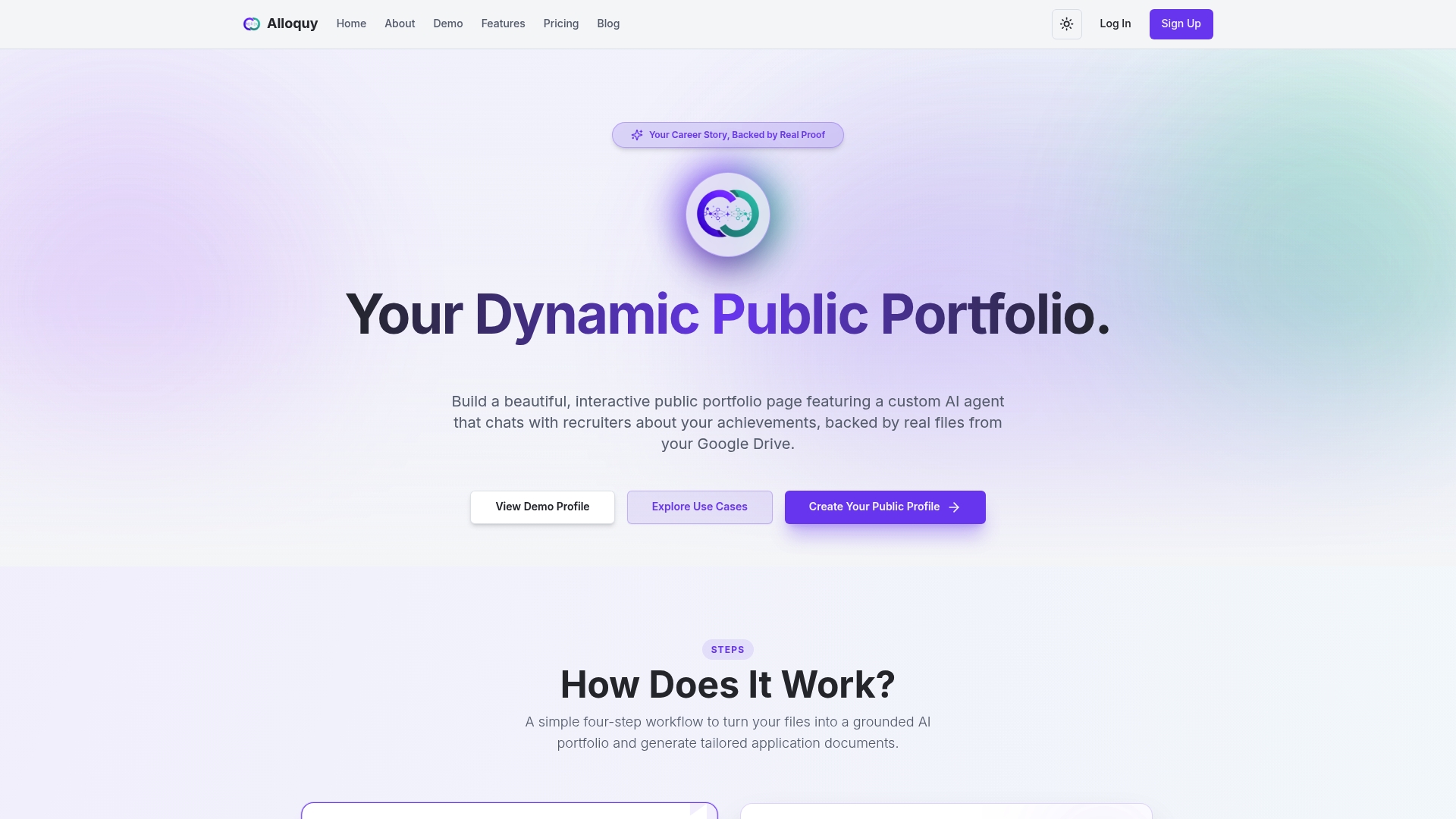
This matters most for the exact readers this guide targets: career changers whose narrative needs backup, senior candidates whose strategic claims benefit from a linked case study, and anyone tired of a static PDF doing all the work alone. Alloquy adds customizable branding, an interactive public profile, and the ability to generate tailored resumes and cover letters straight from your verified evidence, so every application stays current without a rewrite from scratch. Set up your profile and connect your evidence at Alloquy’s pricing page to see which plan fits your job search.
Sources
- How To Use a Storytelling Resume Format in 6 Steps (With Sample) — Indeed
- Improve Your Résumé by Turning Bullet Points into Stories — Harvard Business Review
- 7-Second Resume Rule: How Long Recruiters Really Look (QuickResumeAI summary)
- How Much Do Resume Writing Services Cost? — Career Sidekick
FAQ
What Is the 7-Second Rule in Resumes?
It refers to research showing recruiters spend about 7 to 7.4 seconds on an initial resume scan, reading in an F-pattern focused on six zones in the top third of page one, including name, title, employer, and dates.
How Much Does a Storytelling Resume Cost If You Hire Someone?
Mid-career resume-writing services typically cost $100 to $700, while executive-level narrative resumes commonly run $1,000 to $3,500 or more depending on intake depth and strategy work.
Is Storytelling a Career Skill Employers Actually Value?
Storytelling isn’t a standalone job title for most professionals, but hiring managers read narrative ability as evidence of judgment and self-awareness, which makes it a valued skill across leadership, sales, marketing, and consulting roles.
What Careers Rely Most Heavily on Storytelling?
Roles in marketing, sales, product management, consulting, executive leadership, and teaching or training lean heavily on narrative skill, since each requires explaining not just what happened but why a decision produced a given result.
Can an Interactive Portfolio Replace a Traditional Resume?
No. A resume remains the primary screening document, but a platform like Alloquy adds a verifiable layer behind it, letting recruiters query an AI assistant about the evidence supporting your strongest claims.
Recommended
- Why Multi-Format Resume Assets Are Key to Modern Job Search Success | Alloquy Blog | Alloquy
- Alloquy: Your Interactive AI-Powered Portfolio
- The Death of Cover Letters: Why AI-Tailored Briefs Get 4x Response Rates | Alloquy Blog | Alloquy
- Structuring Your Career Achievements for Maximum AI Citation | Alloquy Blog | Alloquy