

A recruiter outreach message works best when it compresses one line of genuine personalization, one line of relevant proof, and a single clear ask into two or three sentences total. LinkedIn suits a brief introduction; email suits a fuller pitch or a formal application follow-up. The templates and follow-up rules below give you both formats ready to adapt.
TL;DR:
- Personalize each message with the recruiter’s correct name, a company specific detail, and a role related skill; replace broad claims with a measurable result.
- Keep application follow up emails between 75 and 125 words, and make the subject line pair your name with the role or skill.
- Wait 5 to 7 business days before following up; one polite nudge increases response rates by about 22%, and cap total outreach at three attempts.
- Before sharing personal information, verify the recruiter and job listing through the company’s official careers page or verified LinkedIn page, and reject payment requests.
- A short public portfolio link lets recruiters verify your evidence without downloading files, while multiple attachments can weigh down a first message.
Table of Contents
- Templates for LinkedIn, email, and recruiter replies
- How to personalize fast and what proof to include
- When to follow up and what to say
- How to verify a recruiter is legitimate
- Common outreach mistakes that quietly kill response rates
- What actually moves the needle in recruiter outreach
- Put a verified profile link in your next message
- FAQ
- Sources
Templates for LinkedIn, email, and recruiter replies
Short, structured messages outperform long introductions because recruiters scan dozens of them daily. Below are channel-specific starting points you can adjust in under a minute.
LinkedIn templates:
- Connection request: “Hi [Name], I noticed your work hiring for [team/function] at [Company]. I recently [achievement tied to role] and would value connecting.”
- After seeing a job post: “Hi [Name], I saw the [Job Title] opening at [Company]. My background in [skill/result] lines up closely, and I’d welcome a short conversation.”
- Reply to recruiter InMail: “Thanks for reaching out, [Name]. I’m interested in learning more about the [Job Title] role. Here’s a quick look at relevant work: [link].”
Email templates:
- Initial outreach: Subject: “[Your Name] | [Skill/Role] for [Company].” Body: “Hi [Name], I’m reaching out about opportunities on [team]. I recently [specific result], and I think it’s relevant to what your team is building. Would you be open to a brief call?”
- Application follow-up (keep this one in the 75 to 125 word range, which Handshake’s research identifies as the most effective length): “Hi [Name], I applied for [Job Title] on [date] and wanted to follow up. Since applying, I [new detail, if any]. I’d welcome the chance to discuss how my background in [skill] fits the role.”
- Referral request: “Hi [Name], I’m exploring roles in [field] and admire the work your team does at [Company]. Would you be willing to share any insight on open positions or point me to the right contact?”
Subject lines work best when they are specific rather than clever: pairing your name with the role or skill, as in “[Your Name]: Backend Engineer, 5 Years in Fintech,” reads as relevant at a glance.
How to personalize fast and what proof to include
Personalization does not require a rewritten paragraph for every recruiter. Indeed’s guidance on emailing recruiters identifies the recruiter’s name, a company-specific detail, and a relevant skill as the core differentiators between a message that gets opened and one that gets ignored.
Before sending, confirm:
- The recruiter’s name and title are spelled correctly and current.
- One sentence references something specific to the company: a recent product launch, a team expansion, or the job post itself.
- One line states an achievement or skill directly tied to the role, not a generic career summary.
Attach a resume only when asked, or consider sharing a concise version that helps you validate your executive portfolio efficiently. A short link to a public portfolio works better as a first touch because it lets a recruiter skim verified evidence without downloading a file. Our earlier breakdown of AI-tailored application briefs covers why concise, evidence-linked materials tend to outperform generic attachments.
Three quick swaps turn a template into a real message: replace “your company” with the actual name and one fact about it, replace “my experience” with a specific number or outcome, and replace “let me know” with a concrete ask like a 20-minute call.
Pro Tip: Keep your one-line proof concrete: “Reduced onboarding time by automating three manual steps” reads stronger than “experienced in process improvement.”
When to follow up and what to say
Patience pays off, but only within a window. Indeed’s guidance on following up recommends waiting 5 to 7 business days after your first message before sending a follow-up, and capping total outreach at two to three attempts so persistence does not read as pressure.
One follow-up can meaningfully change your odds: according to Handshake’s research on personalized communication, sending a follow-up message increases response rates by about 22%. That single data point justifies one polite, well-timed nudge rather than radio silence after the first attempt.
Short scripts work here too:
- Email follow-up: “Hi [Name], following up on my note from last week about [Job Title]. Happy to share more detail or answer any questions.”
- LinkedIn follow-up: “Hi [Name], wanted to bump this in case it got buried. Still very interested in [role/team] if there’s time to connect.”
If you follow up a second time, add something new: a recent project, a relevant certification, or a direct answer to something in the original job post.
How to verify a recruiter is legitimate
Outreach scams imitate real recruiting language closely enough to fool a tired job seeker scrolling messages at night. A few checks protect you before you reply.
- Check the sender’s email domain against the company’s official site; a mismatch, or a personal address like Gmail, is a warning sign.
- Confirm the recruiter’s profile and the job listing both appear on the company’s own careers page or verified LinkedIn page.
- Treat unexpected links, upfront payment requests, equipment purchase demands, or pressure to move to a private messaging app as red flags, consistent with the FTC’s alert on job-offer scams.
- If anything feels off, contact the company directly through its published channels rather than replying to the message.
- Report suspected scams to the FTC at ReportFraud.ftc.gov or forward suspicious texts to 7726.
Common outreach mistakes that quietly kill response rates
Most unanswered messages fail for predictable reasons:
- Sending a generic, clearly mass-copied line: fix it by naming the recruiter’s recent post or a specific detail about the company.
- Attaching multiple files to a first message: fix it by linking a short portfolio summary instead.
- Making a vague or open-ended ask: fix it by requesting something specific, like a 20-minute call or permission to send more detail.
A message that respects the recruiter’s time with a narrow, clear ask consistently reads as more professional than one that asks for everything at once.
What actually moves the needle in recruiter outreach
Most advice on this topic overindexes on wording: the perfect opening line, the ideal subject hook. The sentence-level polish matters far less than whether the message contains something a recruiter can verify in ten seconds. A claim like “strong background in data analysis” asks the recruiter to take your word for it; a one-line result with a link to supporting evidence asks for nothing but a glance.

The conventional wisdom to “stand out” by writing something creative or unusual often backfires, since recruiters skim for relevance and proof, not personality. What deserves more attention than it gets is the structure of the ask itself: a specific, time-bound request outperforms an open-ended one almost every time, because it removes the mental work of figuring out what you actually want.
If you prioritize one thing, make it proof over polish. A short message backed by a verifiable detail will outperform a longer, well-written one that asks the reader to trust unverified claims.
— Alloquy Team
Put a verified profile link in your next message
A recruiter outreach message gets stronger when the one-line proof it promises is backed by something clickable and real. Alloquy lets you link Google Drive documents and other evidence to an interactive profile, so the claim in your message and the record behind it match exactly.
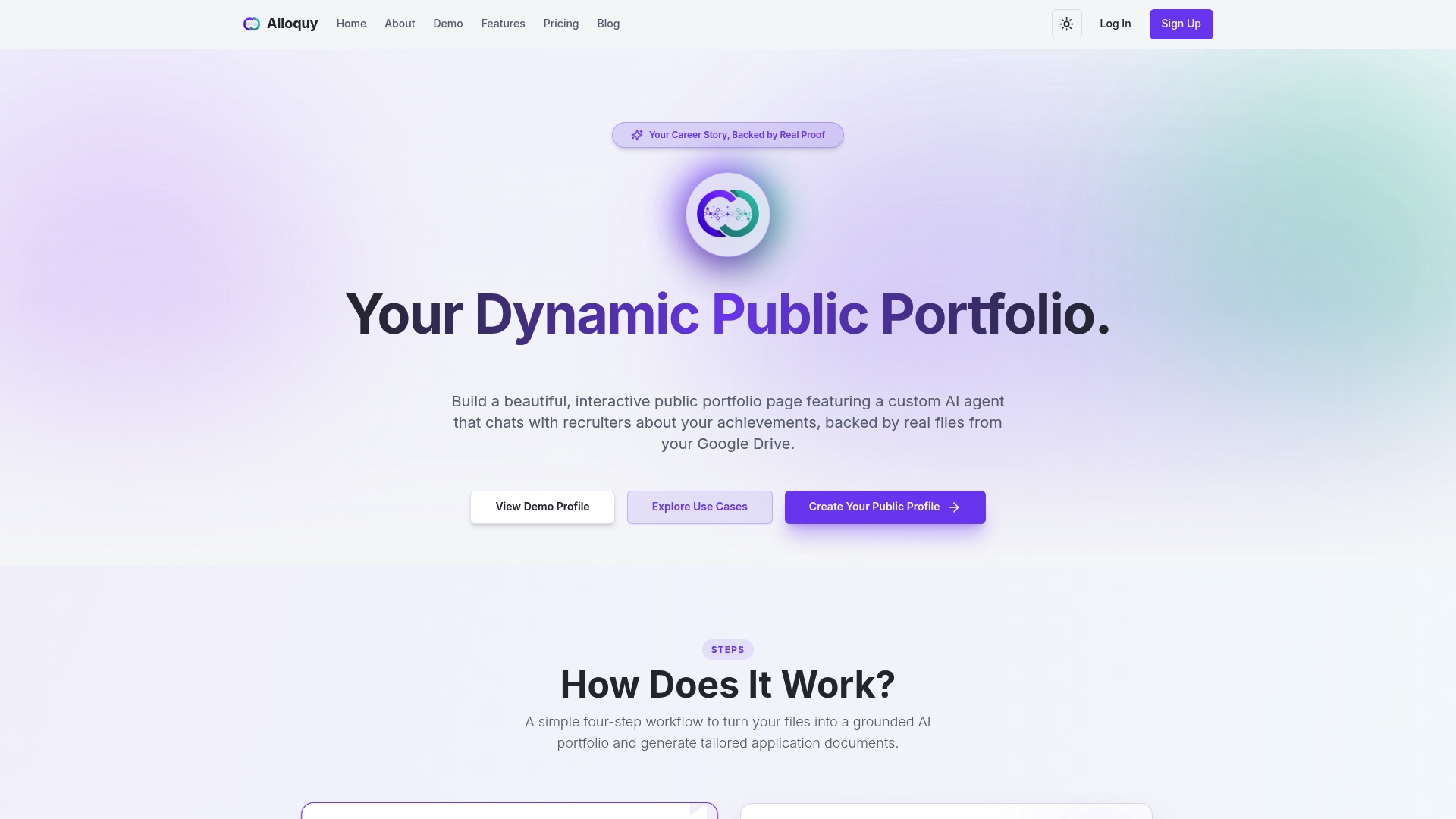
- Include a short public link in your message instead of attaching files.
- Set up a free profile in minutes and start sending evidence-backed outreach today.
- This approach keeps your underlying documents private while surfacing only verified details recruiters ask about.
FAQ
What do you say to a recruiter?
Keep it to two or three sentences: who you are, one relevant result or skill, and a specific ask like a short call. Reference something specific to the recruiter’s company or post to show the message isn’t mass-sent.
Are LinkedIn messages from recruiters legit?
Many are, but the FTC warns that scammers frequently impersonate recruiters through messaging platforms. Verify the sender against the company’s official careers page and LinkedIn presence before sharing any personal information.
How do I decline a recruiter outreach?
A short, polite reply works best: thank the recruiter, state that the role or timing isn’t a fit, and offer to stay in touch for future opportunities. This keeps the relationship open without requiring a lengthy explanation.
What is a good message to send to the hiring team?
Address the right contact by name, state the role you’re interested in, and include one line of relevant proof, such as a specific result or a link to supporting work. Close with a clear, low-commitment ask like a brief call or permission to send more detail.
Sources
- Handshake: Personalizing communications increases replies (Handshake PDF)
- FTC consumer alert: Job-offer texts and recruitment scams (2026)