

A personal brand statement is a one to three sentence summary of who you help, what you do for them, and the outcome you deliver. The fastest way to draft one: “I help [who] achieve [outcome] through [what you do].” Place it in your LinkedIn headline, resume summary, or bio, then revise it as your evidence changes.
TL;DR:
- Specificity and clear metrics make personal brand statements more memorable and actionable for recruiters.
- Including a measurable outcome and evidence directly linked to past results increases credibility and trust.
- Testing different statement formats and placements, like LinkedIn headlines or profiles, improves visibility and response rates.
- Regularly updating your statement with new proof points ensures it remains relevant and reflective of your current achievements.
- Verifiable portfolios that tie proof directly to claims can significantly strengthen your overall personal branding efforts.
Table of Contents
- What Is a Personal Brand Statement (and How It Differs From a Pitch or Tagline)?
- Why Short, Specific Statements Outperform Vague Ones
- 10 Personal Brand Statement Examples by Role
- Templates and Frameworks to Build Your Own Statement
- How to Draft, Test, and Refine Your Statement
- Common Mistakes and a Fast Editing Checklist
- Where to Place It and How to Know if It’s Working
- Why Evidence-Backed Portfolios Strengthen Your Statement
- Why Iteration Beats a Perfect First Draft
- Publish an Evidence-Backed Profile to Back Up Your Statement
- Sources
- FAQ
What Is a Personal Brand Statement (and How It Differs From a Pitch or Tagline)?
A personal brand statement is a compact declaration of value: who you serve, what you do, and the result you produce. It is distinct from two things people often confuse it with. An elevator pitch is the spoken, conversational version, usually 20 to 30 seconds long, delivered in networking settings with room for tone and improvisation. A tagline is shorter still, often a fragment rather than a full claim, used more for memorability than explanation.
The statement sits between them: written, specific, and durable enough to anchor a LinkedIn headline, a resume summary, or the opening line of a bio, and is crucial in building a brand online with AI-driven strategies. Career-center guidance recommends using it directly in your resume summary and online profiles because it gives recruiters a fast, accurate read on fit before they dig into your work history.
Three placements matter most:
- LinkedIn headline or About section, where recruiters scan before deciding whether to open a full profile.
- Resume summary, replacing vague objective lines with a concrete claim of value.
- Networking intros, giving you a consistent answer to “so what do you do?”
Recruiters move fast. A statement that names your audience and outcome in one breath does the filtering work a paragraph of history cannot.
Why Short, Specific Statements Outperform Vague Ones
Three principles separate statements that get read from ones that get skimmed past.
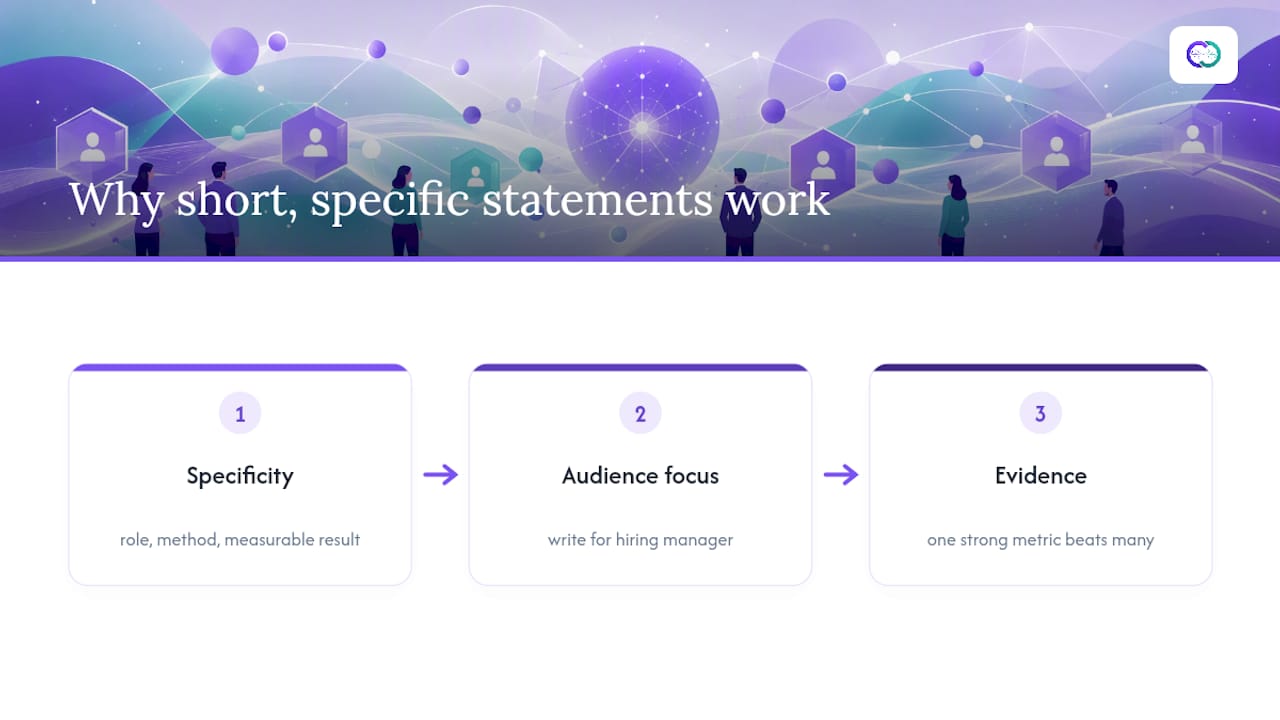
Specificity wins because vague claims are unfalsifiable and forgettable. “I’m a results-oriented marketer” tells a recruiter nothing; “I help B2B SaaS companies cut customer acquisition costs through lifecycle email” tells them exactly who to route you to. Effective statements follow a structure close to I distinct capability for audience to outcome, and templates that combine role, method, and a measurable result consistently outperform generic ‘results-driven’ framing.
Audience focus means writing for a hiring manager, not a peer. This is the basis of what career coaches call the stranger test: if someone who just met you can’t repeat back who you help and what you deliver, the language is too dense or too internal.
Evidence anchors the claim. A single strong metric beats a pile of disconnected ones, according to guidance on proof points in branding statements. “Reduced onboarding time 40%” does more work than three vague accomplishments listed side by side.
Pro Tip: Read your statement out loud to someone outside your field. If they can’t repeat the gist back to you in their own words, cut the jargon before you touch anything else.
10 Personal Brand Statement Examples by Role
Each example below follows the “who, what, outcome” shape, with a note on what makes it work and how to adapt it.
-
Marketing manager: “I help mid-market e-commerce brands grow repeat purchase rate through lifecycle email and SMS.” Why it works: names a specific channel and metric instead of “marketing strategy.” Adaptation tip: swap the channel for whatever you actually own (paid social, content, retention).
-
Software engineer: “I build reliable payment infrastructure for fintech startups so they can scale without downtime.” Why it works: pairs a technical domain with a business consequence a non-engineer understands. Adaptation tip: replace “payment infrastructure” with your specific stack or system.
-
Product manager: “I turn messy customer feedback into shipped features for B2B SaaS teams.” Why it works: uses a verb (“turn”) that implies process, not just a job title. Adaptation tip: name the type of company or product stage you specialize in.
-
Engineering leader: “I help early-stage startups build engineering teams that ship without burning out.” Why it works: signals both technical credibility and management skill in one line. Adaptation tip: swap “early-stage startups” for your actual company-size focus.
-
Career pivoter (teaching to UX): “I design intuitive digital experiences by applying a decade of classroom-tested communication skills.” Why it works: reframes a nontraditional background as an asset instead of hiding it. Adaptation tip: name the transferable skill explicitly rather than implying it.
-
Content creator: “I help solo consultants turn expertise into short-form video that books discovery calls.” Why it works: connects the content format directly to a business outcome (booked calls), not just “views.” Adaptation tip: swap the outcome metric for whichever one your audience actually cares about.
-
Independent consultant: “I help manufacturing companies cut waste through lean process audits, typically within one quarter.” Why it works: adds a timeframe, which makes the promise feel concrete and testable. Adaptation tip: only include a timeframe you can defend if asked.
-
Remote-first operations lead: “I keep distributed teams aligned across time zones using async documentation systems.” Why it works: names the specific problem (time zone misalignment) rather than a generic “operations” label. Adaptation tip: name the tool or method you actually rely on.
-
Operations manager: “I streamline vendor onboarding for healthcare startups so compliance stops slowing down growth.” Why it works: names an industry constraint (compliance) that signals real domain knowledge. Adaptation tip: replace the constraint with whichever bottleneck you’ve actually solved.
-
Early-career professional: “I help nonprofit teams organize donor data so fundraising campaigns launch on time.” Why it works: early-career statements can lean on a specific project or internship outcome instead of years of experience. Adaptation tip: use your most concrete accomplishment, even from a single internship, rather than a generalized aspiration.
Across all ten, the pattern holds: naming the audience and outcome together makes a statement more actionable and easier to customize than any version built around adjectives like “passionate” or “driven.”
Templates and Frameworks to Build Your Own Statement
Two formats cover most situations. Pick based on career stage and how much proof you have ready.
Format 1: “I [do] for [who] to [outcome].” This is the workhorse structure, and it holds up whether you’re five years into a career or writing your first bio.
- “I write technical documentation for developer tools companies to cut onboarding time in half.”
- “I lead cross-functional launches for consumer apps to hit ship dates without scope creep.”
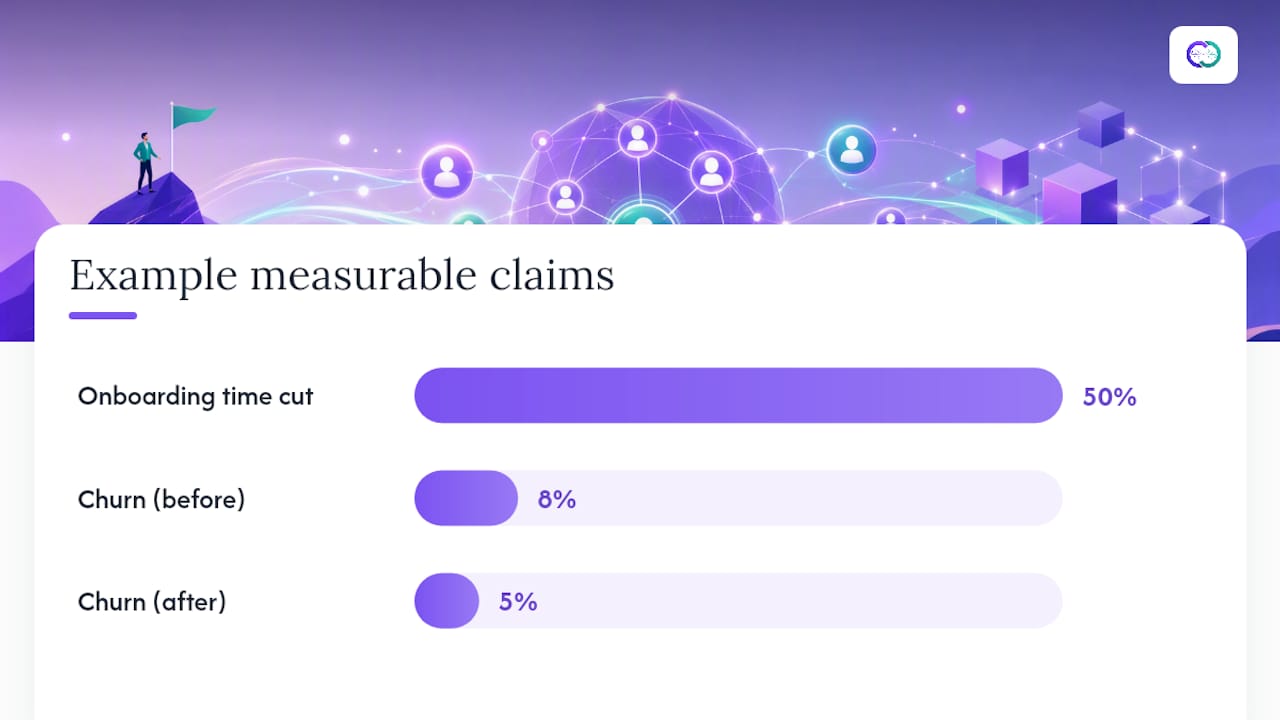
Format 2: V.I.P. (Value, Identity, Proof). State the value you provide, anchor it to your professional identity, then back it with a concrete proof point. This works well once you have a specific metric or case worth citing.
- Value: “I improve retention for subscription businesses.” Identity: “As a lifecycle marketer with a background in behavioral data.” Proof: “I’ve moved churn from 8% to 5% at two companies.”
- Value: “I ship accessible interfaces.” Identity: “As a front-end engineer focused on WCAG compliance.” Proof: “My last three projects passed audit on the first review.”
Early-career professionals with limited metrics should default to Format 1 and lean on a specific project instead of a number. Anyone with a track record of measurable results should reach for V.I.P., since the proof clause is what separates a claim from a fact.
How to Draft, Test, and Refine Your Statement
- Collect three proof points. Pull specific outcomes from past roles, projects, or reviews before you write a single sentence.
- Draft three variants. Write one version each using Format 1, V.I.P., and a hybrid, so you have real options to compare instead of endless tweaks to one line.
- Run the stranger test. Read each variant to someone outside your field and see which one they can repeat back accurately.
- Deploy in one placement first. Put your strongest variant in a single spot, usually your LinkedIn headline, rather than changing everything at once.
- Measure for two to four weeks. Track profile views, recruiter messages, and connection requests as your early signal.
- Iterate based on signal, not guesswork. Treat the statement as a live asset that gets refined as new evidence and roles accumulate, not a one-time task you finish and forget.
Pro Tip: Test two variants over the same four-week window on different platforms (LinkedIn headline vs. bio) rather than sequentially. It isolates the placement effect from natural changes in your outreach volume.
Common Mistakes and a Fast Editing Checklist
The same handful of errors show up across most first drafts.
- Jargon overload. Terms like “synergistic thought leader” mean nothing to someone outside your niche.
- No named audience. A statement that doesn’t say who you help forces the reader to guess.
- Missing proof. Claims without a metric or example read as marketing filler.
- Trying to say everything. Cramming five skills into one sentence dilutes all of them.
Run each draft through this checklist: Is it clear to someone outside your field? Does it name a specific audience? Does it include one piece of evidence? Is it under three sentences? Does it use active verbs instead of passive ones?
Before: “I am a dynamic professional passionate about driving results and delivering value across teams.” After: “I help mid-size retail brands reduce inventory waste through demand forecasting.”
The rewrite cuts word count by roughly a third and replaces every abstract adjective with a concrete claim. That kind of edit matters more than length. A statement stuffed with buzzwords fails the stranger test even when it’s grammatically polished, because “corporate robot” phrasing is exactly what recruiters skim past without registering.
Where to Place It and How to Know if It’s Working
Not every placement carries equal weight. Prioritize by visibility and context.
- LinkedIn headline: highest visibility, seen before anything else on your profile, worth testing first.
- About section: more room for a Format 1 or V.I.P. version with proof included.
- Resume summary: replaces a generic objective line with a specific, screenable claim.
- Spoken elevator pitch: same core claim, different delivery, adjusted for tone and length in live conversation.
Measure results over a two to four week window per variant, since shorter windows rarely produce enough signal. Watch profile views, inbound recruiter messages, and connection request quality. If a variant produces more views but fewer meaningful messages, the language may be broad rather than specific, a signal to sharpen the audience clause rather than the outcome clause.
Why Evidence-Backed Portfolios Strengthen Your Statement
A statement claiming “I reduced churn 20%” is only as strong as a recruiter’s willingness to believe it. Unverifiable claims create hesitation, especially when a candidate pool is large and every resume makes a similar promise. Pairing a one-line statement with linked, inspectable evidence closes that gap.
A verified portfolio lets a claim point directly to its source: the dashboard, the case study, the shipped feature. Instead of asking a candidate to elaborate in an interview, a recruiter can inspect the proof immediately.
- State the outcome in your statement, then link one or two pieces of evidence that support it directly.
- Keep evidence specific: a single dashboard screenshot beats a general project description.
- Update evidence as new results come in, so the statement and the proof stay in sync.
This is the model a platform like Alloquy is built around: a statement makes the claim, and a linked document or case study lets the recruiter check it without a follow-up email.
Why Iteration Beats a Perfect First Draft
Most people write a statement once and never touch it again, which is backwards. The professionals who see real movement, more profile views, more recruiter replies, treat the statement the way a product team treats a landing page: something to test, not something to finish.
The instinct to overclaim is understandable and usually counterproductive. A specific, modest claim backed by real evidence outperforms a sweeping one that a recruiter can’t verify. Evidence changes as careers move forward. A statement that fit your role two years ago rarely fits the one you’re chasing now, which is exactly why it deserves revisiting every time you land a new project worth citing.
— Alloquy Team
Publish an Evidence-Backed Profile to Back Up Your Statement
A sharp one-line statement gets attention. What keeps that attention is proof a recruiter can actually check. Alloquy connects your statement directly to the work behind it: link your Google Drive documents, and its AI assistant answers recruiter questions using your verified achievements instead of a static bullet list.
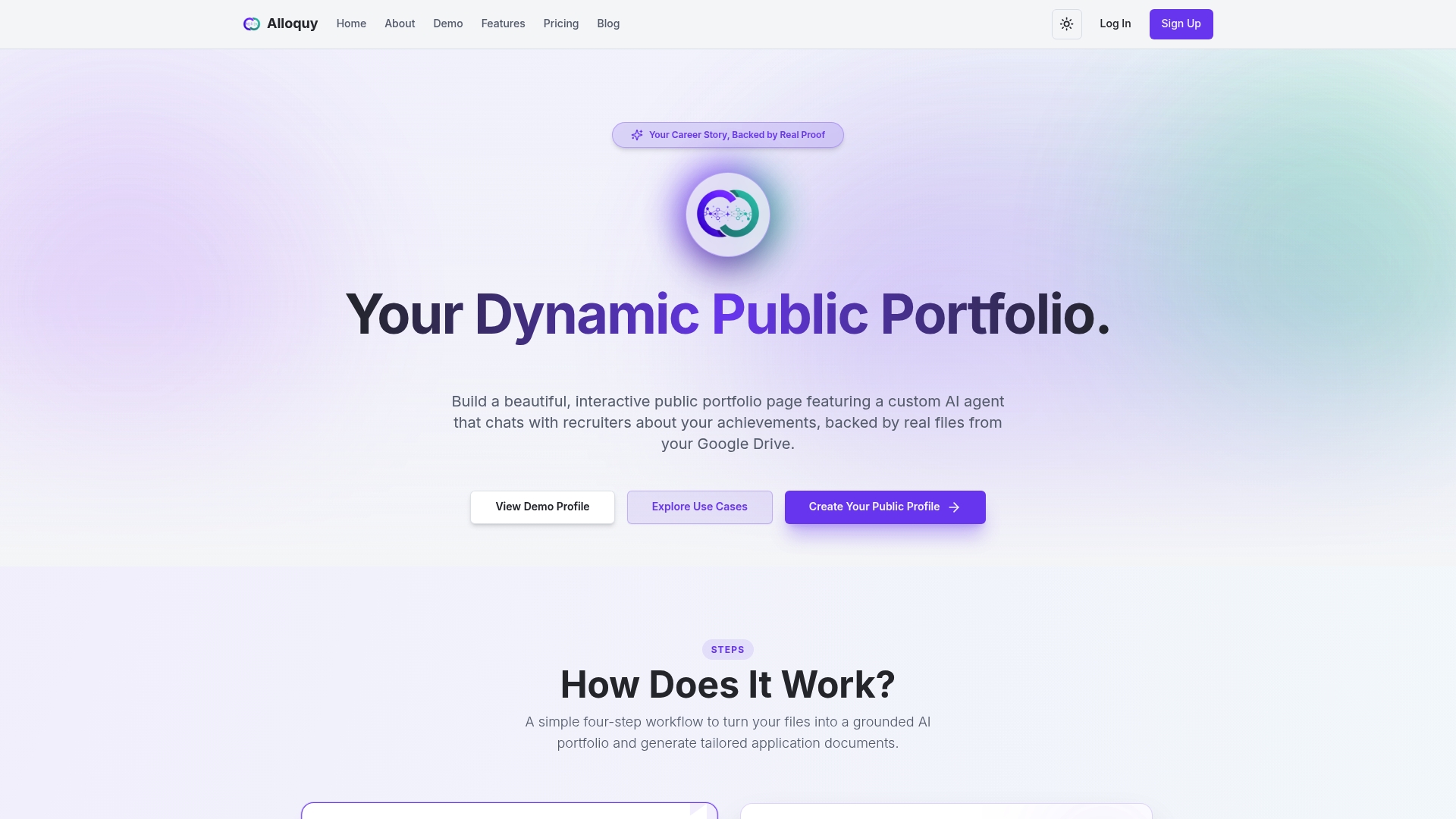
Where a resume asks recruiters to take your word for it, Alloquy lets them query the evidence themselves, turning your one-line claim into a browsable, question-answerable case for why you’re the right fit. The free profile gets you a working page in minutes, with customizable branding and the option to generate tailored application documents once your evidence is linked. If you’ve just drafted a statement using the templates above, the next step is simple: create a free profile and attach the proof points behind it.
Sources
For further guidance, see Forbes on crafting brand statements, The Meaning Movement’s stranger test, and Shopify’s structural breakdown.
- Personal Branding Statement (Defining Your USP) - ControlInterview
- Personal brand statement guide — The Meaning Movement
- Personal brand elevator pitch examples — Confidence Playbook
FAQ
What Is a Personal Brand Statement?
A personal brand statement is a one to three sentence summary of who you help, what you do, and the outcome you deliver. It’s meant for quick placements like a LinkedIn headline or resume summary, not a full biography.
How Is a Brand Statement Different From an Elevator Pitch?
A brand statement is the written, static version used in profiles and resumes, while an elevator pitch is the spoken version delivered in networking conversations. Both should share the same core claim but adjust length and tone for the setting.
How Long Should a Personal Brand Statement Be?
One to three sentences is standard, short enough to fit a LinkedIn headline or the opening line of a bio. Longer versions tend to lose the specific audience and outcome that make the statement useful in the first place.
How Often Should I Update My Statement?
Update it whenever you gain a new proof point worth citing, a new role, or a new metric, since career-development guidance frames the statement as a living asset rather than a one-time task. Most people benefit from revisiting it every few months.
Does Alloquy Help With Personal Brand Statements?
Alloquy doesn’t write the statement for you, but it gives the claim somewhere to point. Its free profile lets you link verified documents so recruiters can inspect the evidence behind whatever your statement claims.