

The highest-leverage AI portfolio projects share one trait: they resolve into a measurable outcome a recruiter can verify in under a minute. Five project types consistently outperform the rest. A document Q&A system built on retrieval-augmented generation (RAG) demonstrates you can ground a model in real data instead of letting it hallucinate. A deployed coding assistant proves you can ship, not just prototype. A structured-data extraction pipeline shows you can turn messy inputs into usable schemas. A reproducibility and evaluation brief signals engineering honesty. A tool-using agent demonstrates you can orchestrate decisions, not just generate text.
Each type earns its place on this list for a specific reason:
- RAG document assistant: proves you can constrain a model to verifiable sources instead of free-floating generation.
- Deployed coding assistant: proves deployment competence, the single most-filtered-for signal in early recruiter screens.
- Structured-data extraction pipeline: proves you can handle real-world messiness, not toy datasets.
- Reproducibility/evaluation brief: proves engineering maturity through documented failure analysis.
- Tool-using agent: proves you can design decision logic, not just prompt a chatbot.
Pro Tip: Pick the one project type that maps most directly to your target role, then deploy a minimal public demo before building a second project. A single live, well-documented system beats three that only run locally.
Key Takeaways
Recruiter-ready AI portfolios succeed when a project’s outcome, evaluation, and live demo are all visible within the first thirty seconds of a scan.
| Point | Details |
|---|---|
| Depth over volume | Two to three deeply evaluated projects outperform five shallow ones for most career stages. |
| Outcome goes first | Place your one-sentence result at the top of both the project page and the README. |
| Freeze your eval set | Use at least 50 test cases, including adversarial and out-of-domain inputs, before tuning further. |
| Deploy something reliable | A working demo with a health check beats an ambitious project that errors out on click. |
| Show verifiable evidence | Alloquy links your Google Drive files into a queryable public profile recruiters can question directly. |
Table of Contents
- What Recruiters Actually Look for in AI Portfolios
- Ten Recruiter-Ready AI Portfolio Examples You Can Build
- The One-Page Case Study Template That Actually Gets Read
- Deployment Checklist for a Demo That Never Breaks
- How Alloquy Helps You Present Verified, Evidence-Backed Work
- How to Pick the Right Project for Your Target Role
- GitHub Hygiene and the Evaluation Metrics Recruiters Trust
- Visual Storytelling Techniques That Make AI Projects Memorable
- Common Mistakes That Push Recruiters Away
- Highlighting Teamwork in AI Projects Without Overstating Your Role
- Why Most Portfolio Advice Undersells the README
- Turn Your Projects Into Evidence Recruiters Can Query
- Sources
- FAQ
What Recruiters Actually Look for in AI Portfolios
Recruiters spend seconds, not minutes, on an initial portfolio scan. What survives that scan is not sophistication. It is legibility: a visible problem, a visible outcome, and a working link.
Research on recruiter behavior consistently identifies the same short list of signals that separate a portfolio that gets a callback from one that gets closed in a tab: problem-solving clarity, measurable outcomes, and evidence of authorship. A project that cannot state its outcome in one sentence rarely gets read past the title.
Here is the checklist that matters, roughly in the order a recruiter applies it:
- A clear problem framed in one sentence at the top of the page, not buried under an architecture diagram.
- A measurable outcome tied to a number, an accuracy figure, a latency reduction, a cost saving, anything concrete.
- A live demo or public URL that works when clicked, not a screenshot promising it worked once.
- A concise README a recruiter can scan in under two minutes, including an architecture note and an evaluation section.
- Honest limitations stated plainly, because a project with zero acknowledged weaknesses reads as untested rather than flawless.
- Visible evidence you built it, meaning commit history, a demo video, or a written decision log, not just a polished output.
Placement matters as much as content. The outcome sentence belongs at the very top of the page and again at the top of the README, because engagement rises sharply when the result is visible before the technical detail. Bury the win under three paragraphs of setup instructions and most reviewers never reach it.
Portfolio size should scale with career stage. Mid-level candidates do better with two to three deeply polished projects than five shallow ones. Senior candidates can support three to five, provided each one still meets the checklist above. Depth beats volume at every level, and industry guidance from 2026 hiring analyses converges on that same two-to-three rule for a reason: a recruiter who finds one weak project in a set of ten often stops looking at the other nine.
Ten Recruiter-Ready AI Portfolio Examples You Can Build
These ten blueprints cover the competencies hiring teams actually screen for. Each one lists the goal, why it lands with recruiters, the minimum deliverables, a metric worth reporting, and a lean tech stack.
1. Document RAG assistant. Goal: answer questions grounded in a defined document set, such as a company’s public 10-K filings or a set of open-source licensing terms. This matters to recruiters because retrieval-augmented generation is one of the highest-demand skills in current hiring markets. Deliverables: a live demo, a README with retrieval accuracy on a held-out question set, and a public repo. Metric: answer-grounding accuracy against a labeled set of 50 or more questions. Stack: a vector store, an embedding model, a lightweight orchestration layer. The decision point that makes it original: choosing a genuinely awkward document set (contracts with inconsistent formatting, scanned PDFs) instead of clean Wikipedia text.
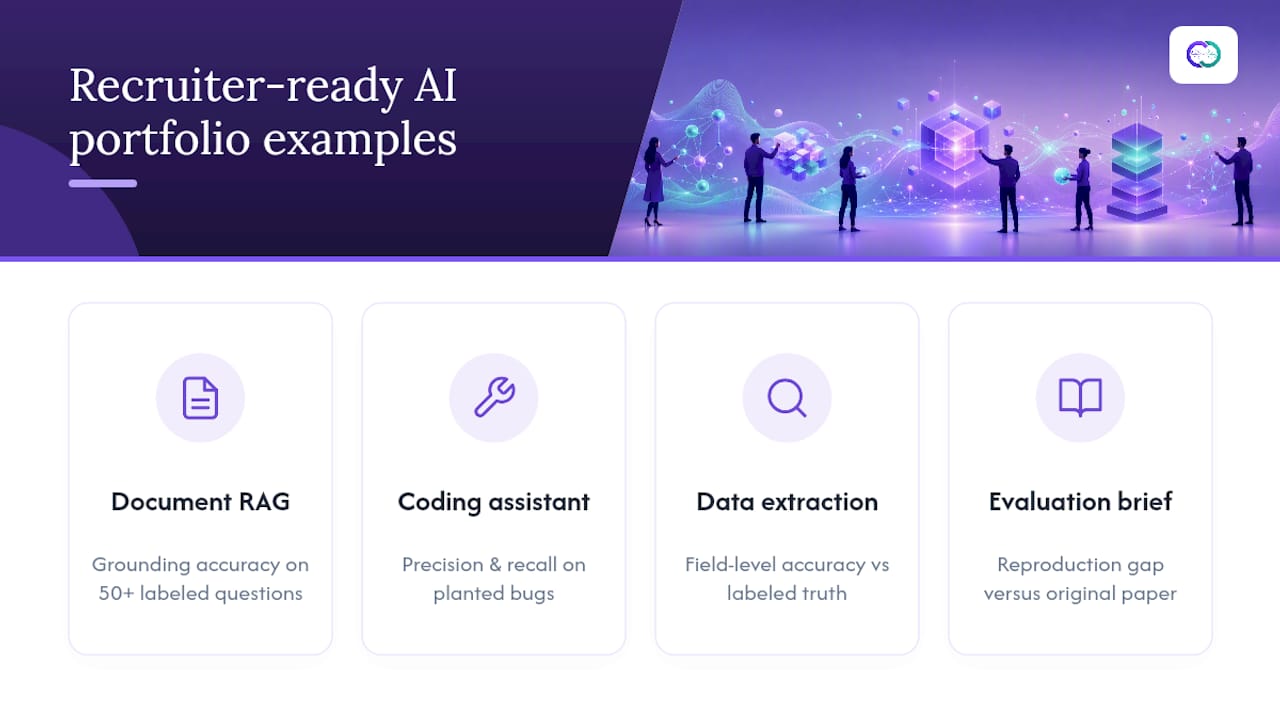
2. Deployed coding assistant. Goal: a tool that reviews pull requests or suggests fixes for a specific language or framework. It matters because it proves you can ship a working service, not just fine-tune a notebook. Deliverables: a live endpoint, a short screen recording of a real review, and error handling for malformed input. Metric: precision and recall on a frozen set of known bugs you planted yourself. Stack: an AST parser for the target language, an LLM API, a simple queue for job handling. Original decision point: writing your own adversarial test cases rather than relying on a public benchmark.
3. Structured-data extraction pipeline. Goal: convert unstructured text, receipts, medical intake forms, resumes, into a defined schema. It matters because most real business data is messy, and recruiters want proof you can handle that mess. Deliverables: a schema definition file, a demo processing five sample documents, and an error log. Metric: field-level extraction accuracy against manually labeled ground truth. Stack: an OCR layer if needed, a schema validator, an LLM for ambiguous fields. Original decision point: the schema design itself, particularly how you handle missing or contradictory fields.
4. Evaluation and reproducibility brief. Goal: take a published model or technique and rigorously reproduce its claimed results, then document where they hold and where they break. It matters because a modest, well-evaluated project with an honest write-up outperforms an ambitious but unreproducible demo. Deliverables: a written brief, code, and a frozen test set. Metric: reproduction gap versus the original paper’s reported numbers. Stack: whatever the original paper used, kept identical for fair comparison. Original decision point: picking a paper with a plausible but unverified claim, then showing exactly where it falls apart.
5. Forecasting dashboard tied to a business metric. Goal: forecast something with real stakes, churn, demand, staffing, and connect the model output to a dollar or headcount impact. It matters because it bridges technical output to business language, which is what hiring managers outside pure research roles care about. Deliverables: a dashboard, a model card, and a stated business interpretation of the forecast error. Metric: mean absolute percentage error alongside an estimated cost of that error. Stack: a time-series model, a dashboarding tool, a small database. Original decision point: translating a statistical error metric into a plain-language cost statement.
6. Multimodal proof of concept. Goal: combine image and text, such as classifying product photos and generating matching descriptions. It matters because multimodal systems are increasingly common in production and rarely appear in junior portfolios. Deliverables: a working demo, sample inputs and outputs, and failure cases. Metric: classification accuracy plus a qualitative review of generated text quality. Stack: a vision model, a language model, a simple web frontend. Original decision point: choosing a domain with genuinely ambiguous images, not clean product catalog photos.
7. Small-scale productionized model with cost tracking. Goal: deploy a model with an explicit budget constraint, capped API spend, a fixed compute ceiling, and document how you engineered around it. It matters because cost-awareness is an underrated signal of production maturity. Deliverables: a live demo with a visible spend cap, and a written note on cost-per-query. Metric: cost per 1,000 requests. Stack: a serverless function, a rate limiter, a lightweight model where possible instead of a large API call. Original decision point: the budget ceiling itself, and the tradeoffs you made to stay under it.
8. Tool-using agent. Goal: an agent that calls two or three real tools, a calendar API, a search function, a calculator, to complete a multi-step task. This is a high-leverage project type for 2026 hiring cycles because orchestration skill is harder to fake than single-turn prompting. Deliverables: a demo video showing a multi-step task, and a log of tool calls made. Metric: task completion rate across a fixed set of test scenarios. Stack: an orchestration framework, two or three real APIs, logging middleware. Original decision point: designing scenarios where the agent must recover from a failed tool call.
9. Domain-focused pipeline. Goal: build a narrow tool for a domain you know well, legal clause comparison, clinical note summarization, supply chain anomaly detection. It matters because domain fluency signals you understand the problem, not just the model. Deliverables: a demo, sample outputs reviewed against domain expertise, and a note on regulatory or ethical constraints where relevant. Metric: domain-expert-reviewed accuracy on a small sample. Stack: whatever fits the domain, often simpler than generalist projects. Original decision point: the domain choice itself, ideally one tied to your actual work history.
10. Usability-focused AI case study. Goal: take an existing model and design the interface and interaction flow around it, then test it with real users. It matters especially for design and product-adjacent roles where model quality is secondary to how people actually use the tool. Deliverables: a demo, a short usability test summary, and before-and-after interface iterations. Metric: task completion time or user-reported confidence score. Stack: any capable model, paired with a prototyping tool. Original decision point: the specific usability friction you identified and how you addressed it.
The One-Page Case Study Template That Actually Gets Read
A project without a written case study is a demo. A project with one is evidence. The distinction matters because a case study becomes verifiable proof only when it documents your decisions, publishes a frozen evaluation set, and reports honest failures alongside its metrics.
Structure the one-pager in this order:
- TL;DR outcome. One or two sentences stating what the project does and what it achieved, placed above everything else.
- Problem and stakeholders. Who would care about this, and why the problem is real rather than invented for the portfolio.
- Dataset and challenges. What data you used, where it came from, and what made it harder than a tutorial dataset.
- Approach highlights, including the key decision. The one choice, a schema design, a model architecture, a data filter, that shaped the whole project.
- Frozen evaluation set and metrics. How you measured success, and on what fixed set of test cases.
- Results, technical and business. The numbers, plus what those numbers mean outside the model itself.
- Lessons learned and next steps. What you would change, and what you would build next.
- Links to demo and code. Both, working, at the bottom.
The README needs the same top-to-bottom logic: outcome first, then a short architecture note, then setup instructions, then the evaluation section, then known limitations. A README with a runbook, an architecture diagram, and an evaluation method substantially raises the odds a recruiter engages further.
Compare these two outcome statements.
A modest, well-evaluated project with an honest write-up beats an ambitious but unreproducible demo. Reviewers trust documented failure more than an unbroken string of claimed successes.
An honest limitations paragraph names a specific failure mode, states roughly how often it occurs, and explains why you did not fix it, whether that is time, data availability, or scope. Vague hedging (“performance may vary”) reads as filler. Specific hedging (“fails on documents scanned at under 150 DPI”) reads as engineering judgment.
Deployment Checklist for a Demo That Never Breaks
A demo link that returns an error is worse than no demo at all, because deployability itself is one of the clearest filters recruiters apply between a portfolio that gets forwarded and one that gets closed.
Keep the architecture minimal and boring on purpose:
- Package the app in a container so it runs identically wherever you deploy it.
- Serve it through FastAPI or Streamlit, both fast to stand up and easy for a recruiter to click through.
- Add a health-check endpoint so you know instantly if the demo goes down.
- Validate inputs and fail gracefully; an unhandled exception on a recruiter’s first click is fatal to the impression.
- Set a hard spend cap on any paid API the demo calls, since a viral link with no ceiling can produce a surprise bill.
- Provide default sample inputs so a visitor can test the demo in one click without typing anything.
Pro Tip: If your demo depends on an expensive or rate-limited API, record a 60-second screen capture as a fallback and embed it directly on the page. A recruiter who hits a rate limit assumes the project is broken, not that it is popular.
A short recording is also the better choice when the underlying model is too large or too costly to host continuously. Reserve a live endpoint for projects genuinely light enough to run affordably around the clock.
How Alloquy Helps You Present Verified, Evidence-Backed Work
The gap between a project that exists and a project a recruiter believes is entirely about evidence. Alloquy addresses that gap directly by linking your Google Drive documents, code artifacts, and write-ups into a public profile backed by a custom AI assistant that recruiters can query for verified detail.
That structure maps onto the recruiter checklist point for point:
- Evidence linking turns your case study, README, and supporting documents into a queryable source instead of a static page a recruiter has to dig through manually.
- Recruiter-accessible AI chat lets a hiring manager ask a specific question about your evaluation set or a design decision and get an answer sourced from your actual documents.
- Privacy controls let you decide exactly what evidence is public versus available only on request.
- Interactive case studies replace a flat PDF with a format that supports follow-up questions, closer to how a technical interview actually unfolds.
Evidence-backed portfolios convert a static claim into a queryable proof point, which is exactly the mechanism recruiters trust more than a resume line.
A platform layer like this earns its keep once you are managing more than one or two projects, or once you want recruiters to discover your work without a cold outreach. A single, simple demo with a clean README is often enough on its own for a first project. The platform becomes valuable when the portfolio needs to scale.
How to Pick the Right Project for Your Target Role
Match the project type to the job description you are targeting, not to whatever tutorial you finished most recently. A machine learning engineer role wants a deployed coding assistant or a RAG system with real evaluation numbers. A data science role responds better to the forecasting dashboard tied to a business metric, since it proves you can translate model output into a decision. A product or design-adjacent AI role should lean on the usability-focused case study, because interface judgment matters more there than raw model performance.
Career stage changes the bar, not the category. An entry-level candidate can succeed with one deeply documented project instead of a shallow portfolio of five. A mid-level candidate benefits from two to three, ideally covering distinct competencies, retrieval, deployment, evaluation, so a recruiter sees range without wading through repetition. A senior or staff-level candidate needs at least one project that demonstrates a real constraint, a budget ceiling, a latency requirement, a compliance rule, since that is what distinguishes senior judgment from technical execution alone.
If you are switching fields entirely, weight your project selection toward the domain-focused pipeline. A supply chain analyst moving into AI roles gains more credibility from an anomaly-detection pipeline built on real logistics data than from a generic chatbot, because it signals domain fluency the model alone cannot prove. Choose the project that answers the specific doubt a hiring manager in that role would have about you, and build directly against that doubt.
GitHub Hygiene and the Evaluation Metrics Recruiters Trust
A public repository with no commit history, no tests, and a single giant notebook signals a project assembled the night before applying. Clean structure signals the opposite: folders separating data processing, model logic, and evaluation, a requirements file that actually installs, and commit messages that show incremental work over time rather than one dump.
The evaluation section is where most portfolios fall short, and where the strongest ones separate themselves. A small frozen evaluation set, at least 50 cases, paired with at least one documented failure, demonstrates honest engineering judgment far more convincingly than a single accuracy number with no context. “Frozen” means the test set never changes once evaluation begins, so you cannot quietly cherry-pick easier cases after seeing early results.
Build that evaluation set deliberately rather than sampling randomly. Include adversarial inputs designed to break the system, cases with missing or malformed fields, and out-of-domain examples the model was never meant to handle well. Documenting how the system fails on each category tells a reviewer more than a clean 95% accuracy figure ever could, because it proves you understand the system’s edges rather than just its average behavior.
Report cost alongside accuracy wherever an API or GPU is involved. A note stating “$0.004 per query at current pricing” signals production awareness that pure accuracy metrics never capture. Pair every metric with the size and composition of the set it was measured against; an accuracy figure with no denominator is not a metric, it is a claim.
Visual Storytelling Techniques That Make AI Projects Memorable
The strongest AI portfolio pages use restraint, not decoration. A single architecture diagram showing data flow from input to output does more work than three separate charts competing for attention. Keep that diagram to five or six boxes maximum; anything denser reads as noise on a first scan.
Before-and-after comparisons carry unusual weight in AI portfolios specifically, because they show the model’s actual behavior rather than a description of it. A raw, messy input document next to the clean structured output it produced tells a story in two images that a paragraph of text cannot match. The same principle applies to a coding assistant: show the flawed pull request beside the suggested fix.
A short demo video, 60 to 90 seconds, consistently outperforms a static screenshot gallery because it proves the system runs in real time under real conditions. Narrate it briefly, stating the input, the action, and the result in plain language, rather than a silent screen capture the viewer has to interpret alone.

Color and layout should stay secondary to legibility. A dense wall of code screenshots signals effort without signaling clarity. Whitespace around your outcome statement, your metric, and your architecture diagram helps a recruiter’s eye land exactly where you want it, on the result, not on how much you built.
Common Mistakes That Push Recruiters Away
The single most damaging pattern is a portfolio built entirely from tutorial projects with no independent decisions layered on top. When a project is indistinguishable from a public tutorial, it removes the exact evidence reviewers check for: the decision points, the measurement choices, the failure analysis. A recognizable Kaggle notebook with your name swapped in reads as a copy, not proof of skill.
A dead demo link is the second most common failure, and often the most avoidable. Set a reminder to test every public demo monthly, since free-tier hosting and API keys expire quietly and without warning.
Overclaiming accuracy without a stated test set size is a subtler but equally damaging mistake. A number with no denominator invites suspicion rather than confidence. Similarly, a README with no limitations section reads as either untested or self-unaware, neither of which helps you.
Finally, avoid burying the outcome under a wall of setup instructions. A recruiter who has to scroll past a dependency list to find out what your project actually does will often stop scrolling first.
Highlighting Teamwork in AI Projects Without Overstating Your Role
Group projects raise a fair recruiter question: which parts did you actually build? Answer it directly instead of hoping it goes unasked. State your specific contribution in the first paragraph of the case study, “I designed the retrieval pipeline and evaluation set; a teammate built the frontend,” rather than describing the project only in collective terms.
Commit history is the most credible evidence of individual contribution available, since it shows exactly which files and functions you touched over time. Link to your specific commits or pull requests rather than the repository as a whole when the project involved more than one contributor.
If the project came out of a hackathon, an internship, or a research group, name that context plainly. It does not diminish the work, and hiding it reads worse than disclosing it. What matters to a recruiter is whether your individual reasoning is visible: a design decision you made, a bug you diagnosed, an evaluation approach you proposed that the team adopted. Describe that reasoning in your own words rather than describing the team’s collective output and hoping your role is implied.
Why Most Portfolio Advice Undersells the README
The conventional wisdom treats the README as documentation, something you write after the real work is done. That framing gets the priority backward. The README is frequently the only part of a project a recruiter actually reads in full, which makes it closer to the product than to an appendix.
Most advice also overweights project count. Five mediocre repositories create five separate opportunities for a recruiter to lose confidence, while two genuinely rigorous ones create two opportunities to build it. The research on this is consistent: a small number of deeply evaluated projects consistently outperforms a large, shallow set.
What the article’s evidence actually supports is a narrower priority than most guides suggest: pick one project, document the decisions inside it honestly, freeze an evaluation set before you start tuning against it, and deploy it somewhere that will not silently go dark in three weeks. Everything else, the visual polish, the second and third project, the framework choice, matters less than whether that first piece of evidence survives a skeptical read.
Turn Your Projects Into Evidence Recruiters Can Query
Building a strong project is only half the problem. Getting a recruiter to actually trust the numbers you report, without a live call to walk them through your decisions, is the harder half. Alloquy closes that gap by turning your Google Drive documents, case studies, and code artifacts into a public profile with a custom AI assistant recruiters can question directly about your evaluation set, your architecture choices, or your reported metrics.
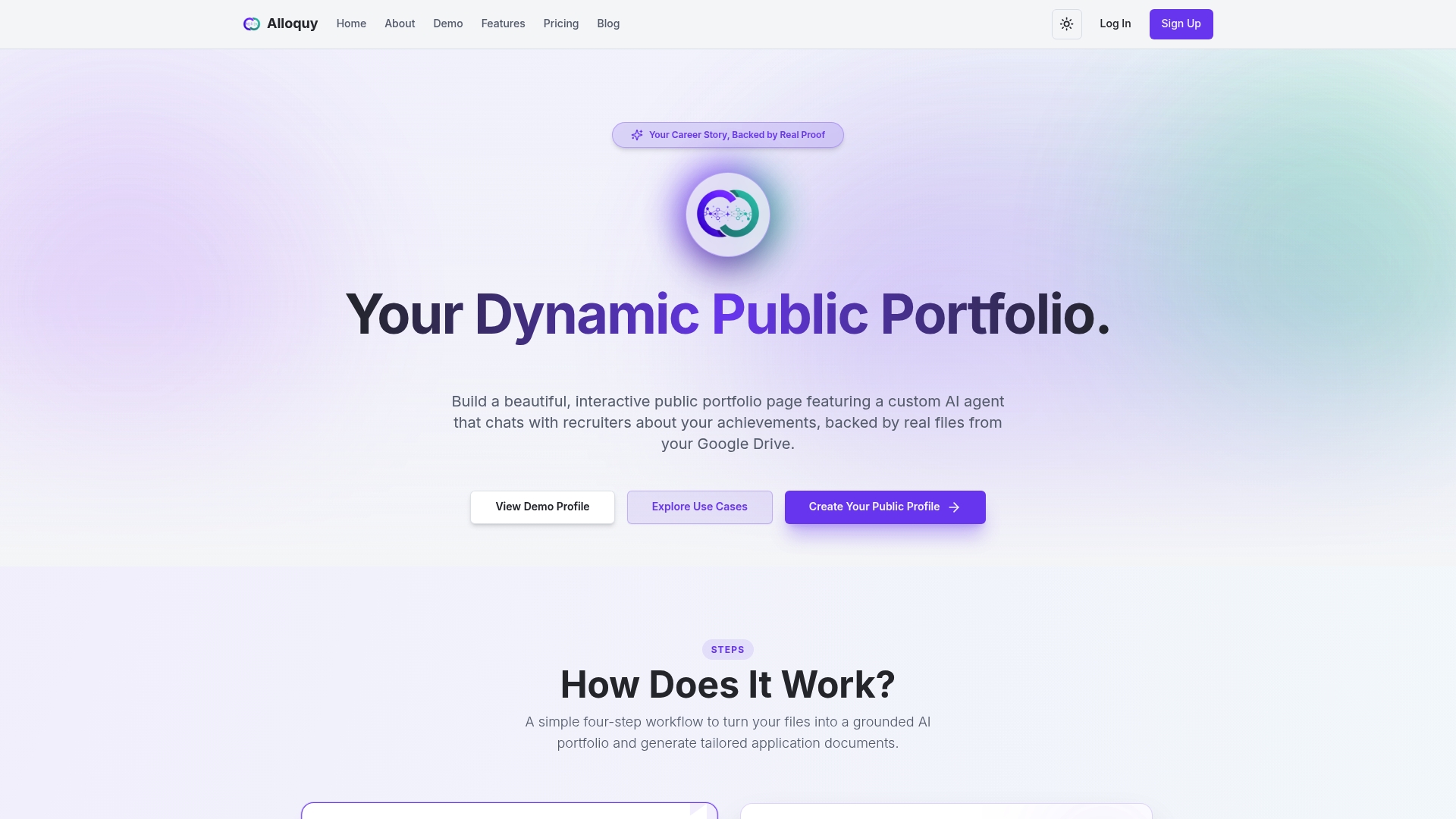
Instead of hoping a recruiter reads your entire README, Alloquy lets them ask a specific question and get an answer sourced from your actual evidence, at any hour, without waiting on you to respond. The feature set includes customizable branding, interactive case studies, and generation of tailored resumes and cover letters pulled from the same verified data backing your public profile.
A free tier lets you build and test a profile with limited functionality before committing to anything. When you are ready to add more evidence storage, AI generation capacity, and full case study features, check the subscription plans and pick the tier that matches how many projects you are actively showcasing.
Sources
- What Recruiters Actually Look for in AI Portfolios · Activated Thinker
- Building an AI Portfolio That Gets You Interviews · Multigrid
- The AI Engineer Portfolio That Gets You Hired in 2026: Proof-of-Work Over Résumés — AI Tech Connect
FAQ
What is a good AI portfolio?
A good AI portfolio has two to three deployed projects, each with a live demo, a concise README, a frozen evaluation set, and an honest limitations section that shows real engineering judgment.
What is an AI portfolio?
An AI portfolio is a collection of deployed projects and documented case studies that prove you can build, evaluate, and ship AI systems, rather than a resume that only claims those skills.
What are some good examples of AI portfolio projects?
Strong examples include a document RAG assistant, a deployed coding assistant, a structured-data extraction pipeline, a reproducibility and evaluation brief, and a tool-using agent, each paired with a measurable outcome.
How many projects should be in an AI portfolio?
Most guides converge on two to three polished, deployed projects for mid-level candidates and up to five for senior candidates, since depth of evaluation matters more than raw project count.
How can I make my AI portfolio more recruiter-friendly?
Place your outcome statement at the top of the page, keep the README scannable in under two minutes, deploy a working demo, and use a platform like Alloquy to let recruiters query your evidence directly instead of hunting through documents themselves.