

A no code portfolio, in the sense that matters for hiring decisions, is an interactive profile that pairs a candidate’s verified documents with an AI assistant capable of answering recruiter questions and citing the exact evidence behind each answer. The core benefit is speed with accountability: recruiters get grounded responses instead of a static biography, and every claim traces back to a source document. The candidate retains control over what gets exposed, redacting sensitive material before anything goes public.
TL;DR:
- An evidence-backed no-code portfolio presents verified documents with source citations, enabling recruiters to verify claims quickly and accurately.
- Evaluating a platform requires checking for provenance, curated evidence, privacy controls, human oversight, and recruiter-friendly features to ensure reliability.
- Building such a portfolio involves document curation, tagging, linking, testing with recruiter questions, and careful redaction before publication.
- Ensuring compliance with privacy laws and anti-discrimination standards involves permissions, redactions, and maintaining human review, not automated decisions.
- Alloquy simplifies this process by allowing users to link documents, generate source-cited answers, and produce consistent application materials without coding.
Table of Contents
- Why recruiters prefer evidence-backed, queryable portfolios
- Core features and evaluation criteria for an evidence-backed no-code portfolio
- Step-by-step workflow to build a recruiter-ready, no-code portfolio
- Security, legal, and discrimination guardrails before you publish
- What evidence-first portfolios change for candidates
- How Alloquy helps you build and publish an evidence-backed portfolio
- Sources
- FAQ
Why recruiters prefer evidence-backed, queryable portfolios
Recruiting workflows revolve around screening, verifying experience, and checking references, and human resources specialists are trained to move through these tasks quickly while confirming that a candidate’s claims hold up. A portfolio built around retrieval-augmented Q&A serves that workflow directly: instead of skimming a resume for keywords, a recruiter can ask a direct question and receive an answer that names its source document, whether that is a performance review, a project brief, or a client email. This grounding is what separates an evidence-backed profile from a conventional bio page, and it shortens the verification step that otherwise consumes a recruiter’s time.
To make that exchange useful, a candidate’s portfolio should be prepared with recruiter-facing outputs in mind, not just an aesthetic layout.
- One-line achievement summaries that state the role, the action, and the measurable result.
- Direct links to the underlying evidence, whether a document excerpt or a project file.
- Dates and metrics attached to each claim so a recruiter can confirm timeline and scale without asking a follow-up.
Recruiters checking references and prior experience benefit from concise, sourced answers rather than long narrative text, a pattern consistent with both HR screening practices and retrieval research on grounded response generation, discussed further below.
Core features and evaluation criteria for an evidence-backed no-code portfolio
Not every AI-enabled profile builder delivers the same reliability, so evaluating a platform, or your own content within one, benefits from a short list of criteria grounded in retrieval and risk-management research.
- Retrieval and provenance. The assistant should show a source link or document identifier for every factual claim and ask a clarifying question rather than guess when evidence is missing, a practice consistent with retrieval-augmented generation evaluation criteria from NIST’s TREC RAG track.
- Curated evidence. Select artifacts deliberately, apply consistent naming, and tag each one for role relevance so retrieval returns the right document instead of a loosely related one.
- Privacy and permissions. Build in redaction, selective sharing, and storage controls before publishing, following the risk-management principles laid out in NIST’s Generative AI profile.
- Validation and human oversight. Require a candidate review gate before publishing, maintain a test-query suite, and keep a change log of what evidence was added or removed.
- Recruiter UX. Concise achievement cards, one-click access to evidence, and exportable tailored resumes reduce the friction of a recruiter’s first pass.
Pro Tip: Tag each artifact with a role-mapping label, such as “PM: roadmap led; metric: ARR +12%”, so the assistant can match a recruiter’s question to the correct document on the first attempt.
Retrieval quality determines whether the assistant feels trustworthy or evasive, and provenance is what lets a recruiter verify a claim in seconds rather than requesting a follow-up call.
Step-by-step workflow to build a recruiter-ready, no-code portfolio
Building an evidence-backed profile does not require writing code. It requires a disciplined sequence of curation, tagging, and testing.
- Curate source documents. Gather performance reviews, project briefs, client feedback, and metrics reports; apply consistent file names and metadata, and redact anything confidential or personally identifying before it enters the system.
- Write role-focused achievement summaries. Each summary should include a keyword a recruiter might search for, a date range, and a quantified outcome, following the structured, keyword-aware formatting BLS guidance recommends for database-driven applications.
- Link documents and tag artifacts. Set metadata fields recruiters will actually query, such as dates, metrics, and technologies used, so retrieval returns precise provenance rather than a generic match.
- Configure the assistant’s behavior. Set how it displays provenance, how it declines to answer when evidence is thin, and when it asks a clarifying question, mirroring the grounding and disambiguation practices documented in RAG evaluation research.
- Run a test suite. Draft a list of recruiter-style questions covering dates, ownership, and outcomes, then check every answer against its cited source and fix any gap before publishing.
- Publish selectively. Decide what belongs on a public profile versus what is shared only through a recruiter-specific link, then generate tailored resume and cover letter exports from the same verified source set.
A few habits make this sequence hold up over time.
- Revisit tags whenever a new artifact is added so retrieval stays precise.
- Re-run the test-query suite after any major content update.
- Keep a rollback option so an unverified claim can be pulled quickly if a source document changes or expires.
Readers building technical portfolios can see this workflow applied in practice through developer portfolio examples and in guidance on writing interactive case studies that map directly to recruiter queries.
Security, legal, and discrimination guardrails before you publish
AI tools used anywhere in recruiting and hiring remain subject to anti-discrimination law, and EEOC guidance is explicit that selection procedures must be job-related, validated, and open to human review and reasonable accommodation. A portfolio assistant should support that review rather than produce an opaque score that substitutes for it.

Human oversight remains a formal requirement, not a courtesy. NIST’s AI Risk Management Framework guidance treats pre-deployment testing and selective disclosure as standard practice for any public-facing generative AI system, which applies directly to a portfolio assistant answering recruiter questions.
Before publishing, work through a short checklist.
- Confirm you have permission to share every linked document.
- Remove personally identifying details and client-confidential material.
- Run the test-query suite one more time and review the change log.
- Keep a rollback path in case a claim needs to come down quickly.
Provide an alternate way for recruiters to reach a human contact, since an assistant is a supplement to a conversation, not a replacement for one.
What evidence-first portfolios change for candidates
An evidence-backed portfolio does not replace a recruiter’s judgment. It changes what a recruiter spends their attention on, shifting the conversation away from verifying basic facts and toward the substance of the work itself. That shift matters more for candidates whose experience is hard to summarize in bullet points: consultants, engineers, and freelancers whose value lives in the detail of a project, not its title.
The honest expectation is narrower than the marketing around AI hiring tools often suggests. An assistant with strong provenance makes a candidate’s claims easier to check, not automatically more impressive, and the underlying work still has to hold up.
— Alloquy Team
How Alloquy helps you build and publish an evidence-backed portfolio
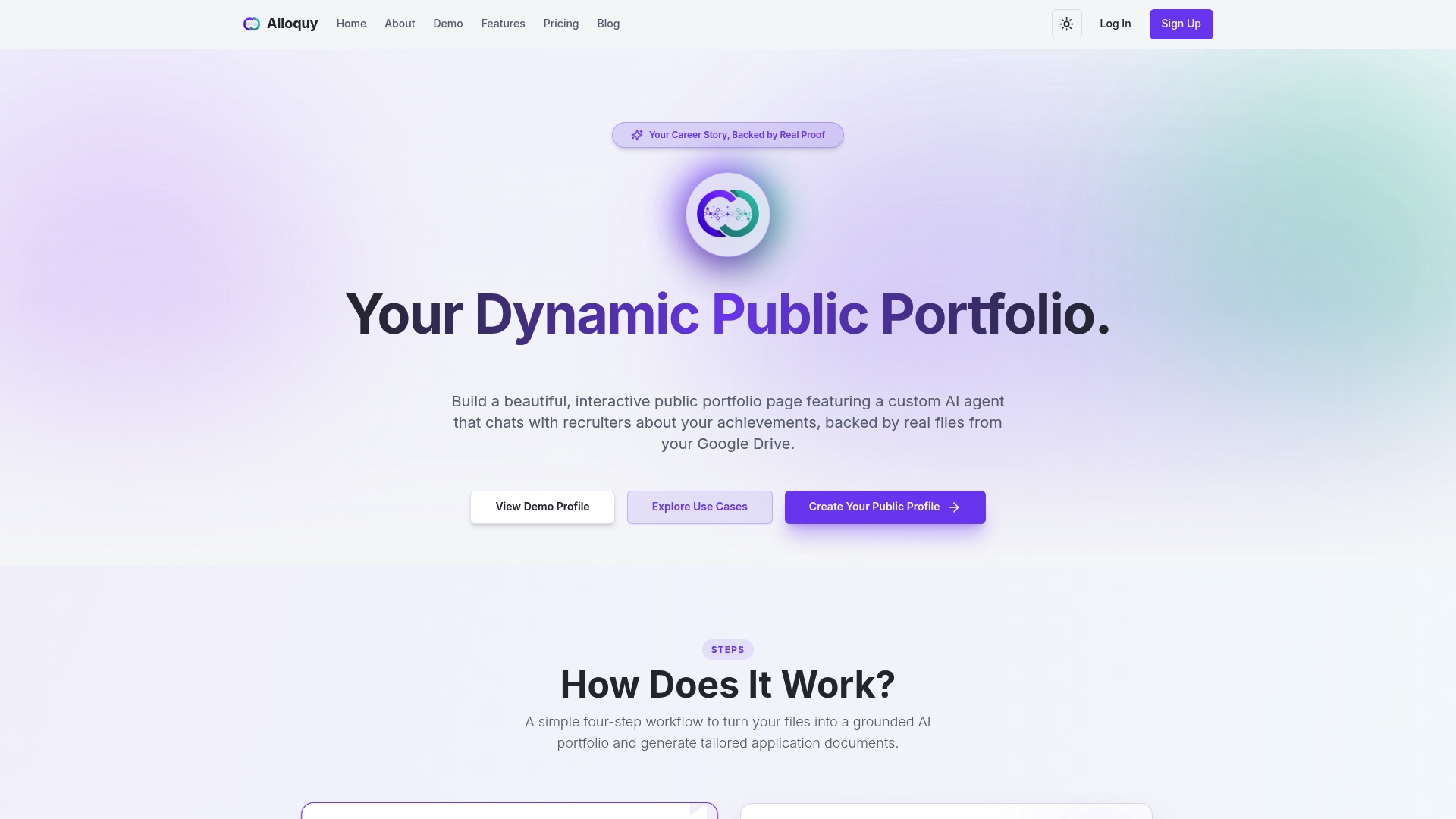
Alloquy turns the workflow above into a working product: you link Google Drive documents, and the platform’s AI assistant answers recruiter questions using only that verified evidence, showing its sourcing rather than asserting unverified claims. Customizable branding and tailored resume and cover letter exports come from the same verified source set, so the materials a recruiter reads and the materials the assistant cites stay consistent.
- Link your existing documents instead of rebuilding a portfolio from scratch.
- Get an AI assistant that cites its source for every answer it gives a recruiter.
- Generate tailored application documents directly from your verified evidence.
A free profile is the fastest way to see how this works with your own documents, and the full feature set is worth reviewing if you want to compare what’s included before you commit any evidence to a public profile.
This article is general information, not a substitute for advice from a qualified lawyer. Consult a qualified legal professional about your own circumstances before acting on anything here.
Sources
- Human resources specialists (Bureau of Labor Statistics)
- Overview of the TREC RAG track (NIST)
- Generative AI profile and AI RMF (NIST)
- Employment discrimination and AI for workers (EEOC)
FAQ
What is a no code portfolio in practice?
It is an interactive profile that links your verified documents to an AI assistant, so recruiters can ask questions and get answers grounded in cited evidence rather than a static list of claims. No coding is required to build or maintain it.
How is this different from a drag-and-drop website builder?
A drag-and-drop builder gives you a visual layout with no verification behind it, while an evidence-backed portfolio ties every statement to a source document a recruiter can check. The difference is provenance, not design.
What should I redact before publishing my portfolio?
Remove personally identifying details, client-confidential material, and anything you lack explicit permission to share, following the privacy and testing practices in NIST’s Generative AI profile. Review your redaction process carefully before every update.
Can an AI assistant on my portfolio be legally risky in hiring?
AI tools used in recruiting and hiring remain covered by anti-discrimination law according to EEOC guidance, which calls for human review and reasonable accommodation rather than automated decisions. A portfolio assistant should support a recruiter’s review, not replace it.
Does Alloquy require coding or a developer to set up?
No. Alloquy connects to your Google Drive documents and configures the AI assistant, branding, and tailored exports without any coding, and a free profile is available to start with.