

Portfolio navigation is the process a recruiter or hiring panel uses to locate, sample, and verify evidence inside an interactive, evidence-backed portfolio, rather than skim a static résumé. The immediate priority for candidates is structural: surface short, signal-first micro-cases with clear provenance so a reviewer can authenticate a claim in under a minute. Platforms like Alloquy and frameworks from F1000Research both point to the same conclusion — navigable evidence, not polish, wins the first pass.
TL;DR:
- Most recruiters prioritize micro-cases with clear problem framing, measurable outcomes, and documented trade-offs over aesthetic polish in portfolios.
- Streaming a concise 15-second thesis, a short walkthrough video, and an outcomes table significantly improve evidence scanability and initial engagement.
- Automated features like verifier tokens, searchable tags, and AI-driven Q&A help portfolios efficiently answer recruiter queries and reduce panel disagreement.
- Sensitive artifacts should be shared via ephemeral links, redacted, or anonymized, with provenance signals to maintain confidentiality without losing verification.
- Regular updates, strategic organization by themes or project types, and analysis of engagement data help keep portfolios relevant and improve their chances of converting views into interviews.
Table of Contents
- What Recruiters Look for When Navigating a Portfolio
- How Do You Make Portfolio Evidence Easy to Scan?
- How Do Recruiters Actually Query an Interactive Portfolio?
- Balancing Verification and Privacy in Portfolio Evidence
- How Alloquy Solves the Portfolio Navigation Problem
- Organizing Portfolio Content by Theme or Project Type
- Keeping a Portfolio Relevant Over Time
- Portfolio Formats: Websites, PDFs, and Interactive Platforms
- Tailoring a Portfolio to Your Industry or Role
- Tracking How Recruiters Interact With Your Portfolio
- Publisher Perspective: A 90-Day Checklist for Candidates and Hiring Teams
- Build a Portfolio Recruiters Can Actually Verify
- Sources
- FAQ
What Recruiters Look for When Navigating a Portfolio
Recruiters increasingly evaluate portfolios against structured judgment rubrics instead of gut reactions to visual polish. The F1000Research analysis of AI-integrated recruitment found that reviewers consistently weigh problem framing, personal contribution, and learning loops over aesthetic execution alone. That shift matters for how you build a profile, because it means the reviewer is hunting for specific data points, not browsing for inspiration.
A well-structured scorecard typically checks for:
- Problem framing: Did the candidate define the actual constraint, not just the deliverable?
- Personal contribution: What did this person specifically own versus what the team did?
- Measurable outcome: Is there a number, a before/after, or a documented result?
- Learning loop: Did the candidate iterate, and can they explain why?
- Trade-offs made: What did they sacrifice, and was that the right call?
Structured scorecards also solve a quieter problem: panel disagreement. When two interviewers read the same portfolio through different lenses, they often reach different verdicts on the same candidate. The seven-step portfolio review process outlined by iCreatives shows how calibrated criteria and documented outcomes reduce that variance substantially.
Each of these five axes maps to something concrete you can add to a case study: a heading that states the problem in one line, a metadata tag naming your specific role, and an evidence block showing the metric that moved. Skip the axis, and a reviewer has to guess, or worse, move on to the next candidate.
How Do You Make Portfolio Evidence Easy to Scan?
Recruiters spend seconds, not minutes, on an initial pass. The fix is a repeatable micro-case template that front-loads the signal before it asks for a click.
- Write a 15-second thesis. One sentence: the problem, your role, the outcome. No preamble.
- Attach a 60 to 90 second walkthrough clip. A short recorded explanation beats a slide deck, because it proves you can narrate your own decisions in real time.
- Build an outcomes table. Columns for role, timeline, metrics, and trade-offs give a reviewer the exact fields their scorecard asks for.
Signal-first headings do the heaviest lifting. A heading that summarizes a clear, measurable improvement as lead engineer, with context about budget and timeline, tells a recruiter everything they need before they decide whether to click further. Compare that to a generic project title, and the difference in navigability is stark.
Evidence blocks close the loop. Each one should carry an artifact thumbnail, a provenance line stating where the work came from, a verifier token or signed artifact link, and a one-line trust note explaining what the reviewer is looking at. Interactive portfolios are increasingly expected to ship with exactly this kind of verifiable, machine-readable provenance by default.
Pro Tip: Record your walkthrough clip in one take. A slightly imperfect, unscripted explanation reads as more credible to a recruiter than a polished voiceover, because it proves you can defend the work live.
For engineers specifically, small organizational choices around these blocks separate a portfolio that gets read from one that gets skipped. Alloquy’s writeup on portfolio pitfalls senior engineers make covers several of the most common structural mistakes.
How Do Recruiters Actually Query an Interactive Portfolio?
Most reviewers follow a predictable path: skim the summary, open one or two micro-cases that look most relevant to the open role, request verifier artifacts for anything that seems too good to be true, then schedule the interview. Portfolio navigation succeeds or fails at that second step, because that’s where a reviewer decides whether to keep going.
When a portfolio includes an AI assistant, the queries tend to be pointed and specific:
- “What was this person’s role on Project Y, and which parts did they own alone?”
- “Which metrics improved, and by how much?”
- “What trade-offs were made, and what didn’t work the first time?”
- “Can I see the original artifact, not just the summary?”
Recruiter-friendly portfolios anticipate these questions with built-in features: one-click review bundles that package the relevant micro-cases for a panel, guided 90-second tours for a first pass, and searchable tags mapped directly to the competencies a job description names. Alloquy’s own breakdown of how recruiter-facing AI scoring works walks through what these automated systems actually prioritize when they parse a profile. The portfolios that convert views into interviews are the ones built to answer a query, not just display a project.
Balancing Verification and Privacy in Portfolio Evidence
Recruiters need proof. Clients and former employers need confidentiality. Navigating that tension well is what separates a defensible portfolio from a liability.
- Use ephemeral links for sensitive artifacts, so access expires after a set window instead of staying public indefinitely.
- Redact identifying details — company names, client data, proprietary metrics — while keeping the structural decision visible.
- Offer anonymized or synthesized datasets when the real numbers can’t leave the building, and say so plainly rather than hiding the substitution.
- Attach provenance signals: signed artifacts, timestamps, and collaborator confirmations that let a verifier token do the follow-up work instead of an email chain.
Pro Tip: When in doubt about whether you can share something, default to a synthesized example and label it as such. A labeled substitute holds more credibility than an unlabeled exaggeration.
Ask former clients or employers for explicit permission before publishing anything proprietary. Alloquy’s guide on proving work without compromising privacy covers redaction patterns candidates can apply immediately.
How Alloquy Solves the Portfolio Navigation Problem
Alloquy builds portfolio navigation into the platform rather than leaving it to a candidate’s formatting choices. Its AI assistant answers recruiter questions directly against verified documents pulled from Google Drive, so a query about role or outcome gets a sourced answer instead of a guess. That structure mirrors what the F1000Research findings describe as AI-integrated screening paired with human-verified evidence, which improves both consistency and speed.
Alloquy supports the patterns above directly:
- An AI assistant that answers recruiter Q&A tied to verified source documents, not free-text claims.
- One-click review bundles a hiring panel can open without hunting through folders.
- Customizable evidence blocks for outcomes tables, walkthrough clips, and provenance notes.
- Selective sharing controls, including ephemeral access for sensitive artifacts.
Recruiter pilots that track structured review workflows over roughly 90 days tend to see measurable gains in reviewer-time savings and lower panel disagreement, which is the exact outcome a navigable, evidence-backed profile is built to produce.
For a minimal setup, start with three strong micro-cases, enable verifier tokens on anything sensitive, and add concise role and outcome metadata to every entry before you share the link…
Organizing Portfolio Content by Theme or Project Type
The wrong default is chronological. A reviewer scanning for a specific skill doesn’t care what you did first; they care what you did that matches the role. Group entries by theme, whether that’s “systems design,” “growth experiments,” or “client turnarounds,” and let recency be a secondary sort, not the primary one.
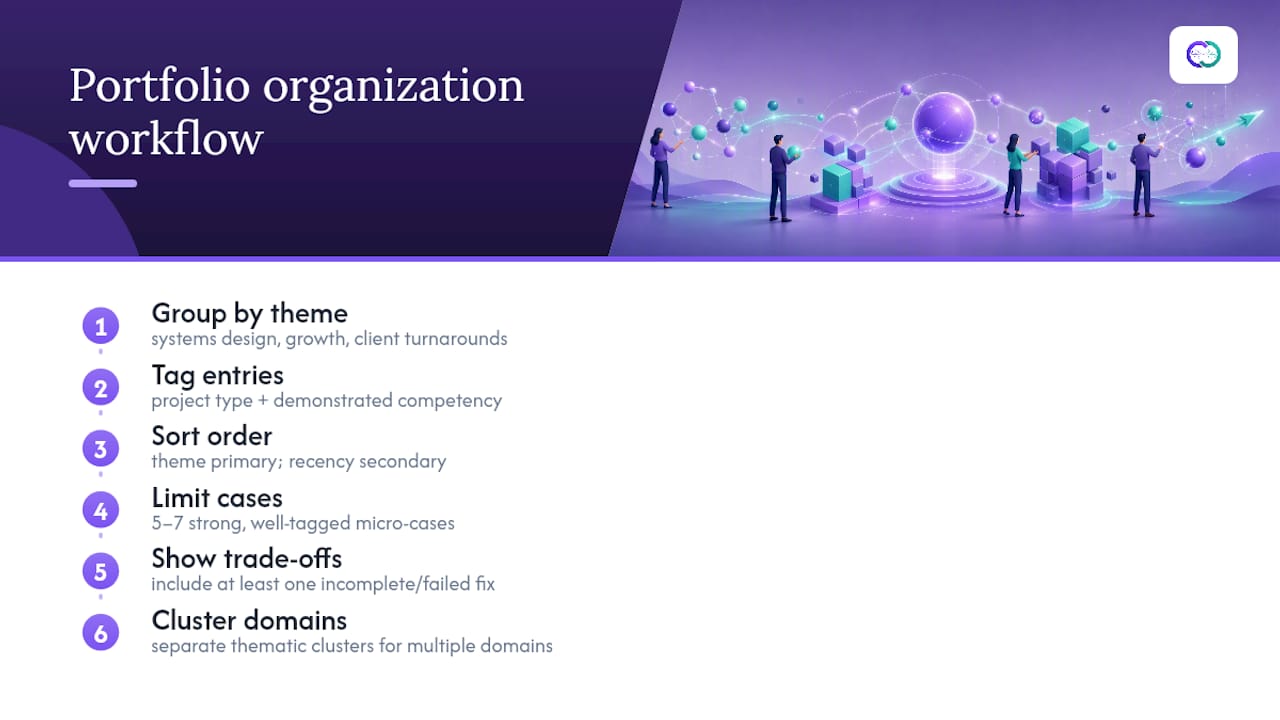
For candidates with range across disciplines, a hybrid structure works better than a single list. Tag each micro-case by project type (greenfield build, migration, incident response, optimization) and by the specific competency it demonstrates. A recruiter searching for someone who has led a migration should be able to filter to exactly that, rather than click through a dozen unrelated entries first.
Keep the count intentional. Five to seven strong, well-tagged micro-cases outperform twenty thin ones, because navigability collapses once a reviewer has to open more than a couple of entries to find what they need. If you work across multiple domains, consider separate thematic clusters within one profile rather than diluting a single narrative with unrelated wins.
Trade-off documentation belongs inside each theme, not bolted on separately. A cluster on “performance optimization” should include at least one entry where the fix didn’t fully work, because recruiters read the absence of visible friction as a sign the story has been edited. Group by what you were solving, and let the constraints show inside that grouping.
Keeping a Portfolio Relevant Over Time
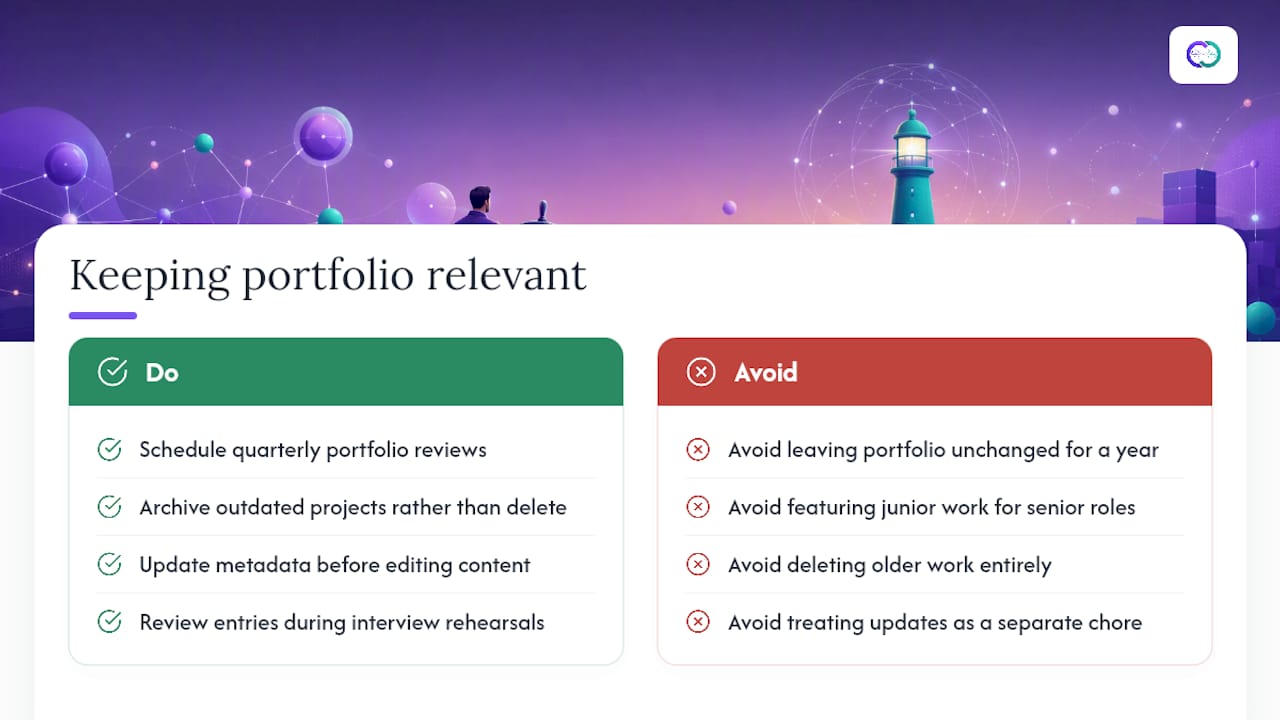
A portfolio that hasn’t changed in a year reads as abandoned, even if the work inside it is still strong. Set a recurring quarterly review, not because every entry needs updating, but because roles, tools, and target companies shift, and your evidence needs to keep pointing at what you’re applying for now.
Retire entries that no longer represent your current level. A junior-level project that once anchored your profile can become a liability once you’re interviewing for senior roles, because it anchors the reviewer’s expectations too low. Archive it rather than delete it; some platforms let you keep older work available on request without featuring it on the main view.
Refresh metadata before refreshing content. Often the fastest relevance fix isn’t a new project, it’s updating an outcome metric you learned six months after the fact, or adding a walkthrough clip to a case study that previously had only static text. Timestamps matter here too: a dated entry signals you’re tracking your own progress, while an undated one invites the question of whether it’s current at all.
Finally, treat the update cadence as part of your interview prep, not a separate chore. Every time you rehearse a project story for an actual interview, you’re also testing whether that entry still holds up. If you stumble explaining a trade-off you made a year ago, that’s the signal to revise the entry, not just your talking points.
Portfolio Formats: Websites, PDFs, and Interactive Platforms
The three dominant formats each solve a different problem, and most professionals end up using more than one.
| Format | Strength | Weakness |
|---|---|---|
| Static PDF | Universally portable, works offline, easy to attach to an email | No navigation beyond scrolling; recruiters can’t query it or verify claims live |
| Personal website | Full design control, good for narrative storytelling | Often lacks structured evidence blocks; verification requires manual follow-up |
| Interactive platform | Searchable, queryable, supports AI Q&A and verifier tokens | Requires setup time and depends on the platform staying maintained |
A PDF still has a place. Some application systems require an attached document, and a well-built PDF summary works as a leave-behind after an interview. But a PDF can’t answer a question, and it can’t prove anything beyond what’s printed on the page.
A personal website gives you narrative control that a templated platform sometimes doesn’t, but building genuine navigability, search, tagging, verifier links, provenance metadata, is a real engineering project on its own. Most candidates underestimate how much of that infrastructure a purpose-built interactive platform already solves.
The strongest setup pairs a lightweight PDF for compliance requirements with an interactive profile as the actual evidence hub recruiters explore. That’s the format expected to dominate professional profiles going forward, largely because it’s the only one built to answer a follow-up question without another email.
Tailoring a Portfolio to Your Industry or Role
A portfolio built for a software engineer and one built for a product designer should not share a structure, because recruiters in each field are scanning for different proof.
Engineers should lead with architecture decisions, code samples with context, and measurable system outcomes (latency reduced, incidents avoided, throughput gained). A hybrid review model that pairs automated screening with a human-led walkthrough is increasingly standard for technical hiring, so a portfolio that supports a live code discussion outperforms one that only shows finished output.
Designers and creatives need to show process, not just final artifacts. Sketches, rejected directions, and client feedback loops matter more here than in most other fields, because the craft is judged partly on iteration.
Product managers and consultants should lean on outcome metrics and stakeholder alignment stories, since their contribution is often invisible in any single artifact. A trade-off table showing what got deprioritized and why often does more work than a polished deck.
Whatever the field, the tagging and metadata should speak the vocabulary of that hiring pipeline specifically. A generic “project” label means nothing to a recruiter scanning for a named competency from the job description; a tag that matches their exact language gets found first.
Tracking How Recruiters Interact With Your Portfolio
Analytics turn a portfolio from a static asset into something you can iterate on the same way you’d iterate on a product. At minimum, track which micro-cases get opened, how long a viewer stays on each one, and whether they request a verifier artifact.
Drop-off points matter more than raw traffic. If viewers consistently leave after the summary and never open a single case, the summary itself isn’t earning the click, regardless of how strong the underlying work is. If they open a case but never request the verifier link, the evidence block may not be making a strong enough claim to warrant follow-up.
Time-on-artifact is a useful proxy for genuine interest versus a cursory skim. A recruiter who spends ninety seconds on a walkthrough clip is a meaningfully different signal than one who bounces after five. Platforms that expose this kind of interaction data let you prioritize which case studies to refine first, rather than guessing which ones are underperforming.
Treat these numbers the way a product team treats usage data: directional, not absolute. A single low-traffic week doesn’t mean a case study failed; a consistent pattern across many viewers over a quarter does mean something is worth fixing.
Publisher Perspective: A 90-Day Checklist for Candidates and Hiring Teams
Over the next 90 days, audit every project for missing timestamps and outcomes, then rebuild the weakest three as full micro-cases. Add ephemeral links wherever sensitive material sits behind a claim, and record short 60 to 90 second walkthroughs for your top entries.
The habit that actually pays off is rehearsal. The follow-up question is what separates a real portfolio from a fabricated one, so practice narrating your near-misses and trade-offs out loud, not just your wins.
…
— Alloquy Team
Build a Portfolio Recruiters Can Actually Verify
Alloquy turns your Google Drive documents into a queryable, evidence-backed profile, so a recruiter’s question about your role, your metrics, or your trade-offs gets answered against verified source material instead of a résumé bullet they have to take on faith.
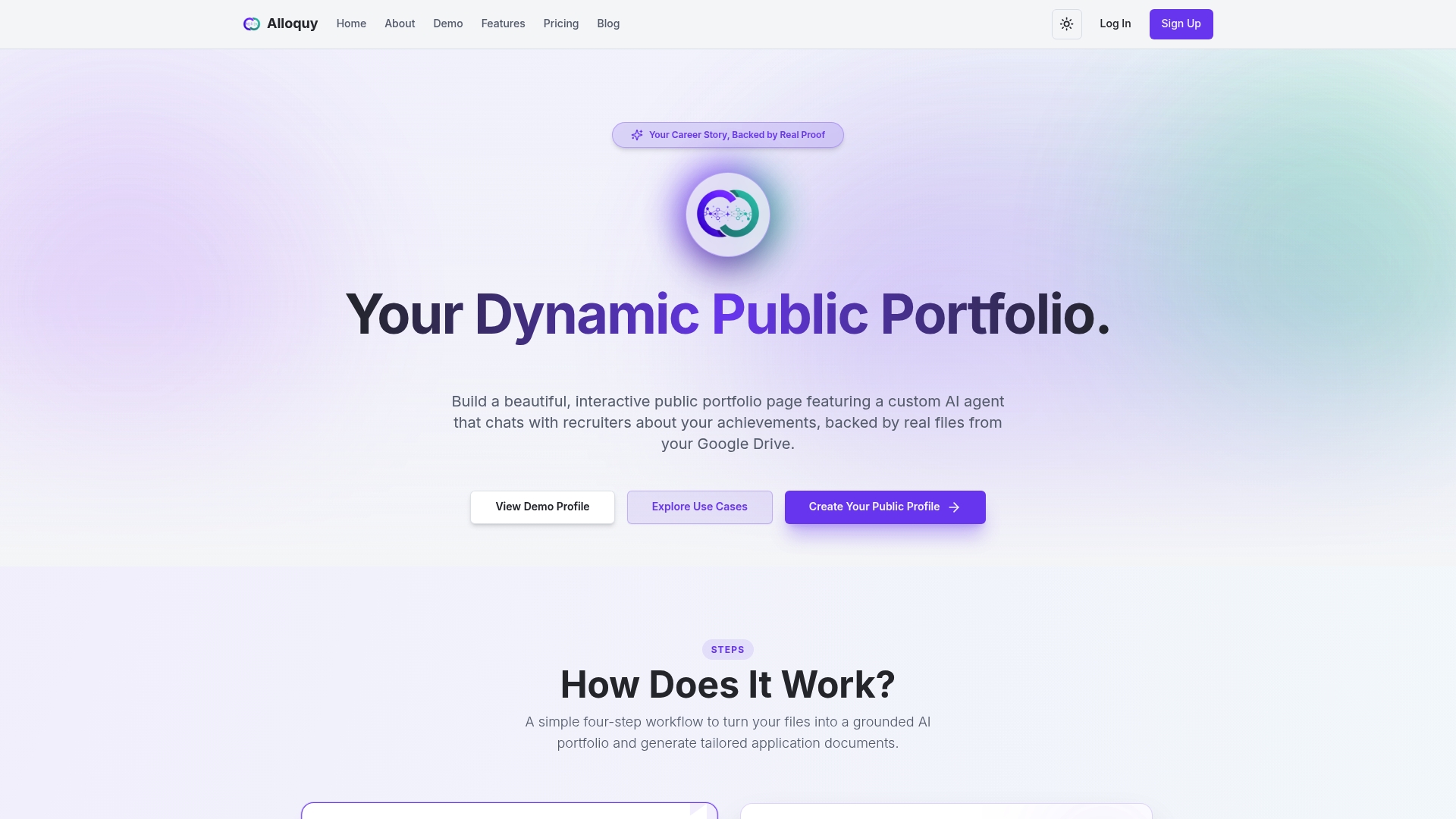
The platform handles the structural work this article covers automatically: AI-assisted Q&A tied to your real documents, customizable evidence blocks for outcomes and walkthroughs, and selective sharing controls for anything sensitive. You bring the projects; Alloquy builds the navigable case studies around them, and generates tailored resumes and cover letters from that same verified data when you need them fast. Check Alloquy’s pricing and plans to see which tier fits your evidence storage and AI Q&A needs, and set up your first three micro-cases this week.
Sources
- F1000Research article on AI-integrated recruitment and portfolio evaluation (2026-05-26)
- Professional Portfolios in 2026: Interactive, Private
- The 7-step portfolio review process every creative hiring manager needs
- AI can fake your portfolio. It can’t fake the second question. – Virtual Job Guru
FAQ
What Is Portfolio Navigation in Recruiting?
Portfolio navigation is how recruiters find, sample, and verify evidence inside an interactive portfolio, using search, tags, AI Q&A, and verifier links rather than scrolling a static résumé.
How Many Micro-Cases Should a Portfolio Include?
Three to seven strong, well-tagged micro-cases outperform a longer list, since navigability depends on a reviewer finding relevant proof within one or two clicks.
Can AI Assistants Answer Recruiter Questions About My Work?
Platforms like Alloquy let an AI assistant answer specific recruiter queries, such as role, metrics, and trade-offs, directly against verified source documents rather than free-text claims.
How Do I Protect Sensitive Client Data in a Portfolio?
Use ephemeral links, redact identifying details, and offer anonymized or synthesized datasets when real figures can’t be shared publicly.
Why Do Recruiters Ask Follow-Up Questions About Trade-Offs?
Because AI can generate polished artifacts quickly, recruiters rely on live follow-up questions to confirm a candidate genuinely understands the decisions behind their own work.
Recommended
- Alloquy: Your Interactive AI-Powered Portfolio
- Executive Career Portfolios: How VP & C-Suite Candidates Win Global Roles | Alloquy Blog | Alloquy
- 5 Critical Pitfalls Senior Engineers Must Avoid on Technical Portfolios | Alloquy Blog | Alloquy
- Why Multi-Format Resume Assets Are Key to Modern Job Search Success | Alloquy Blog | Alloquy