

A portfolio case study must lead with the outcome and your role, not the process. Pick 3–5 projects that together prove consistent skill, and structure each one around the decisions that produced a measurable result. Hiring managers scan for evidence, not aesthetics — so the visuals matter far less than what you claim, and whether you can prove it.
TL;DR:
- Focus on showcasing 3 to 5 outcome-driven projects, emphasizing measurable results and your specific role rather than volume or aesthetic polish.
- Clearly state decisions made, rejected alternatives, and their rationale, supported by quantifiable or qualitative evidence with a defined baseline, timeframe, and source.
- Use 2 to 4 targeted visuals per case study that directly support each decision, including annotations, early sketches, and transparent role and outcome statements for accessibility and clarity.
- Prepare concise hero summaries and detailed decision stories for interviews, backed by easily accessible source documents or evidence to build trust and credibility.
- Link your achievements to verifiable evidence through platforms like Alloquy, which enhance trust and allow recruiters to ask follow-up questions grounded in actual data.
Table of Contents
- What Hiring Managers Actually Look For in a Case Study
- A Copyable Case Study Template: Hero Summary Plus Six Blocks
- How to Choose Which Projects to Showcase
- [Writing the Decisions Section So Outcomes Feel Credible](#writing-the-decisions-section-so-outcomes-feel-crediblehttpsletsbuildmyappcomblog5-step-product-scoping-process)
- Choosing Visuals That Prove Your Thinking
- Presenting Your Case Studies in Interviews and Reviews
- An Evidence-Backed Model: How Alloquy Applies These Rules
- The Honest Case Study Wins the Interview
- Build Your Case Studies on Verified Evidence, Not Just Prose
- Sources
- FAQ
What Hiring Managers Actually Look For in a Case Study
Hiring managers hire people, not portfolios. That distinction shapes everything about how a case study should read. A reviewer flipping through your work in a first screening pass isn’t grading your typography choices. They’re checking whether you can articulate a problem, own a decision, and connect that decision to a result someone else can verify.
AIGA’s guidance on portfolio presentation frames the portfolio as a communication tool first and a design showcase second. Candidates are expected to narrate their work: explain the brief, state their role plainly, and name the constraints that shaped the outcome. AIGA recommends narrowing to 3–5 projects rather than presenting a sprawling archive, because depth on fewer projects reads as more credible than volume.
Nielsen Norman Group’s research on UX portfolios backs this with a specific structure: problem, role, process, outcome, and evidence. Notice what’s missing from that list. Process is one item out of five, not the centerpiece. A separate NN/g video on what hiring managers look for makes the point that portfolios serve two jobs at once: getting you into the interview room, then giving you material to talk through once you’re there.
The signals that matter most in a short scan are explicit: your role on the team, the constraints you worked within, the decisions you made, and the measurable outcome that followed. A polished mockup with no stated role tells a reviewer nothing about what you contributed versus what a teammate or an agency partner built.
Here’s the counterintuitive part. A project that admits a failed iteration or a compromise forced by budget or timeline often reads as more trustworthy than one that presents flawless execution start to finish. Real design work involves trade-offs. Case studies that pretend otherwise tend to raise more questions than they answer.

A Copyable Case Study Template: Hero Summary Plus Six Blocks
Every case study benefits from starting with a hero summary, a tight block that front-loads the information a reviewer needs before they decide to keep reading. Write it in one to two sentences: company or project name, your role, the core problem, and the headline outcome. If a reviewer only reads this line, they should still know whether you’re worth interviewing.
Below the hero summary, six supporting blocks carry the detail:
- Context — what the business or product situation was before you got involved, and why it mattered.
- Role and team — your exact title, who else was involved, and where your contribution started and stopped.
- Decisions — three specific choices you made, each with the alternative you rejected and why.
- Solution and artifacts — the screens, flows, or prototypes that resulted, shown selectively.
- Outcome with evidence — the measurable or qualitative result, tied to a timeframe and a source.
- Reflection — what you’d change, what you learned, and what didn’t work as planned.
UX Companion’s nine-block case study template organizes this same information slightly differently, splitting research and solution into separate blocks, and it prescribes a length range of 1,200 to 1,800 words with 4 to 6 strong screens per case study. That word count matters more than it sounds. It’s enough room to explain a decision properly without turning the case study into a design diary.
When you’re writing under an NDA, anonymize rather than omit. Rename the client “a mid-size healthcare SaaS company” instead of leaving out the industry context entirely. A reviewer can still evaluate a decision even when the company name is masked, but they can’t evaluate a decision you never describe.
How to Choose Which Projects to Showcase
Picking the right 3–5 projects matters more than polishing a sixth or seventh. Response rates tend to improve when candidates cut down to a small set of outcome-focused case studies rather than padding the portfolio with everything they’ve touched, according to industry guidance from WeAreArch’s portfolio research. Here’s a practical selection process:
- List every project you could include, then score each one for outcome strength. A project with a number attached, even a modest one, usually beats a project with only a nice screenshot.
- Map each candidate against the roles you’re targeting. If you’re applying for product design roles at B2B software companies, a consumer app redesign with no metrics does less work than a workflow tool with a completion rate improvement.
- Choose for breadth across the set, not within any single project. Three case studies that each show research, decision-making, and execution beat five that all look the same.
- Cut anything you can’t speak to confidently in an interview. If you can’t remember the reasoning behind a decision, it doesn’t belong in your top five.
- Write the thumbnail caption last, and write it around the outcome. Reviewers scan portfolios in roughly 6 to 8 seconds per project before deciding whether to click in, based on scanning behavior described in WeAreArch’s hiring research. A caption like “Redesigned onboarding flow” tells a reviewer nothing. “Cut onboarding drop-off by redesigning the signup flow” survives the scan.
Writing the Decisions Section So Outcomes Feel Credible
The decisions section is where most case studies fall apart, usually because they describe a process instead of a choice. A decision micro-template fixes this: state the choice you made, name the alternative you rejected, explain the rationale, acknowledge the trade-off, and report the result. Three decisions built this way outperform a long narrative walking through every step of the design process, according to practitioner commentary gathered by AIGA Eye on Design, which treats naming rejected options as the single strongest credibility signal a case study can show.
Metrics need three things to hold up under scrutiny: a baseline, a timeframe, and a data source. “Increased conversion” means little on its own.

If you genuinely don’t have hard numbers, qualitative evidence works, but it needs the same rigor. State your sample size and describe how the team actually used your output. Saying “five usability sessions surfaced a consistent navigation issue, which led the team to simplify the menu structure before launch” is more credible than inventing a percentage you can’t back up, a point UX Companion’s template guidance makes directly.
When the work was a team effort, attribute it plainly. “I led the interaction design; a researcher on the team ran the usability sessions” avoids overclaiming while still making your specific contribution clear. If the case study centers on a revenue-critical flow, isolating that one flow and showing simple, readable math connecting your change to the business result tends to land better than a scattershot list of metrics, an approach detailed in Lazarev.agency’s analysis of UX ROI case studies.
Choosing Visuals That Prove Your Thinking
Visuals exist to support a decision, not to fill space. A gallery of ten polished screens with no annotation tells a reviewer you can execute, but it doesn’t tell them why you made any particular choice. Two to four artifacts per case study, each mapped directly to a decision you’ve already described in text, does more work than a longer scroll of unlabeled images.
- Annotate screenshots with short callouts pointing to the specific element the decision affected.
- Skip long image carousels in favor of a handful of screens that each earn their place.
- Include early sketches or wireframes next to the final version when the contrast shows your reasoning.
- Keep role and outcome statements as real, selectable text rather than baking them into an image, so screen readers and search tools can parse them.
That last point matters more than it seems. A case study built entirely as image files is invisible to accessibility tools and to anything indexing your site. Recruiters occasionally copy a line from your case study into a note or a message to a hiring manager. If that line lives inside a flattened PNG, it can’t be copied at all.
Presenting Your Case Studies in Interviews and Reviews
A case study written well on the page still needs to survive being talked through out loud. Prepare a 30 second hero summary for each project. You should be able to state the company, your role, the problem, and the outcome without checking notes, because that’s often the first thing a reviewer asks for.
Beyond the hero summary, rehearse two decision stories per case study in detail: the choice, the rejected alternative, and the result. AIGA Raleigh’s portfolio review prep guide recommends bringing notecards into live reviews and treating the presentation itself as something reviewers are actively evaluating, not just the work on screen.
Bring backup evidence you can pull up quickly: a screenshot of the actual metrics dashboard, a research note, or an early sketch that didn’t make the final case study. Reviewers vary widely in what they want. Some want you to move fast through five projects; others want to sit inside one decision for ten minutes. Practice pivoting between a 30 second summary and a five-minute deep dive on the same project, because you often won’t know which one you’ll need until the reviewer starts asking.
An Evidence-Backed Model: How Alloquy Applies These Rules
Every rule above depends on one thing: a reviewer’s willingness to trust the outcome you claim. Alloquy addresses that trust gap directly by letting you link source documents, such as Google Drive files, directly to the achievements in your case studies. When an outcome ties back to a real report or dataset, the claim stops being something the reader has to take on faith.
The platform includes a recruiter-facing AI assistant that helps hiring managers ask follow-up questions about a case study and get answers grounded in linked evidence, rather than in a generic profile description. Built-in templates and customizable branding also help apply the hero summary and decision-block structure consistently across projects without rebuilding the format from scratch each time.
Pro Tip: Before publishing a case study anywhere, link its central outcome claim to the source document that proves it. If you can’t point to evidence for a number, soften the claim to what you can actually back up.
The Honest Case Study Wins the Interview
Staged perfection reads as suspicious to anyone who has shipped real design work. A case study that names a rejected option, admits a trade-off, and attributes credit accurately earns more trust than a flawless narrative with nothing to check. When you’re unsure whether to polish or prove, prove it.
— Alloquy Team
Build Your Case Studies on Verified Evidence, Not Just Prose
Everything in this guide points to the same problem: a case study is only as convincing as the evidence behind it, and static portfolio pages give reviewers no way to check your claims beyond trusting your writing. Alloquy solves that by connecting each achievement directly to the Google Drive documents that prove it, so a recruiter can ask Alloquy’s AI assistant a follow-up question and get an answer grounded in your actual files, not a paraphrase.
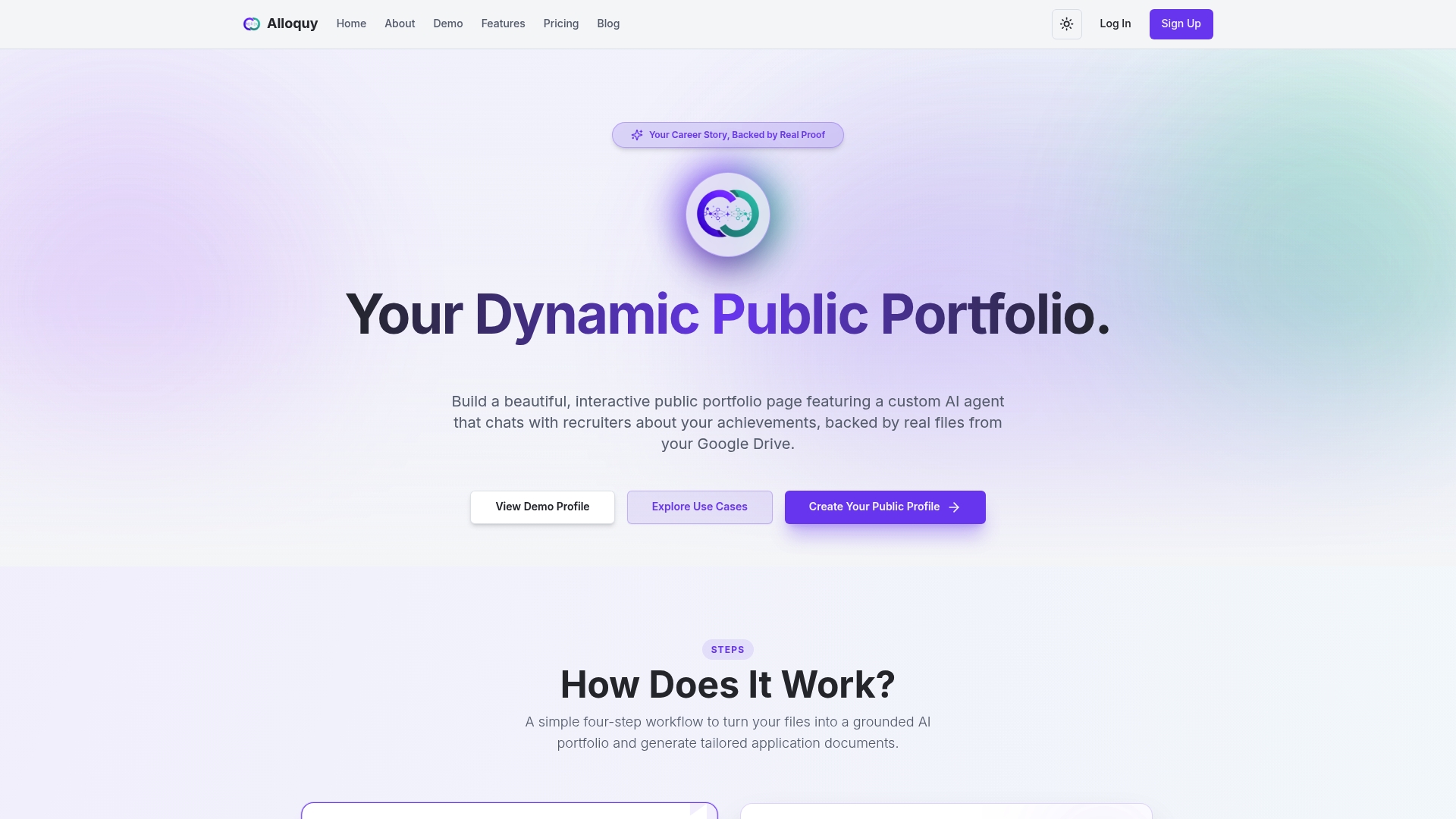
The platform’s templates handle the hero summary and decision block structure this guide walks through, and customizable branding keeps every case study looking like your own work rather than a generic layout. You can also generate tailored resumes and cover letters pulled from the verified data once your profile is built out. Start with a free profile to see how linked evidence changes what a recruiter can ask you, or check Alloquy’s plans if you’re ready to scale past the basics.
Sources
- Presenting your portfolio — AIGA
- 5 Steps to Creating a UX-Design Portfolio — Nielsen Norman Group
- UX Case Study Template (with framework + downloads) — UX Companion
FAQ
How Many Projects Should a Design Portfolio Include?
Most guidance converges on 3 to 5 projects, a range AIGA and Nielsen Norman Group both recommend. Fewer, deeper case studies read as more credible than a large archive of shallow ones.
How Long Should a Portfolio Case Study Be?
A well-scoped case study typically runs 1,200 to 1,800 words with 4 to 6 strong screens, according to UX Companion’s case study template. That length gives you room to explain decisions without turning the write-up into a diary of every step taken.
What Do Hiring Managers Look for First in a Case Study?
Reviewers scan for your explicit role, the constraints you faced, the decisions you made, and a measurable outcome, usually within seconds of opening a project. This approach of linking outcomes to verifiable source documents directly addresses this scanning behavior by making the evidence checkable on demand.
Should I Include Failed Projects or Iterations in My Portfolio?
Yes, when the failure or compromise leads somewhere useful. Naming a rejected alternative and explaining why it didn’t work is one of the strongest credibility signals a case study can show, according to practitioner insight from AIGA Eye on Design.
How Do I Show Outcomes Without Hard Metrics?
Use qualitative evidence with a clear sample size and a description of how the team acted on your findings. “Five usability sessions revealed a consistent navigation issue” is more convincing than a fabricated percentage, and some platforms let you link the actual research notes so a recruiter can verify the claim directly.