

The right approach is narrow and specific: select the one or two achievements that most directly match the role’s required outcomes, then present each as either a quantified one-line hook (Power Verb plus task plus metric) or a compressed two-sentence STAR story. Keep the full letter between 300 and 400 words, and lead with the role title paired with your strongest measurable result.
TL;DR:
- Prioritize achievements from the past two to three years that match a specific posting requirement, show measurable impact, and distinguish you from similar applicants.
- Build the strongest story around the situation, task, action, and result; compress a secondary example into an action, task, and measurable impact hook.
- Give every metric a baseline, timeframe, and scope; if exact figures are unavailable, label a reasonable estimate and be ready to explain it.
- Check claims against dashboards, deliverables, or other primary records, and link supporting evidence where recruiters can verify results directly rather than relying on memory.
- Use prose for the story, reserving bullets for three compact achievements or a cluster of hard skills; keep the page to three or four paragraphs.
Table of Contents
- How to choose the right achievements to highlight
- How to structure achievement stories: STAR and Power-Verb plus Task plus Impact
- Quantifying achievements: which metrics to use and how to present estimates
- Short, copy-ready achievement examples and micro-templates by role
- Where and how to fit achievements into a standard cover letter
- Credibility checklist before you start writing
- Why measurable achievements win interviews now
- How Alloquy helps you turn achievement claims into verifiable evidence
- FAQ
- Sources
How to choose the right achievements to highlight
Start by auditing the job posting itself. Most postings reveal their top two or three required outcomes in the first few bullet points, often repeated in the “responsibilities” and “qualifications” sections. Pull those phrases out before you write anything.
Next, build a quick inventory of everything you could draw from: paid roles, side projects, coursework, volunteer work, and leadership positions. Most candidates default to resume bullets alone, but a cover letter works better when it adds narrative context the resume does not already cover, according to career counseling guidance from Wesleyan University.
Once you have a list, prioritize using four filters:
- Recency: favor achievements from the last two to three years over older ones.
- Direct relevance: match the achievement to a specific line in the posting, not a general skill.
- Measurable impact: choose stories with a number, even an estimated one, over purely descriptive ones.
- Uniqueness: pick what sets you apart from a typical applicant with similar experience.
Two achievements, chosen well, outperform five chosen loosely.
How to structure achievement stories: STAR and Power-Verb plus Task plus Impact
Two formulas cover nearly every situation you will face when turning a scattered work history into a cover letter paragraph.
- STAR (Situation, Task, Action, Result). You describe the context briefly, state what you were responsible for, explain the specific action you took, and close with the measurable result. Career center guidance from Wesleyan University recommends this structure specifically because it shows the challenge and the outcome rather than just listing a duty. An intern might write: “Our team’s onboarding process took new hires nearly three weeks to complete. I mapped the existing workflow, flagged four redundant approval steps, and worked with my manager to cut the process to nine days.”
- Power Verb plus Task plus Impact. This is the compressed, single-line version used in opening hooks or bulleted lists. Yale’s Office of Career Strategy frames this as starting with a strong action verb, naming the task, and closing with the metric: “Redesigned the onboarding workflow, cutting completion time by 57%.”
Use the full STAR paragraph for your strongest, most job-relevant story, the one you want the reader to remember. Use the one-line hook for your opening sentence or for a secondary achievement that needs less explanation.
Pro Tip: Write the one-line hook first, then expand it into a STAR paragraph only if the role specifically calls for that depth of detail.
Quantifying achievements: which metrics to use and how to present estimates
A number only helps you if it means something to the person reading it. Before you write a metric into a sentence, decide which type fits the achievement and add the context that makes it legible.
Common metric types worth using:
- Percent change: growth, reduction, or improvement relative to a starting point.
- Absolute counts: users onboarded, features shipped, clients managed.
- Dollar figures: revenue generated, costs saved, budget managed.
- Time saved: hours, days, or weeks removed from a process.
- Frequency or volume: transactions processed, tickets resolved, campaigns launched.
Each number needs a baseline, a timeframe, and a sense of scope to carry weight. Yale’s career strategy guidance points to this kind of context as the difference between a number that reads as noise and one that reads as evidence.
Hiring teams consistently favor accomplishment statements built on the Power Verb plus Task plus Impact formula over duty-based descriptions, according to Yale’s Office of Career Strategy, because metrics let a reviewer assess fit at a glance rather than infer it from a list of responsibilities.
When you do not have an exact figure, estimate honestly rather than guessing wildly or omitting the number altogether. Phrases like “approximately” or “helped contribute to an estimated 20% reduction” keep the claim defensible while still giving the reader a sense of scale. Never round up to a number you cannot explain if asked about it directly.
Short, copy-ready achievement examples and micro-templates by role
Adapt these rather than copying them outright; a reviewer who has read the same template twice in one afternoon notices.
- Product manager hook: “Led a cross-functional team of six to launch a billing redesign that reduced customer support tickets by 31% within two months.”
- Engineer hook: “Rebuilt a legacy data pipeline, cutting nightly processing time from four hours to 45 minutes.”
- Designer hook: “Redesigned the checkout flow using user testing data, increasing completion rate by 18% over one quarter.”
- Intern hook: “Audited our team’s reporting process and proposed a template that saved roughly three hours per week.”
Before and after: “Responsible for social media content” becomes “Grew weekly engagement by 24% over four months by shifting posting cadence based on audience data.” The second version repeats nothing from a typical resume bullet; it adds the reasoning behind the result, which is exactly the narrative gap a cover letter is meant to fill, per guidance from Illinois Wesleyan University’s career center.
Where and how to fit achievements into a standard cover letter
Structure the letter in a predictable flow: open with the role title and your strongest quantified hook, use the middle paragraph or two for one or two STAR stories, and close with a confident, brief statement of availability.
A short bulleted list works well when you are presenting three compact achievements or a cluster of hard skills; otherwise, keep the body in prose so the letter reads as a narrative rather than a second resume. UMass Amherst’s cover letter guide recommends keeping the whole letter to one page across three or four paragraphs.
Formatting checklist:
- Target 300 to 400 words total.
- Use a 10 to 12 point standard font.
- Keep the letter to one page.
- List contact information in plain text, not inside a graphic or header object that parsing software might skip.
Credibility checklist before you start writing
Evidence beats assertion. Before drafting, gather the documents, dashboards, or deliverables tied to each achievement; reviewing before and after performance this way is itself useful for identifying which skills to highlight, based on NACE research on intern skill development. Linking those primary sources, rather than restating a claim from memory, gives a recruiter something to verify directly.

Why measurable achievements win interviews now
AI screening tools and human reviewers increasingly converge on the same preference: a specific, quantified claim is easier to evaluate than a general one, whether the evaluator is an algorithm or a hiring manager reading fast between meetings. We’d rather see job seekers walk into an application with one or two verifiable stories per role, tailored tightly to the posting, than a drawer full of unquantified duties. That shift in what gets rewarded is not going away.
— Alloquy Team
How Alloquy helps you turn achievement claims into verifiable evidence
Writing a strong quantified hook is only half the job; backing it up is the other half. Alloquy lets you link the Google Drive documents, dashboards, or deliverables behind each achievement to a public profile, where a custom AI assistant can answer a recruiter’s follow-up questions directly from that evidence.
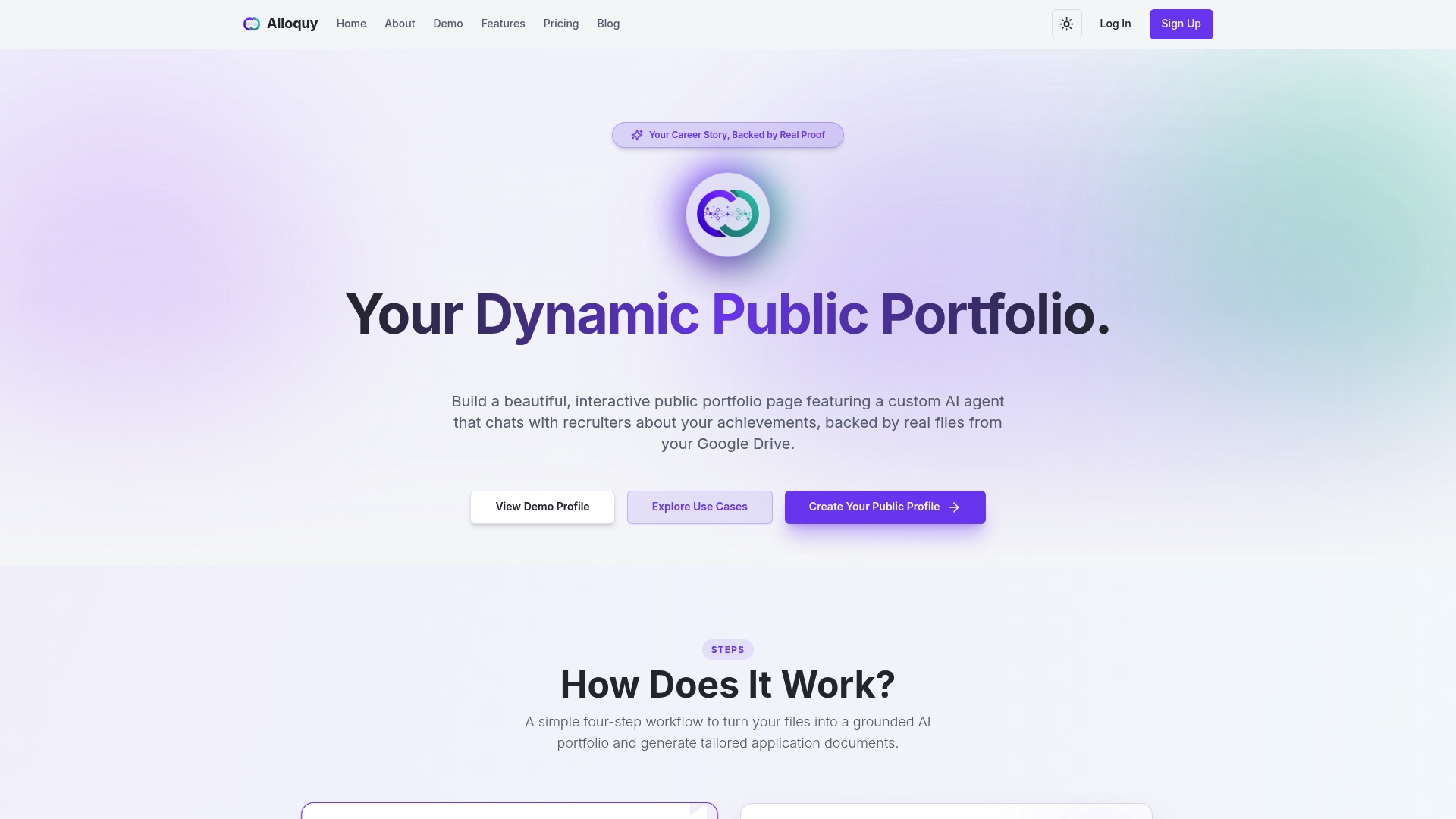
From that same verified profile, you can generate tailored resumes and cover letter text grounded in linked proof rather than memory alone. Start with a free profile and see how your next cover letter reads when every claim has a document behind it.
FAQ
What is an example of a best work achievement?
A strong work achievement names a specific action and a measurable result, such as redesigning a workflow that cut processing time by half or growing a program’s enrollment by a documented percentage over a defined period. The best examples use the Power Verb plus Task plus Impact structure recommended by Yale’s Office of Career Strategy so the result is immediately clear.
Can you provide some examples of internship cover letters?
University career centers, including Columbia Career Education, publish sample cover letters and templates you can adapt for internship applications rather than copy directly. A strong internship letter typically opens with the role title, includes one STAR story drawn from coursework or a prior project, and closes with a brief statement of interest and availability.
Should a cover letter have bullet points?
A short bulleted list works well for presenting a handful of hard skills or three compact achievements, but the rest of the letter should stay in prose so it reads as a narrative rather than a condensed resume. UMass Amherst’s cover letter guide recommends keeping the overall letter to three or four paragraphs across one page.
What are 10 good skills to put on a resume?
The right skills depend entirely on the job posting, since the strongest resumes mirror the specific language and required outcomes listed in that posting rather than a generic skills list. Review the top requirements in the posting first, then choose skills you can back with a quantified achievement, which matters more to a reviewer than the skill name alone.
Sources
- Cover Letter Guide – Gordon Career Center | Wesleyan University
- Writing impactful resume bullets – Office of Career Strategy | Yale University
- SBS cover letter guide – UMass Amherst