

A tailored cover letter is a job application letter customized to a specific role and company by mirroring the employer’s language, selecting proof examples that match the top requirements, and removing anything that doesn’t connect to that posting. Every other cover letter is a generic one.
Start here, right now:
- Pull up the job description and highlight the top two or three requirements.
- Match each requirement to one concrete result from your experience.
- Swap the company name, role title, and proof examples into your base letter.
Two-line micro-template (paste and adapt):
“I’m applying for the [Role Title] at [Company Name] because [one specific company detail — recent product, initiative, or value]. In my previous role at [Employer], I [specific result tied to the top job requirement].”
Key Takeaways
A tailored cover letter built on a modular base letter, two or three verified proof points, and mirrored employer language is the most reliable path from application to interview.
| Point | Details |
|---|---|
| Use a modular base letter | Keep placeholders for role title, company name, and proof points to tailor in 15–20 minutes. |
| Mirror the job description’s language | Use the posting’s exact tool names and task nouns to satisfy both ATS parsing and human readers. |
| Lead with a specific company detail | One researched company detail in the opening outperforms a paragraph of generic enthusiasm. |
| Keep proof points measurable | Replace vague claims with results: numbers, timelines, and outcomes a recruiter can verify. |
| Alloquy generates evidence-backed letters | Alloquy links your verified portfolio items to tailored cover letter output, removing the blank-page problem. |
Table of Contents
- What does a tailored cover letter structure look like?
- How do you tailor a cover letter to a specific job?
- Copy-ready templates for five common situations
- What recruiters actually expect — and what to avoid
- How a portfolio link strengthens your cover letter claims
- Why specificity is the only thing that actually works
- Turn your portfolio evidence into a tailored cover letter with Alloquy
- Sources
- FAQ
What does a tailored cover letter structure look like?
A well-structured letter follows a tight, four-paragraph plan. MIT’s career advising team recommends one page, 10–12 point font, one-inch margins, and three to four paragraphs: an introduction, one or two body paragraphs, and a close. That framework holds for almost every industry.
Paragraph plan:
| Paragraph | Purpose | What to include |
|---|---|---|
| Introduction | Hook + fit signal | Role title, one specific company detail, and your strongest qualification |
| Body 1 | Proof of core requirement | One concrete example with a measurable result |
| Body 2 (optional) | Second proof or context | Career change rationale, gap explanation, or second achievement |
| Closing | Call to action | Enthusiasm for next steps, availability, and a portfolio or work-sample link |
Formatting rules:
- Length: One page, always. Recruiters spend seconds on a first pass.
- Font: Arial, Calibri, or Georgia at 10–12 pt. Avoid decorative fonts.
- Margins: One inch on all sides.
- Spacing: Single-spaced paragraphs with a blank line between them.
- File type: PDF unless the job posting specifies otherwise. PDFs preserve formatting across every device.
Submission details:
- File name: Use a clean convention:
FirstName-LastName-CoverLetter-CompanyName.pdf. Hiring managers open dozens of files; a named file is easier to retrieve. - Addressing the hiring manager: Search LinkedIn or the company website for the hiring manager’s name. “Dear [First Name] [Last Name]” beats “Dear Hiring Manager” every time. If the name is genuinely unavailable, “Dear Hiring Team” is the next best option.
- Pasting vs. uploading: When an ATS asks you to paste text, remove all special formatting. When you upload, use the PDF. Never submit a .pages file.
Pro Tip: If the job posting lists a specific ATS (like Workday or Greenhouse), paste a plain-text version of your letter into a notes app first to strip hidden characters before copying it into the system.
How do you tailor a cover letter to a specific job?
The method is repeatable and, once you have a base letter, takes 15–20 minutes per application. Resume lays out the core steps: read the job description twice, identify the top three requirements, match each to a specific example, mirror the employer’s language, and cut anything that doesn’t connect to the role.
Here is the full workflow:
- Read the job description twice. First pass: get the overall picture. Second pass: underline every verb and noun that describes what success looks like in the role (“led cross-functional teams,” “managed a $2M budget,” “proficient in Salesforce”).
- Extract the top two or three requirements. These are the skills or experiences mentioned more than once, listed first in the responsibilities, or called out in a “must-have” section.
- Map each requirement to a proof example. For each requirement, write one sentence: “When I did X, the result was Y.” Keep four or five of these proof stories ready in a separate document so you can swap them in quickly.
- Mirror the employer’s language. If the posting says “cross-functional collaboration,” use that phrase, not “teamwork.” Using the job posting’s exact nouns for tools and tasks signals to both a human reader and an ATS that you read the posting carefully.
- Run the swap test. Replace the company name and role title with a competitor’s name. If the letter still reads perfectly, it isn’t tailored. A truly customized letter should break when you swap those details.
- Cut the rest. Remove every sentence that doesn’t connect to the role. If a paragraph could appear in a letter for a different industry, delete it.
Excelsior College’s keyword guidance reinforces step four: mirroring employer language isn’t flattery, it’s proof that you understand the role’s priorities.
When to skip a tailored letter: If you’re applying to a high-volume, low-fit role as a backup, a polished generic letter is better than a rushed tailored one. Tailoring pays off most when the role is a strong match and the hiring team is small enough to read applications carefully.
Pro Tip: Build a modular base letter with placeholders: [Role Title], [Company Name], [Specific Company Detail], [Proof Point 1], [Proof Point 2]. ApplyBtn’s research confirms that changing only 2–4 sentences per application makes true tailoring a 15–20 minute task without sacrificing personalization.

Copy-ready templates for five common situations
Each block below is sized for direct use. Swap the bracketed text for your specifics. The adaptation note tells you exactly what to change.
Entry-level applicant
“I’m applying for the [Role Title] at [Company Name]. I’m eager to bring that same approach to your team.”
Adaptation note: Replace the internship detail with a class project, volunteer role, or freelance work. The result doesn’t have to be large; it has to be specific.
Mid-level professional
“[Company Name]'s focus on [specific value or strategic priority from their website] is what drew me to the [Role Title] opening. Over the past [X] years at [Current/Previous Employer], I [specific achievement with a number: e.g., led a team of six engineers to ship a feature used by 200,000 active users]. I’m looking to bring that track record to a team working at [Company Name]'s scale.”
Adaptation note: Pull the company’s strategic priority from their About page, a recent press release, or their LinkedIn. One specific detail outperforms a paragraph of generic enthusiasm, as Columbia University’s career education team notes.
Career changer
“My background is in [Previous Field], and I’m making a deliberate move into [New Field] because [one-sentence rationale tied to the company’s work]. The transferable skill that matters most here: [specific skill from the job description]. At [Previous Employer], I applied it to [concrete example], and the outcome was [result].”
Adaptation note: Address the change directly. A cover letter is most useful when your resume raises questions a recruiter can’t answer on their own. Don’t bury the transition; lead with it and frame it as a strength.
Referral or internal applicant
“[Referrer’s Name], [their title] on your [team name] team, suggested I reach out about the [Role Title] opening. [He/She/They] mentioned that [specific team challenge or goal], which maps directly to what I built at [Previous Employer]: [brief proof point].”
Adaptation note: Name the referrer in the first sentence. It’s the single highest-signal opener available to you. Confirm with the referrer before using their name.
Remote-role pitch
“I’ve worked fully remotely for [X years], managing [type of work] across [number] time zones. At [Employer], I [specific remote achievement: e.g., coordinated a product launch across teams in Austin, Berlin, and Singapore, shipping on schedule]. [Company Name]'s distributed model is one of the reasons this role stood out.”
Adaptation note: Remote roles attract high application volume. A concrete remote-work result cuts through generic “I’m comfortable working independently” language immediately.
What recruiters actually expect — and what to avoid
The most common cover letter mistake is treating it as a resume summary. A longtime recruiter’s advice via Business Insider is direct: recruiters want context, personality, and the “why” behind your interest in the company, not a paragraph restating your work history. The resume already does that job.
What to avoid:
- Repeating the resume. “As you can see from my resume, I have five years of experience in…” wastes the recruiter’s time and your word count.
- Vague evidence. “I improved team performance significantly” tells a recruiter nothing. “I reduced onboarding time from six weeks to three by rebuilding the training curriculum” tells them everything.
- Misaddressing the recipient. “To Whom It May Concern” signals you didn’t try. Spend two minutes on LinkedIn.
- Generic enthusiasm. “I’ve always been passionate about marketing” is filler. A single specific company detail — a recent campaign, a product they launched, a value they’ve publicly committed to — is more persuasive than a paragraph of broad excitement.
- Exceeding one page. Recruiters at high-volume companies spend an average of seven seconds on an initial resume scan; a two-page cover letter rarely gets read in full.
ATS keyword guidance:
Modern applicant tracking systems parse cover letters for keyword matches against the job description. Use the exact tool names, methodology terms, and role-specific nouns from the posting. If the job description says “Agile sprint planning,” write “Agile sprint planning,” not “iterative project management.” The distinction matters to the algorithm before it matters to the human.
Quick proofreading checklist:
- Company name spelled correctly (check twice)
- Hiring manager’s name and title verified
- Role title matches the posting exactly
- No pronouns left from a previous application (“I’m excited about the opportunity at [previous company]”)
- PDF opens and displays correctly on a mobile screen
Cover letters are making a comeback among recruiters who want to distinguish candidates with similar resumes. A specific, well-crafted letter is increasingly a differentiator, not a formality.
How a portfolio link strengthens your cover letter claims
A cover letter sentence that ends with a link to verified work is categorically different from one that doesn’t. The same sentence with a link to a case study showing the before/after metrics is verifiable. Hiring teams notice that difference.

Here is what an evidence citation looks like inside a cover letter sentence:
That one sentence does three things: states the result, provides context, and gives the recruiter a path to verify the claim without asking for it.
How to link to portfolio items professionally:
- Link to a single, curated item, not a folder of raw files. One polished case study beats five unorganized documents.
- Include a one-line context sentence before the link so the recruiter knows what they’re clicking on.
- Avoid linking to private Google Drive folders, Dropbox files requiring login, or documents with tracked changes visible.
- Use a clean, short URL. A link to a named portfolio page reads more professionally than a 90-character Google Drive share link.
Pro Tip: The modern career tech stack increasingly includes interactive portfolio platforms that let recruiters query your work directly. A link to a live, evidence-backed profile is more engaging than a static PDF attachment and signals that you treat your career assets as active, verifiable data.
Multi-format evidence — screenshots, project briefs, recorded demos — gives hiring teams the context a resume line can never provide. Use it deliberately, not exhaustively.
Why specificity is the only thing that actually works
There is a persistent belief in job-search advice that a cover letter’s primary job is to show enthusiasm. It isn’t. Enthusiasm is table stakes. Every applicant is enthusiastic. What separates the letters that generate interviews from the ones that don’t is specificity: a named result, a concrete company detail, a proof point the recruiter can verify.
The modular base-letter method described in this article isn’t a shortcut around personalization. It’s the infrastructure that makes genuine personalization sustainable across a real job search. Keeping four or five proof stories ready, each with a measurable result, means you’re never writing from scratch. You’re selecting and positioning.
AI-tailored briefs are changing recruiter expectations, and that shift raises the bar for what “tailored” means. A letter that swaps a company name but keeps generic language isn’t tailored. A letter that pulls a specific initiative from the company’s recent press, maps it to a verified result from your own work, and links to the evidence is. That’s the standard worth building toward.
Turn your portfolio evidence into a tailored cover letter with Alloquy
Writing a strong tailored letter requires two things most job seekers don’t have organized: verified proof points and a fast way to generate role-specific language from them. Alloquy solves both.
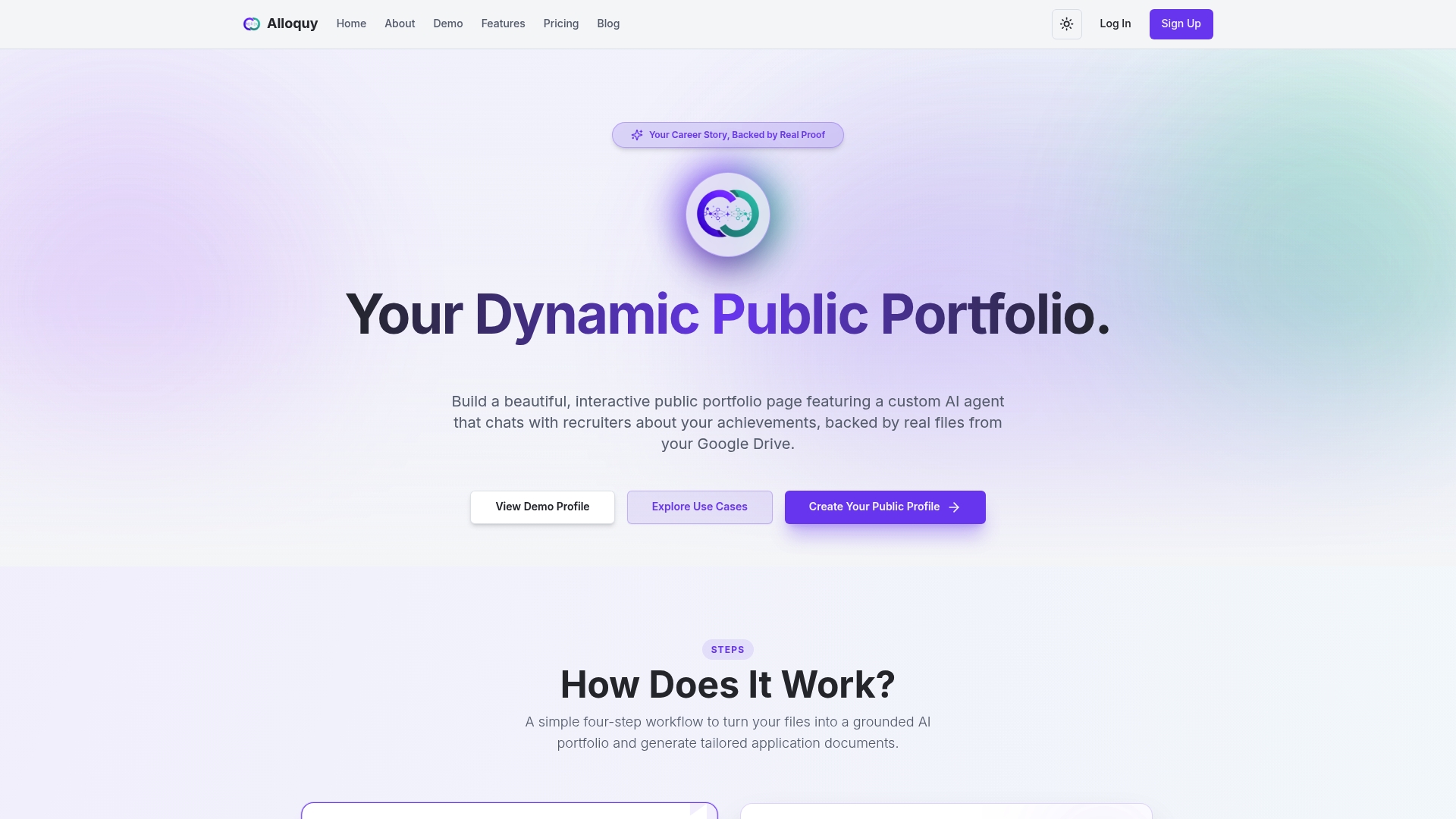
The platform lets you link Google Drive documents, case studies, and project briefs to a public interactive profile. Each piece of evidence is verified and queryable, so when you generate a cover letter through Alloquy, the output draws on your actual work history rather than generic templates. The result is a letter where every claim traces back to a real, linkable artifact — exactly the kind of specificity that recruiters say distinguishes memorable applications.
From a single portfolio item, Alloquy can generate a tailored cover letter sentence with the result, the context, and a link to the evidence already formatted. No blank page, no guessing which proof point fits the role. Explore Alloquy’s features or view pricing to start building a profile that works as hard as your application does.
Sources
- How to write an effective cover letter – Career Advising & Professional Development | MIT
- Resume
- How to tailor a cover letter for each job | ApplyBtn
- A longtime recruiter explains how to write a memorable cover letter | Business Insider
FAQ
What is a tailored cover letter?
A tailored cover letter is a job application letter customized to a specific role by mirroring the employer’s language, selecting proof examples that match the top job requirements, and including a specific company detail that shows genuine research.
How do you write a tailored cover letter quickly?
Build a modular base letter with placeholders for the role title, company name, and two proof points. Changing only those 2–4 sentences per application makes true tailoring a 15–20 minute task without starting from scratch each time.
What is the 70/30 rule in hiring?
The 70/30 rule is a hiring heuristic suggesting candidates who meet roughly 70% of the listed requirements should still apply, since many posted requirements are aspirational rather than absolute. A tailored cover letter is especially useful in this scenario because it lets you frame your strongest matching qualifications directly rather than leaving the recruiter to infer fit from a resume.
Are cover letters still relevant in 2026?
Yes. Recruiters increasingly use cover letters to distinguish candidates with similar resumes, looking for personal voice, specific company knowledge, and the “why” behind an application. A generic letter hurts more than it helps; a well-tailored one remains a genuine differentiator.
How should you handle a career gap in a tailored cover letter?
Address it briefly and directly in the second body paragraph. One sentence explaining the gap (caregiving, health, retraining, freelance work) followed immediately by what you did or learned during that period is more persuasive than leaving the recruiter to speculate. The cover letter’s job is to answer what the resume cannot.