

Use this prompt to create a 200 to 300 word, tailored cover letter in under three minutes: “Write a three-paragraph cover letter for a [job title] role at [company name]. My two strongest achievements are: [achievement 1] and [achievement 2]. I’m applying because [one specific reason tied to the company]. Use a [tone: confident, warm, direct] tone, open with a concrete result rather than my name, and keep the total length under 280 words.”
Three rules make that output usable instead of generic:
- Cap it at 250 to 300 words, matching the length career-guidance sources like Monster recommends for modern hiring.
- Include at least one measurable result. A vague draft with no evidence is the fastest way to get flagged as AI-written.
- Human-edit every line for voice and factual accuracy before you send it.
Skip the letter entirely if the application has no upload field and doesn’t ask for one. Write it if a referral, a name-addressed hiring manager, or a career pivot needs explaining.
Key Takeaways
A cover letter works when it pairs one verified achievement with a specific reason for applying, stays under 300 words, and gets a human edit before it’s sent.
| Point | Details |
|---|---|
| Lead with evidence, not identity | Open with a measurable result instead of your name or the job title. |
| Keep it short and structured | Stick to three short paragraphs and 250 to 300 words total. |
| Always human-edit the draft | Check for generic AI phrasing and confirm every claim is accurate before sending. |
| Match prompts to the role | Swap in industry-specific metrics and language for technical, creative, or sales positions. |
| Feed prompts verified evidence | Alloquy turns linked documents into verified impact statements you can drop straight into any prompt. |
A Note From the Alloquy Team on Prompt Best Practices
We tell every user the same thing: keep your evidence close before you open any AI tool. The habits that consistently produce stronger response rates are simple: gather your best proof points first, edit every draft for your own voice, and open with something that proves you actually researched the role. Polished AI text without evidence reads as noise. A specific, slightly imperfect sentence backed by a real number reads as a person worth interviewing.
Get Started: Turn Verified Evidence Into Prompt-Ready Inputs
Most cover letter advice assumes you already know your best achievements cold. Alloquy is built for the more common reality: your strongest project details are scattered across old files, docs, and folders you haven’t opened in months.
Link your Google Drive documents and Alloquy’s AI assistant surfaces verified impact statements you can drop directly into any prompt from this article, no digging through old performance reviews required. Your public profile then lets recruiters ask follow-up questions and get evidence-backed answers instead of another static PDF, and the same verified data powers tailored resumes and cover letters whenever you need one fast. Customizable themes keep your branding consistent across every application. Check the available plans and start building your evidence base today.
Table of Contents
- When Do You Actually Need a Tailored Cover Letter?
- Ground Rules for Using AI to Draft a Cover Letter
- The Prompt Bank: Copy-Paste Prompts by Purpose
- How Alloquy Makes These Prompts More Effective
- Customizing Prompts for Different Industries and Roles
- What a Prompt-Built Cover Letter Actually Looks Like
- Weaving Personal Stories Into AI-Generated Drafts
- Balancing Originality With Template Efficiency
- Ethical Considerations When Using AI for Your Cover Letter
- Sources
When Do You Actually Need a Tailored Cover Letter?
Cover letters aren’t dead, but they aren’t universal either. Hiring experts note they still carry weight at small and mid-sized employers, in roles where a specific hiring manager reads every application, and in any case where your resume alone raises a question a letter can answer.
Write one when:
- The application explicitly requests it.
- You have a referral or a warm contact at the company.
- The role leans on writing or communication skills.
- You’re explaining a career pivot, a gap, or an unconventional path.
Skip it when you’re feeding a high-volume automated pipeline with no upload option, or the posting says “optional” and gives you zero space to attach one. Run this 30-second check before every application: does a human read this, and does my resume leave a gap a letter could close? If yes to either, write it.
Ground Rules for Using AI to Draft a Cover Letter
AI is a drafting partner, not an author. Feed it your own evidence first, then let it handle structure and phrasing. Career guidance from sources like USF’s career center backs this order: your facts in, polished prose out, never the reverse.
Run every draft through this sequence:
- Supply two real achievements and a specific reason for applying before you ask for a single sentence.
- Check for AI giveaways: generic openings (“I am excited to apply”), templated transitions, or a company name that doesn’t match the role.
- Spend two minutes humanizing the voice, tightening word choice, and confirming every claim is true.
- Match your resume’s formatting and address the hiring manager by name whenever the posting lists one.
Keep the final letter to three short paragraphs, 200 to 300 words. Business Insider reports that recruiters now spot unedited AI text almost instantly, which makes the editing pass non-negotiable rather than optional.
Pro Tip: Paste your resume bullets into the prompt itself. AI models draft far more specific sentences when they can quote your own numbers back to you instead of inventing filler.
The Prompt Bank: Copy-Paste Prompts by Purpose
Each prompt below solves one specific problem. Run them in sequence, editing between each step, rather than asking for a finished letter in one shot.
1. The opening hook prompt
Generic openings are the number one reason recruiters stop reading. Cornell’s career guidance emphasizes leading with fit and evidence, not a restatement of your name and the job title.
“Write one opening sentence for a cover letter that starts with a specific, measurable achievement from my career, not my name or the job title. The achievement: insert result, e.g., ‘reduced onboarding time by [40% across three product teams’]. Connect it directly to why I’m a fit for [job title] at [company].”
2. The value-paragraph prompt
This is where two flat resume bullets become a narrative. The most reliable pattern pairs a concrete input with a request for interpretation, not invention.
“Turn these two resume bullets into a 3 to 4 sentence paragraph that shows impact, not just tasks: [bullet 1], [bullet 2]. Frame the paragraph around what changed because of my work, and connect it to the [job title] role’s core responsibilities.”
3. The tone and polish prompt
Once the content exists, tighten it. This step catches robotic phrasing and enforces the word count.
“Revise this paragraph to sound confident and conversational rather than formal or robotic. Keep it under 90 words. Remove any generic phrases like ‘team player’ or ‘results-driven’ and replace them with specifics from the text: [paste paragraph].”
4. The ATS keyword prompt
Applicant tracking systems scan for language from the job description. The trick is weaving it in naturally rather than stacking keywords.
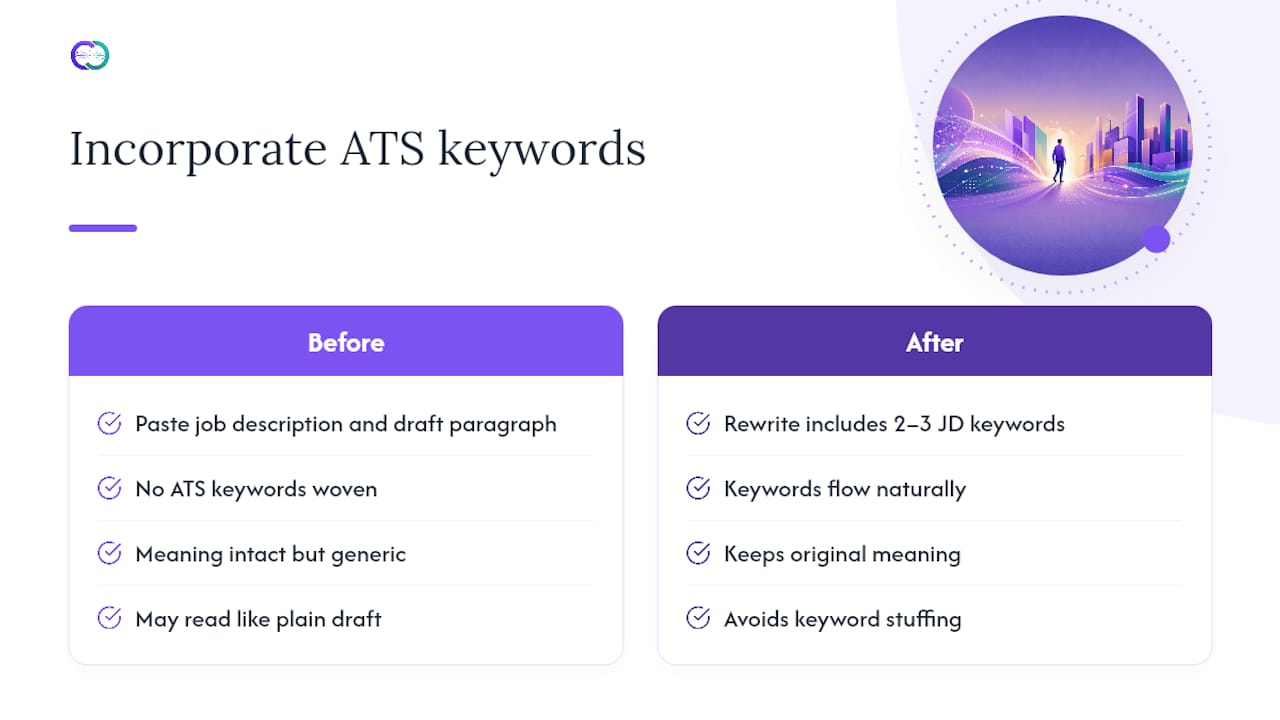
“Here is a job description: [paste JD]. Here is my draft paragraph: [paste paragraph]. Rewrite the paragraph to naturally include 2 to 3 key terms from the job description without changing the meaning or making it sound like a keyword list.”
5. The shortening prompt
Long letters lose readers fast. Monster’s guidance points to 250 to 400 words as the sweet spot, and shorter is usually safer.
“Shorten this cover letter to 220 to 250 words total while keeping the opening achievement and the specific company reference intact: [paste full letter].”
Run all five in order and you get a letter built from your real evidence, tightened for length, and checked against the actual job posting, not a template guessing at what recruiters want to hear.
How Alloquy Makes These Prompts More Effective
The weak point in most AI cover letter workflows isn’t the prompt. It’s the input. A prompt can only be as specific as the evidence you feed it, and most job seekers are pulling vague memories from a resume they wrote a year ago.
Alloquy shortens that gap with a five-step flow: link your Google Drive documents or add evidence manually, let the platform’s AI assistant surface one or two verified impact statements per role, drop those statements straight into your prompt, edit for voice, then export.
- Linked documents replace guesswork with dated, verifiable project detail.
- The AI assistant answers recruiter questions using that same verified evidence, so your cover letter and your public profile tell one consistent story.
- Templates keep formatting aligned with your resume automatically.
Pro Tip: Pull your strongest project’s exact numbers from Alloquy before you open ChatGPT. A prompt fed a real figure produces a materially sharper opening line than one fed a vague description.
A cover letter built on a verified achievement reads differently than one built on a guess. Recruiters can tell the difference in the first sentence.
For more on why evidence-backed applications outperform generic ones, see why AI-tailored briefs get higher response rates and how to structure achievements for AI citation.
Customizing Prompts for Different Industries and Roles
A prompt built for a marketing coordinator won’t produce a strong letter for a data engineer, and the fix isn’t a different template. It’s a different set of inputs.
For technical roles, feed the prompt a specific tool, metric, or system you built or improved, not a soft skill. If you’re applying to a role evaluated by technical screening tools, framing your achievement in the same language recruiters and hiring platforms use to assess technical talent helps your letter mirror how the role is actually scored.
For creative or writing roles, ask the prompt to preserve your natural sentence rhythm rather than smoothing it into generic corporate phrasing. Add an instruction like “keep some sentence variety and avoid uniform sentence length.”
For sales or client-facing roles, anchor the prompt on a number: revenue generated, retention rate, deal size closed. Vague enthusiasm reads as filler in a field built on measurable outcomes.
For career pivots, tell the prompt directly what’s changing and why, then ask it to draw a straight line between your old skill set and the new role’s requirements. Don’t let the AI paper over the pivot. Naming it directly builds more trust than dancing around it.
Freelancers and independent contractors face a slightly different problem: no single employer to anchor the narrative. If that’s your situation, communities like The Freelance PM Club are a useful place to see how other nontraditional career paths get framed for hiring managers who expect a linear resume.
What a Prompt-Built Cover Letter Actually Looks Like
Consider a marketing manager applying for a senior role at a mid-sized retail company.
The value paragraph that follows, generated from two resume bullets about a product launch and a cross-functional team lead, reads as a short narrative: what the project was, what changed because of the candidate’s specific decisions, and how that mirrors the target role’s stated priorities from the job description.
The closing paragraph, run through the tone and polish prompt, drops the boilerplate “I look forward to hearing from you” in favor of a specific next step: referencing a recent company initiative and stating plainly why it matters to the applicant.
The pattern holds across industries. A software engineer’s version leads with a performance metric instead of a revenue number. A nonprofit program manager’s version leads with a participant outcome instead of a sales figure. What stays constant is the structure: one measurable hook, one evidence-backed paragraph, one specific closing line, all inside 250 to 300 words, consistent with the three-to-four-paragraph structure career centers recommended. The AI supplies the sentence construction. The applicant supplies everything that makes it true.
Weaving Personal Stories Into AI-Generated Drafts
The paragraphs AI drafts well are the ones with clear inputs: numbers, project names, dates. The paragraphs it drafts badly are the ones that need a human story, like why you actually want this job or what a specific moment in your career taught you.

The fix is a hybrid approach. Write your personal story paragraph yourself, in your own words, even roughly. Then ask the AI to tighten it without replacing your phrasing: “Edit this paragraph for clarity and flow, but keep my original sentence structure and word choices as much as possible: [paste your draft].” That instruction matters. Left unconstrained, most models will smooth your voice into something generic.
A good place for a personal story is the motivation paragraph, the section explaining why this company and not just this job. If you switched careers because a specific experience changed your priorities, or you’ve followed a company’s product for years before applying, that detail belongs in your own words, sitting between two AI-refined evidence paragraphs. The contrast actually works in your favor: a recruiter reading a letter that’s polished throughout except for one clearly human paragraph reads that paragraph as more credible, not less.
Keep the story short. One sentence of context, one sentence of connection to the role. Anything longer starts to crowd out the evidence paragraphs that are doing the actual persuading.
Balancing Originality With Template Efficiency
Templates exist because structure repeats: an opener, a value paragraph, a motivation paragraph, a close. That skeleton is not the problem. The problem is copying the sentences inside it.
Use a template for structure only. The Cornell career blog and similar university guidance outline the same basic shape: header, opener, value paragraph, culture or motivation paragraph, closing. That shape is safe to reuse across every application you send. What can never repeat is the content inside each section. Your achievement, your reason for applying, and your specific reference to the company have to change every time, because that specificity is exactly what a recruiter is scanning for in the first few seconds.
A useful test: if you could swap the company name in your letter and it would still make sense, you’ve leaned too hard on the template and not hard enough on the prompt inputs. Rerun the value-paragraph and opening-hook prompts with fresh, specific evidence before you submit.
Ethical Considerations When Using AI for Your Cover Letter
Everything in your letter has to be true. AI will happily generate a fluent sentence about a project you didn’t lead or a metric you never measured if you give it vague or exaggerated inputs, and that’s on you, not the model, once it’s submitted under your name.
Three principles keep the process honest. First, every fact in the letter should trace back to something you can defend in an interview. Second, disclosure isn’t typically required, but authenticity is expected. Most hiring guidance now assumes candidates use AI tools; the issue isn’t the tool, it’s submitting text you didn’t edit, verify, or fully understand. Third, don’t let AI invent a company detail to sound informed. If you don’t actually know why you want to work there, research it before you write the motivation paragraph, or leave the specificity out rather than fabricate it.
For a deeper look at where the ethical line sits between using AI as a drafting tool and letting it write your professional identity for you, see Alloquy’s guidelines on authentic AI use in career tools.
Sources
- Hiring experts reveal why cover letters aren’t dead yet
- Are cover letters necessary?
- RIP cover letters? How generative AI changed hiring
- How To Write An Effective Cover Letter | Cornell University
FAQ
Are cover letters outdated in 2026?
No. They aren’t universally required, but hiring experts confirm they remain effective at small and mid-sized employers, in manager-reviewed applications, and whenever a career pivot or gap needs context.
Can I use ChatGPT for my cover letter?
Yes, but feed it your own achievements and a specific reason for applying first, then edit the output for voice and accuracy. Alloquy’s evidence-linking workflow gives ChatGPT prompts sharper, verified inputs to work from instead of vague resume memories.
What should a cover letter include?
A header with contact details, a personalized greeting, an evidence-based opening, a value paragraph connecting your experience to the role, and a closing that references a specific next step, per Cornell’s recommended structure.
What are common cover letter mistakes?
Generic openings, mismatched company names, restating the resume instead of adding context, exceeding 300 words, and submitting unedited AI text that recruiters can spot within seconds.
How long should a cover letter be?
Aim for 250 to 300 words across three short paragraphs, consistent with the 250 to 400 word range career guidance recommends.