

AI Portfolio Q&A: Answer 3 Recruiter Questions With Evidence
An AI portfolio Q&A is an assistant that answers a recruiter’s direct questions about your work by citing the specific documents, metrics, and approvals you have linked as evidence. The benefit is structural: recruiters move past unverifiable bullet points toward sourced answers, aligned with frameworks like NACE’s competency model and governed by EEOC guidance on AI in hiring, with platforms like Alloquy built around this evidence-first exchange.
TL;DR:
- Pair project reports, metrics, client approvals, design files, or code with competency labels and one sentence explaining measurable impact, so recruiters can verify claims.
- Prompt rules alone still left fabrications in roughly 50% of hiring pipeline outputs; human review eliminated identity fabrications and sharply reduced other invented claims.
- Share documents tied to the role through expiring links, redact sensitive details, and keep an audit trail instead of opening entire folders.
- Research found AI evaluators favored resumes generated by the same model, making those candidates 23% to 60% more likely to reach shortlists.
Table of Contents
- How AI portfolio Q&A actually works behind the scenes
- Why hiring teams prefer evidence-backed AI Q&A
- Step-by-step: prepare your portfolio for recruiter questions
- How to avoid hallucinations and keep recruiter answers accurate
- Sharing and privacy: safe access controls for recruiter Q&A
- Three recruiter questions, three evidence-backed answers
- Why human checkpoints still define recruiter trust
- Publish a recruiter-queryable portfolio with Alloquy
- FAQ
- Sources
How AI portfolio Q&A actually works behind the scenes
The mechanism behind a credible AI portfolio assistant is retrieval-augmented generation: instead of inventing an answer from general training data, the system searches your linked documents, pulls the most relevant passages, and feeds them to the model as grounding context before it responds. This is the same architectural pattern recruitment-technology researchers describe for job-matching systems, where dense retrieval and reranking produce explanations tied directly to source evidence rather than free-form guesses.
Grounding only matters if it is visible. A well-built assistant attaches a citation, a document name, or an excerpt link to every substantive claim, so a recruiter can click through and confirm the number or outcome themselves rather than taking the model’s word for it.
The recruiter-facing flow typically works like this:
- A recruiter asks a direct question, such as how you reduced load times or managed a client escalation.
- The assistant returns a sourced snippet along with a citation to the originating document.
- The recruiter asks a follow-up, and short annotations you have written in advance let the system respond without stalling to reinterpret an entire raw file.
Large language models can still fabricate details when the underlying evidence is thin or ambiguous, which is why the provenance link, not the fluency of the answer, is the real trust signal.
Why hiring teams prefer evidence-backed AI Q&A
Recruiters face an information imbalance: a resume makes claims, but verifying them traditionally means a phone call, a reference check, or a leap of faith. An evidence-backed Q&A assistant helps close that gap by letting a recruiter validate a specific claim and spend their limited attention on judgment calls rather than fact-checking.
This matters for compliance as much as efficiency. SHRM reporting from 2026 notes that employers worry about discrimination and liability when leaning on AI screening tools, and that transparent, evidence-based portfolios give recruiters something to validate instead of trusting an opaque model’s judgment outright. The EEOC has been explicit that federal anti-discrimination law still applies when AI enters recruiting, and that employers remain accountable for outcomes regardless of which tool produced them.

Evidence also needs a common language. Mapping your achievements to employer-valued competencies, the approach NACE recommends for e-portfolios, helps the retrieval system surface the right document and helps the recruiter interpret it without extra translation.
A layered verification chain, combining sourced citations with a human checkpoint, is what separates a trustworthy portfolio assistant from a chatbot reciting unverified claims.
- Provenance links let recruiters audit a claim instead of accepting it at face value.
- Competency mapping gives retrieval systems and human readers a shared vocabulary for impact.
- Human-reviewed answers close the gap that automated summarization alone cannot.
Step-by-step: prepare your portfolio for recruiter questions
Building a portfolio an AI assistant can answer from well starts with choosing the right source material, not with writing more text.
- Link primary evidence first. Project reports, before-and-after metrics, client sign-offs, design files, and code snippets each give the retrieval system something concrete to cite, rather than a paraphrase of your own opinion.
- Map each piece of evidence to a competency. Framing a project around a NACE-style competency, such as problem solving or leadership, mirrors the language recruiters already use when they screen, and it helps the assistant retrieve the right document for a related question.
- Write a one-sentence impact line for every document. A short, specific summary (what changed, by how much, over what period) gives the retrieval layer a high-signal anchor instead of forcing it to summarize an entire PDF on the fly.
- Use plain file names, clear headings, and short excerpts. Metadata and structure are not cosmetic: a retrieval-augmented system matches queries to text, so a file named “Q3_report_final_v2” is far less useful than “Checkout Redesign Conversion Report.”
- Set access permissions deliberately. Decide which documents are fully open to recruiter queries and which require a citation note pointing to a summary instead of the raw file.
- Draft a concise reviewer summary for each major project. This gives a human reader a fast way to confirm the assistant’s answer matches the real story behind the work.
Our guide to building an interactive, recruiter-ready portfolio walks through this structure in more detail, including how to sequence projects for a first-time reviewer.
Pro Tip: Treat every linked document as an answer waiting for a question: if you can’t guess what a recruiter would ask about it, add a one-line note explaining why it’s there.
How to avoid hallucinations and keep recruiter answers accurate
Language models fabricate details when prompts alone are left to police accuracy. Empirical research on multi-stage hiring pipelines found that even with prompt guardrails in place, fabrications still appeared in roughly 50% of outputs, while adding a human-in-the-loop checkpoint after generation eliminated identity fabrications and sharply reduced other invented claims. That finding supports a layered approach rather than a single fix.
- Prompt guardrails narrow what the model is allowed to say, but they rarely catch every fabrication on their own.
- Retrieval grounding anchors each answer to a real document, which gives a verifier something concrete to check.
- A human-in-the-loop checkpoint, even a brief one, catches what guardrails and grounding miss.
Present evidence so a verifier can work fast: a short excerpt, the specific metric, and the source document beat a long narrative a reviewer has to re-read in full. Over-polished, AI-written summaries carry their own risk. Research on self-preferencing in algorithmic hiring found that AI evaluators can favor resumes generated by the same model, making those candidates 23% to 60% more likely to be shortlisted, a bias that interventions like system prompting partly correct. Separate qualitative research on recruiting workflows describes generative AI tools as “invisible architects” of hiring decisions, underscoring why your own writing voice, not a uniformly polished AI tone, should carry through your evidence.
Pro Tip: If you use AI to draft a summary, run it through a tool like HumanizeAI to restore your natural voice rather than leaving a uniformly machine-polished tone that can read as generic.
Sharing and privacy: safe access controls for recruiter Q&A
Letting an AI assistant answer questions about your work does not require opening every file you own. Least-privilege sharing, scoped to the documents relevant to a given role, keeps your evidence base useful without oversharing.
- Use read-only, time-limited links for sensitive documents instead of permanent full-drive access.
- Mask or redact client names, salary figures, or proprietary details that are not needed to verify your contribution.
- Grant access per document rather than to an entire folder, so a recruiter sees only what supports their question.
- Keep an audit trail of what was shared and when, so provenance remains verifiable without requiring blanket access.
Disclose AI usage where a platform or employer requires it, and favor tools that build auditability into the sharing process rather than treating it as an afterthought.
Three recruiter questions, three evidence-backed answers
Short scenarios make the mechanics concrete.
- Engineering: asked how a candidate improved application performance, the assistant cites a linked performance report, points to the before-and-after latency figures inside it, and adds a one-sentence summary of the fix.
- Design: asked about a product launch, the assistant references a case study, pulls supporting screenshots, and quotes a short excerpt explaining the design rationale behind a key decision.
- Consulting: asked about client results, the assistant points to an engagement summary, a client approval note, and the quantified outcome documented inside the project file.
Our collection of real AI portfolio examples shows this pattern across more roles, including how evidence and narrative fit together for less linear career paths.
Why human checkpoints still define recruiter trust
Evidence-first portfolio design only works when the documents behind it are real, current, and traceable. We built our approach around linking directly to source material, not around generating polished claims that cannot be checked.
Automation accelerates retrieval, but a human checkpoint, whether that is you reviewing your own evidence or a recruiter confirming a citation, remains what makes an AI’s answer trustworthy rather than merely fluent. We encourage professionals to experiment with evidence-backed Q&A while keeping the safeguards above in place.
— Alloquy Team
Publish a recruiter-queryable portfolio with Alloquy
We built Alloquy around the exchange described throughout this piece: you link your documents, we connect them to a custom AI assistant, and recruiters get grounded answers instead of guesses about your resume. A profile lets you link evidence and set up your assistant to answer questions.
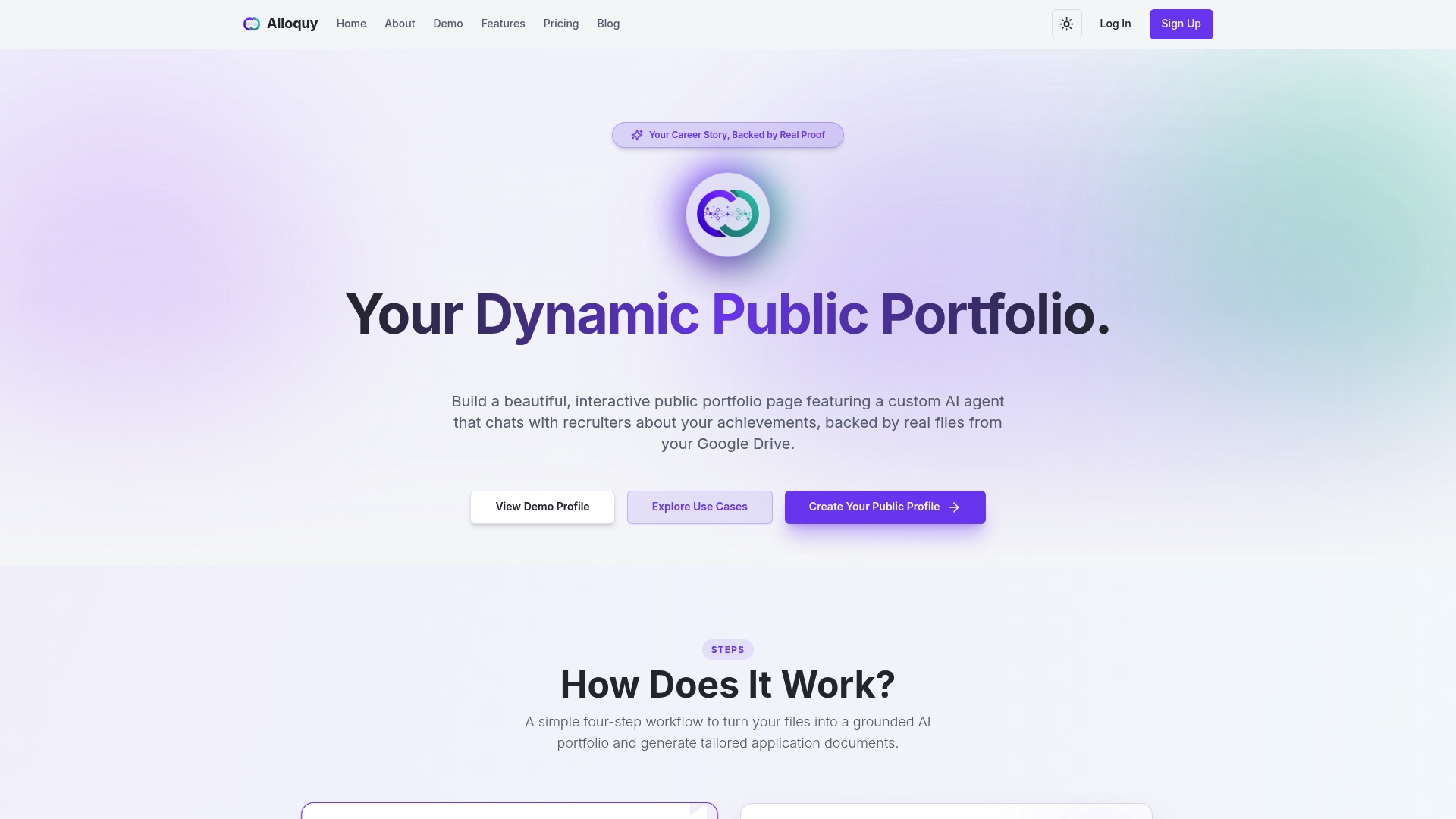
Start with a free profile, or visit Alloquy to see how the assistant and public profile fit together before you commit to a paid plan.
FAQ
What is AI portfolio Q&A exactly?
AI portfolio Q&A is an assistant that answers a recruiter’s specific questions about your work by citing the linked documents, metrics, or approvals that support each claim. The goal is a verifiable answer rather than a paraphrased resume bullet.
How do I stop an AI assistant from making up answers about my work?
Ground every answer in a linked source document and add a human review checkpoint before publishing. Research on multi-stage hiring pipelines found that guardrails alone still leave fabrications in about half of outputs, while adding a human-in-the-loop check eliminated identity fabrications entirely.
What documents should I link for the best recruiter answers?
Prioritize primary evidence: project reports with measurable outcomes, client approvals, design files, and code snippets, each paired with a one-sentence impact summary. This mirrors the competency-based approach NACE recommends for connecting experience to employer-valued skills.
Is it safe to let recruiters query an AI about my private documents?
Yes, when access is scoped: share individual documents with read-only, time-limited links instead of full folder access, and redact sensitive details that are not needed to verify your contribution. Keeping an audit trail lets you confirm what was shared without granting blanket access to your files.
Does Alloquy charge for a recruiter-queryable portfolio?
Alloquy offers a free profile to get started. Expanded features and pricing details are listed on the Alloquy pricing page.
Sources
- Naceweb
- Is Your AI Hiring Tool Discriminating? Here’s How to Find Out
- Employment Discrimination and AI for Workers