

This roundup collects marketing case study examples spanning email, social, SEO, PPC, video, and omnichannel campaigns, each paired with a metric and a timeframe. It also includes a copy-ready template covering headline, snapshot, challenge, approach, results, and quote, so you can build your own case study without starting from a blank page.
TL;DR:
- Make sure the case study clearly states a specific result with a measurable outcome and a defined timeframe to establish credibility.
- Prioritize stories that feature a named channel, a concrete mechanic, and verifiable results that support the main claim.
- Verify all data and quotes before publication by requesting evidence from the client and confirming accuracy with signed approval.
- Use the case study as a system to generate multiple assets, matching format and length to the intended distribution channel and funnel stage.
- Select client stories with impressive, relevant results that are willing to be named or anonymized while maintaining clear, specific metrics.
Table of Contents
- Marketing Case Study Examples Worth Modeling
- How to Write a Marketing Case Study That Converts
- Turning One Case Study Into Five Assets
- Choosing Which Client Stories Become Case Studies
- What This Means for Your Own Portfolio Case Studies
- What a Marketing Case Study Actually Is
- Mistakes That Undermine an Otherwise Good Case Study
- Using Storytelling to Keep Readers in the Case Study
- Verifying the Numbers Before You Publish
- The Alloquy Team’s Take on Case Study Fatigue
- Sources
- FAQ
Marketing Case Study Examples Worth Modeling
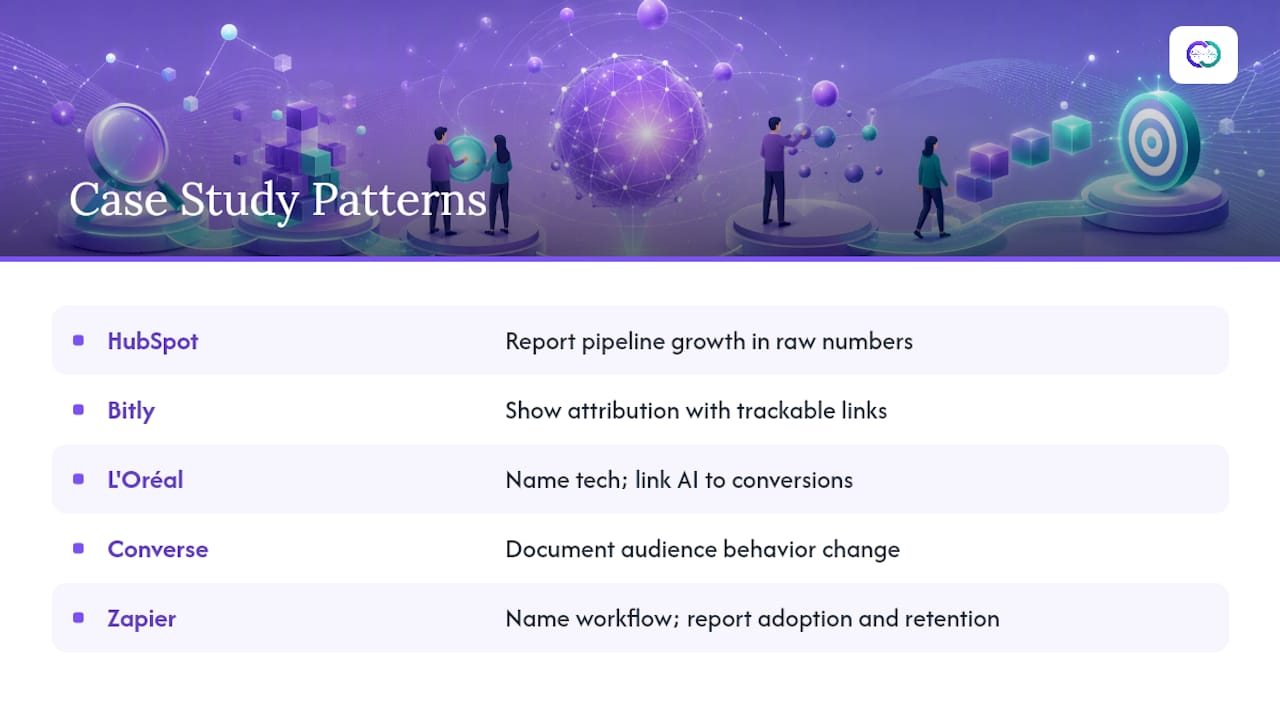
A marketing case study earns its place in a portfolio, a sales deck, or a training file when it does one thing: pair a specific claim with a specific number. The examples below draw on names that recur across nearly every serious case study collection, including HubSpot, Bitly, L’Oréal, Converse, and Zapier, because their published stories consistently show clear metrics alongside implementation details readers can actually replicate. Use each entry as a pattern, not a script.
HubSpot’s inbound-to-revenue playbook (content marketing). HubSpot built its own case study library around a simple structure: identify a stalled pipeline, apply an inbound content system, then report pipeline growth in raw numbers rather than vague “increased engagement” language. The tactical takeaway is to always report a business outcome (revenue, qualified leads, deal velocity) instead of stopping at a vanity metric like page views.
Bitly’s link-tracking proof point (SEO and analytics). Bitly’s customer stories typically show a marketing team that could not attribute campaign traffic to specific channels until they added branded, trackable short links across every touchpoint. The lesson: attribution clarity is itself a sellable outcome, and a case study built entirely around “we could finally see what worked” resonates with any reader drowning in disconnected campaign data.
L’Oréal’s personalization-at-scale story (omnichannel, PPC). L’Oréal’s marketing case studies frequently center on using AI-driven personalization and dynamic ad creative to match product recommendations to shopper behavior across paid and owned channels. The takeaway for anyone writing a similar story: name the specific technology or process shift (not just “we used AI”) and connect it directly to a conversion or basket-size outcome.
Converse’s community-driven social campaign (Instagram, brand). Converse has built repeated case studies around user-generated content and community storytelling on Instagram, where the brand hands creative control to sneaker culture rather than dictating it. The takeaway: a social case study is stronger when it documents audience behavior change (shares, remixes, community submissions) rather than just impressions.
Zapier’s product-led growth story (SaaS, email). Zapier’s case studies lean on a specific mechanic: automated workflows that reduce manual work for a named customer segment, followed by adoption and retention figures. The lesson for B2B writers is to name the exact workflow or integration that solved the problem, since specificity is what separates a credible SaaS story from generic praise.
A mid-size SaaS company’s onboarding email sequence (email marketing). A common pattern across SaaS case studies is redesigning a five-email onboarding sequence around a single desired action, then tracking activation rate over the following 30 days. The takeaway: email case studies convert best when the story isolates one behavior change, not a bundle of tweaks.
A DTC apparel brand’s PPC retargeting overhaul (paid search). Retargeting case studies in the DTC space typically follow a similar arc: an audience segmentation change (cart abandoners split from browsers) paired with a return-on-ad-spend improvement over a defined quarter. The tactical lesson is to always specify the audience segment, since “we improved ROAS” without context reads as unverifiable.
A regional restaurant chain’s local SEO turnaround (SEO, local search). Local SEO case studies usually document a Google Business Profile cleanup and review-generation push, followed by a jump in map-pack visibility and foot traffic over a defined period. The takeaway: local case studies work best when they tie a digital action (review volume, listing accuracy) to a physical-world result (in-store visits).
A B2B software vendor’s short-form video launch (video marketing). Video case studies increasingly follow a “before the change, after the change” structure: a dense product demo replaced by a 90-second customer-voice video, then a measurable lift in demo requests. The lesson: video case studies should show the creative shift itself, not just describe it, because readers weighing this tactic want to see format before committing budget.
A nonprofit’s hybrid email-and-social fundraising push (omnichannel). Nonprofits often build case studies around coordinating an email appeal with a matching social countdown campaign, then reporting total donations against a campaign goal. The takeaway: omnichannel case studies need one unifying number (total raised, total signups) even when the tactics span multiple channels.
Notice what every one of these examples shares: a named channel, a specific mechanic, and a result that could be checked against something real. That pattern is not an accident. It is the entire reason case studies persuade at all, and it is the structure the next section turns into a repeatable template.
How to Write a Marketing Case Study That Converts
Every high-performing case study follows a version of the same skeleton. An outcome-led headline with a metric, magnitude, and timeframe consistently pulls stronger engagement than a descriptive title, according to template testing from WebCoreLab.
Buyers reading case studies rank specific metrics and industry relevance as their top requirements, and roughly 64% skim rather than read start to finish, according to research summarized by SEOAuthori. That behavior, plus the fact that AI assistants increasingly pull from clearly labeled snapshot sections when citing case studies, makes the executive summary box a load-bearing element rather than decoration.
Here is the template, in order:
- Headline with metric. State the outcome, the magnitude, and the timeframe in one line. “How [Client] Cut Onboarding Time 60% in Six Weeks” beats “A Success Story” every time.
- Snapshot summary. Three to five sentences covering the client, the industry, the challenge, and the headline result. This is the section a skimming reader or an AI assistant will lean on most.
- The challenge. Describe the specific business problem in concrete terms: a stalled funnel stage, a support bottleneck, a channel with no attribution.
- The approach. Name the exact tactic, tool, or process change. Vague language (“we optimized their strategy”) kills credibility here faster than anywhere else in the document.
- The results. Lead with one primary metric, then support it with two or three secondary metrics. Case studies with a leading metric plus supporting context tend to convert better than single-number claims, based on template research from WebCoreLab.
- Customer quote. A short, specific quote that contextualizes the numbers in human terms. Even one sentence of genuine voice does more work than another paragraph of description.
- Call to action. Point the reader toward a next step: a demo, a download, a contact form.
Format length depends on channel. A full web case study runs 600 to 900 words. A downloadable PDF one-pager should stay closer to 500 to 700 words with heavier use of pull-quotes and visual metrics. Video highlight reels rarely need more than 90 seconds to hit the challenge, approach, and result beats.
Pro Tip: If a client hesitates to share a hard number, ask for a range or a relative comparison instead of a raw figure. “Cut response time from days to hours” still gives the reader something concrete, even when the client won’t confirm exact percentages.
Turning One Case Study Into Five Assets
A single case study is a source document, not a finished product. Treat it as a system that feeds multiple channels, since 88% of marketers rate case studies as the most effective B2B content format, according to industry guidance from Reach Labs.
- Full web version: 600 to 900 words, built for organic search and detailed reading.
- One-page PDF: 500 to 700 words, designed for sales teams to attach directly to proposals.
- Short video: roughly 90 seconds, hitting only the challenge, approach, and headline result.
- Social snippets: a quote card for the customer statement, plus a three to five slide carousel walking through the numbers.
Match format to funnel stage: web versions and video work well for top-of-funnel discovery, PDFs and carousels support mid-funnel consideration, and quote cards embedded in sales emails close bottom-funnel deals. Build a simple distribution checklist (web page live, PDF exported, quote card designed, social copy scheduled) so production doesn’t stall after the writing is done.
Choosing Which Client Stories Become Case Studies
Not every satisfied customer deserves a full case study. Prioritize stories with these traits:
- Measurable, impressive results that hold up under a reader’s scrutiny.
- Relevance to your target buyer’s industry or company size.
- Willingness to be named, or at minimum, to approve specific anonymized details.
- A story with texture — a real obstacle, not just a smooth success.
Timing matters as much as selection. Asking a client for participation right after a milestone, and framing the request as recognition rather than a marketing favor, meaningfully increases willingness to share specifics and be quoted, based on outreach guidance from Brafton. When a client can’t be named, keep the metrics and mechanics specific while anonymizing only the company identity and industry vertical.
What This Means for Your Own Portfolio Case Studies
The same metric-first structure that sells a marketing campaign can sell an individual career story. A portfolio snapshot should mirror the case study template: outcome first, then context, approach, and evidence links a recruiter can actually check.
- Map “headline with metric” to a one-line portfolio result, such as “Redesigned onboarding flow, cut support tickets 30% in one quarter.”
- Map “results and quote” to verified evidence links and a colleague’s endorsement rather than an unverifiable claim.
- Alloquy’s guide to structuring portfolio case studies and its organization guide for the 60-second hiring manager scan both apply this same logic to individual career stories.
- A derived example: “Led a five-email onboarding redesign that lifted 30-day activation 18%, backed by the analytics export and manager sign-off linked below.”
What a Marketing Case Study Actually Is
A marketing case study is a documented account of a specific campaign, tactic, or client relationship that proves a claim with evidence rather than assertion. It follows a fixed arc: a defined challenge, a specific approach, and a measurable result, usually within a stated timeframe.
The format works because it solves a trust problem generic marketing copy cannot. Telling a prospect “our platform improves retention” invites skepticism.
That evidentiary weight is why case studies remain a staple of B2B marketing decades after the format was popularized, and why they now do double duty as material AI assistants pull from when answering buyer questions. A well-structured case study, with clear headings and a metric-first summary, is easier for both a skimming human and a language model to extract and cite accurately. Vague case studies get skipped by both audiences for the same reason: neither can locate the actual claim.
Mistakes That Undermine an Otherwise Good Case Study
The most common failure is burying the result. Writers spend three paragraphs on company background before mentioning the number that actually matters, and by then, a skimming reader has already left the page.
A second frequent mistake is reporting a metric with no timeframe.
Overusing a single client across a portfolio of stories is a subtler problem. Reusing one flagship customer in every case study on a website suggests either a shallow client base or a reluctance to seek new proof points, both of which quietly erode credibility.
Finally, treating the customer quote as decoration rather than evidence flattens the story. A generic quote (“They’re great to work with!”) adds nothing a reader couldn’t have guessed. A specific quote that names the mechanism (“Their integration cut our reporting time from three days to two hours”) does the persuasive work a paragraph of marketing copy can’t.
Using Storytelling to Keep Readers in the Case Study
Metrics prove the claim, but narrative tension is what keeps a reader moving from the headline to the results section. The strongest case studies frame the challenge section as a real obstacle with stakes, not a throwaway sentence before the “good part.”
Give the challenge a human face. Instead of “the company struggled with attribution,” write “the marketing team couldn’t tell leadership which channel deserved next quarter’s budget, and the CMO was one bad forecast away from losing headcount.” That specificity turns an abstract business problem into something a reader recognizes from their own job.
Sequence the story in the order the client actually experienced it: problem, attempted fixes that didn’t work, the actual solution, and the result. Skipping the “attempted fixes” beat makes the eventual solution feel less earned, even when the underlying facts are the same.
Close the loop with the customer’s own words wherever possible. A quote that describes how the change felt, not just what it measured, gives the story an emotional landing point the numbers alone can’t provide.
Verifying the Numbers Before You Publish
A case study is only as strong as its weakest number, and unverified figures are the fastest way to lose institutional trust once someone checks.
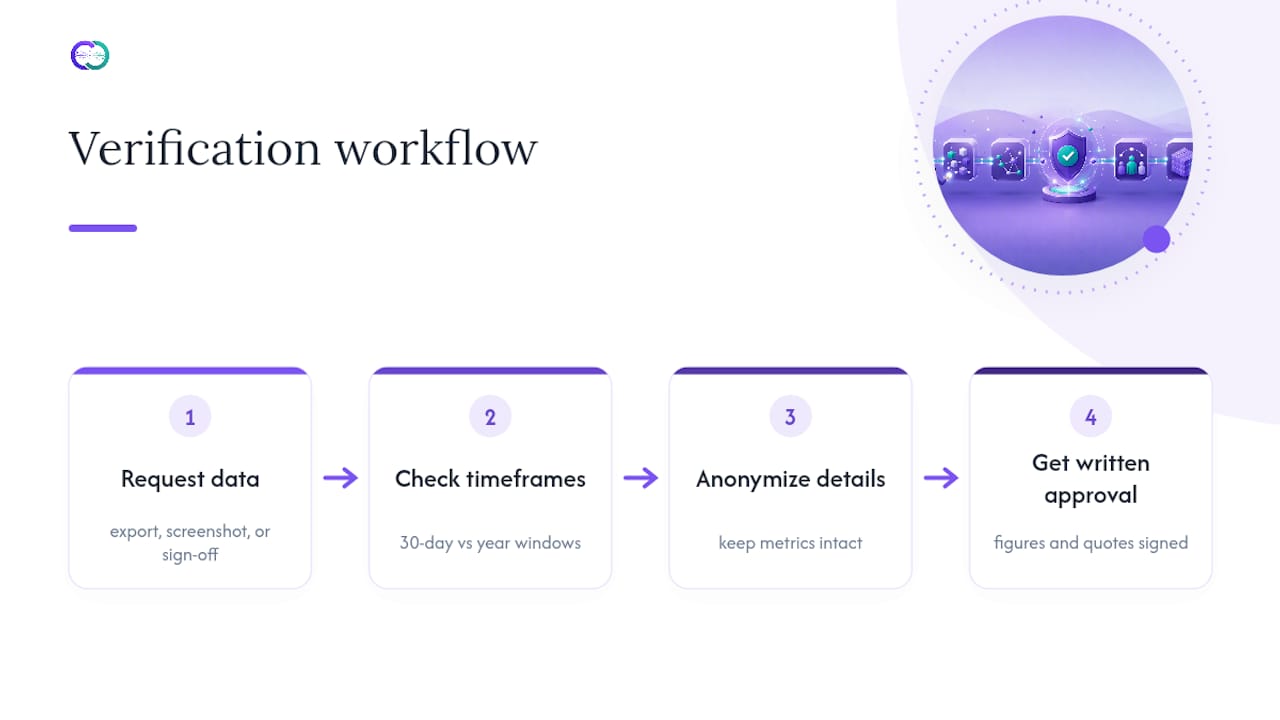
Start by requesting the underlying data directly from the client, whether that’s an analytics export, a dashboard screenshot, or a signed sign-off from a named stakeholder.
Cross-check timeframes carefully. A metric measured over a 30-day window looks very different from the same metric measured over a full year, and mismatched windows are one of the easiest errors to make when compiling data from multiple sources or team members.
Where a product endorsement isn’t possible, strong storytelling around the client’s success can still hold up without naming the specific product, according to commentary from TopRank Marketing on cases with endorsement restrictions. In those situations, keep the metrics intact and anonymize only the identifying details, so the evidentiary core of the story survives even when the client name doesn’t.
Finally, get written approval on the exact figures and quotes before publication, not just approval on the general concept. A client who approved the idea of a case study may still object to a specific number once they see it printed.
The Alloquy Team’s Take on Case Study Fatigue
Most advice on case studies focuses on persuasion mechanics, headlines, quotes, formatting, while treating verification as an afterthought. That ordering is backwards. A case study’s entire value rests on the reader believing the number is real, and once one inflated metric is discovered, every other claim in a company’s marketing gets read with suspicion.
The bigger gap, though, is that professionals apply almost none of this discipline to their own career stories. Resumes list responsibilities. Portfolios list projects. Almost nobody applies the case study structure, challenge, approach, verified result, to their own work, even though it’s the format hiring managers already trust from years of reading vendor case studies.
Recruiters skim resumes for roughly the same reason buyers skim case studies: they’re pattern-matching for a specific, checkable claim, not a list of duties. The professionals who borrow the case study template, and back it with linkable evidence rather than self-reported summaries, are making the same trust argument a strong marketing case study makes to a skeptical buyer.
— Alloquy Team
Sources
- B2B Case Study Template: Write Winning Stories Fast! – WebCoreLab
- How to Write a Marketing Case Study That Actually Converts: A 2026 Framework | SEOAuthori Blog
- Case Study Marketing: The Definitive Guide for 2026
- 7 B2B and B2C Case Study Examples to Model Your Content After | Brafton
FAQ
What are some examples of case studies in marketing?
Common examples include HubSpot’s inbound content case studies, Bitly’s link-attribution stories, L’Oréal’s personalization campaigns, Converse’s social community content, and Zapier’s product-led growth stories, each pairing a specific tactic with a measurable outcome.
What is a case study in marketing?
A marketing case study is a documented account of a specific campaign or client relationship that proves a result with evidence, typically structured around a challenge, an approach, and a measurable outcome within a defined timeframe.
What is the 3-3-3 rule in marketing?
Definitions of the “3-3-3 rule” vary across marketing sources and no single standardized version applies specifically to case studies, so treat any claimed framework by that name with caution and verify it against the primary source before applying it.
What are some good case study examples?
Strong examples lead with an outcome-led headline, include a specific metric and timeframe, and support the claim with a customer quote, patterns visible in published stories from brands like HubSpot, Bitly, and Zapier.
How long should a marketing case study be?
A full web case study typically runs 600 to 900 words, a downloadable PDF works best at 500 to 700 words, and a highlight video should stay close to 90 seconds.