

A recruiter-ready case study leads with a headline result and a constraint, not a project title. Get that sequence right and the piece survives a 60-second cold read; get it wrong and the strongest work you’ve ever done sits unread below a wall of context nobody has time for.
Effective case study organization means treating each project page as an evidence-backed story with a verifiable claim at the top, not a chronological narrative. Three named elements make this work in practice:
- Alloquy, which links your evidence directly to a recruiter-queryable AI assistant
- A stated measurement method for every outcome you cite
- An evidence pack that proves the claim actually happened
Key Takeaways
A recruiter-ready case study leads with a measured headline result and a stated constraint, then backs every claim with a permissioned evidence file.
| Point | Details |
|---|---|
| Lead with the result | State the headline outcome and the constraint before any narrative context. |
| Name your measurement method | Report proxies like task completion across sessions, and always state the method used. |
| Show rejected decisions | Naming what you chose not to do signals judgment recruiters weigh heavily. |
| Keep an evidence pack | Map every claim to a permissioned file; label anything unproven as illustrative. |
| Limit your case count | Publish 2 to 4 strong case studies rather than many thin ones, and consider Alloquy to link evidence directly to a recruiter-queryable profile. |
Table of Contents
- What Belongs in Every Case Study You Publish
- How to Build a Case Study From Raw Evidence to a Published Page
- Make Every Section Pass a Six-Second Glance
- How Do You Report Outcomes Without Access to Production Data?
- Building an Evidence Pack Recruiters Can Actually Verify
- Where to Publish and How Many Case Studies to Keep
- Why Reasoning Beats Metrics in Most Case Studies
- Publish an Evidence-Linked Case Study With Alloquy
- Sources
- FAQ
What Belongs in Every Case Study You Publish
Run this checklist against any case study before you call it done.
- A one-line headline result with a number or a named proxy metric (“Reduced onboarding time from 12 minutes to 4” beats “Improved onboarding”).
- A 30-second summary stating your role, the scope, the timeframe, and the top result, positioned before any narrative detail.
- A problem framed as a constraint with a baseline attached (“Support tickets on the checkout flow ran at 340/week before the redesign”).
- The decisions you rejected and why, not just what you shipped.
- An evidence index noting permission status for each artifact (published, redacted, or illustrative).
A hiring manager who scans only the top third of the page should be able to state your impact back to you. If they can’t, the checklist above tells you exactly which piece is missing.
Pro Tip: Write your headline result and 30-second summary last, after the full case study is drafted. It’s easier to compress a story you’ve already told than to summarize one you haven’t written yet.
How to Build a Case Study From Raw Evidence to a Published Page
Most case studies fail not because the work was weak but because the writer started drafting prose before organizing what they actually had. A three-pillar workflow, moving from evidence to problem, approach, and outcome, fixes that (OpenDoorsCareers).
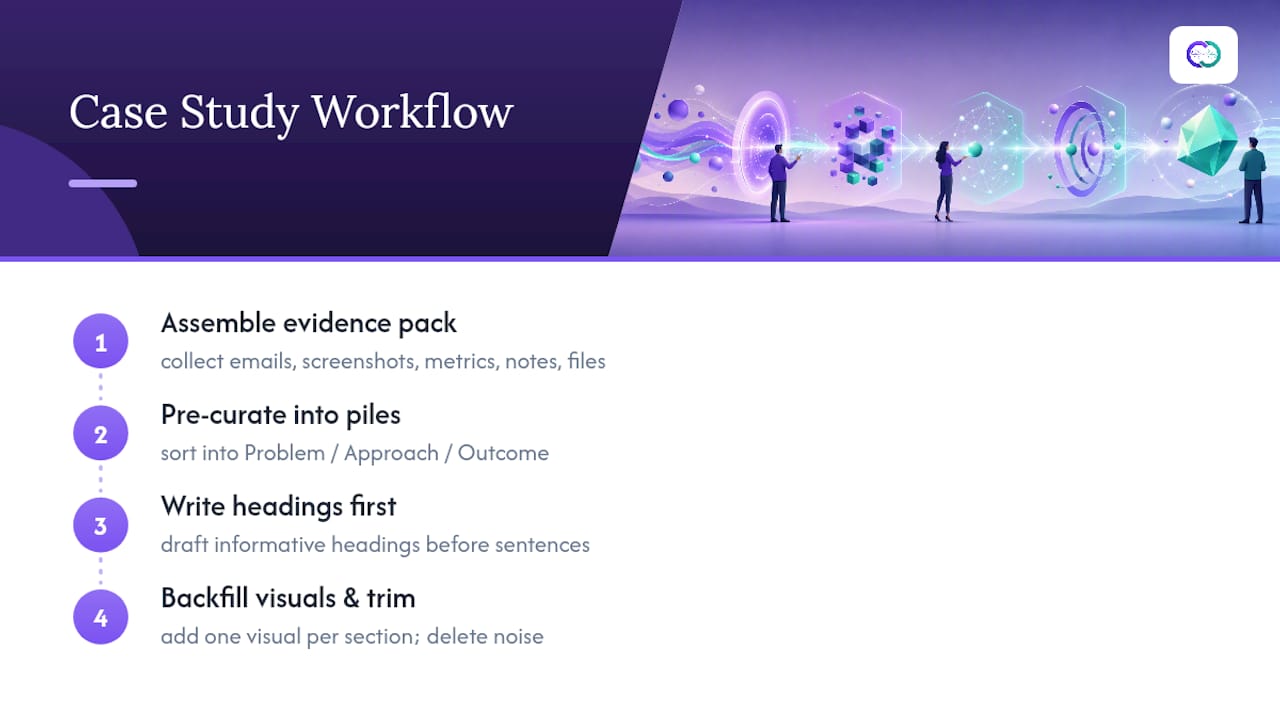
Step 1: Assemble the evidence pack first. Before writing a single sentence, gather everything that could support a claim: permission emails, screenshots, exported metrics, project briefs, meeting notes, and any redacted files. If you can’t locate a file backing a claim, that claim doesn’t make the final draft.
Step 2: Pre-curate into three piles. Sort every artifact into problem (what was broken and its scope), approach (what you tried, including what you rejected), or outcome (what changed and how you measured it). Anything that doesn’t fit one of the three piles is probably background noise, not evidence.
Step 3: Write headings before body text. A heading like “Cut checkout abandonment from 22% to 9% by removing a redundant form step” carries more information than three paragraphs under a heading that just says “The Solution.” Draft every heading in the case study before writing a single supporting sentence underneath it. If a reader could reconstruct your entire story from headings alone, you’ve structured it correctly.
Step 4: Backfill visuals and trim. Add one visual per section, then cut. Keep detail where the decision was genuinely contested; compress or delete sections where the path was obvious. A case study that spends equal words on every phase reads as padded, not thorough.
Pro Tip: If a section of your draft doesn’t change what a recruiter believes about your judgment, delete it rather than trim it.
Make Every Section Pass a Six-Second Glance
Headings carry the informational weight in a scanned document, and design reviewers typically spend around 60 seconds on a first pass through a case study, which means headings must do the work paragraphs would otherwise do (UXfol.io).
A heading that states outcome and mechanism together outperforms a generic label:
- Weak: “User Research”
- Strong: “Interviews With 8 Support Agents Surfaced the Real Bottleneck”
Visual rules that keep a page scannable:
- One image, screenshot, or recording per section, not a gallery.
- For multi-screen flows, use an interactive prototype rather than stacking static screens; a visualization format built for multi-discipline pitches often communicates a flow faster than five separate images.
- Caption every artifact with what it proves, not just what it shows.
- Check that images render legibly on mobile screens and carry alt text, since a meaningful share of cold reads happen on a phone between meetings.
How Do You Report Outcomes Without Access to Production Data?
Name the measurement method before you state the number.
When production analytics aren’t available, small-sample usability testing produces a credible, verifiable substitute. One accepted framing: task completion improved from 40% to 80% across five moderated sessions, method and session count stated up front (MentorCruise). That level of transparency reads as more credible than an unsupported percentage, not less.
Practical rules for proxy metrics:
- Always report the baseline alongside the lift (“from 3 completed tasks out of 5 to 5 out of 5”).
- State session count so the reader can judge sample size for themselves.
- Use qualitative counts when numbers don’t exist (“4 of 5 testers found the new flow without assistance”) rather than inventing a percentage.
Building an Evidence Pack Recruiters Can Actually Verify
Every public claim in a case study should map to a file in an evidence pack; if permission is missing, publish an illustrative walkthrough clearly labeled as such rather than a claim you can’t back (AI Expert).
- Keep a permission email on file for every client or employer named, even loosely.
- Store raw exports and screenshots separately from the polished case study copy.
- Write redaction notes explaining what you removed and why, so gaps look intentional rather than suspicious.
- Run a permission audit: for each claim on the page, confirm it traces to a specific file or mark it “illustrative, not evidenced.”
Alloquy’s Google Drive linking model turns this evidence pack into the backbone of a public profile automatically, letting a recruiter’s questions get answered against your actual files rather than your memory of them.
Pro Tip: When an NDA blocks you from naming a client or sharing real numbers, publish an anonymized version labeled “illustrative case” rather than skipping the case study entirely. A clearly-labeled composite still demonstrates process.
Where to Publish and How Many Case Studies to Keep
Host case studies on a personal site with a proof index, one linkable page per case, rather than burying them inside a single long PDF. A proof-of-work model that pairs one resume with a handful of flagship wins and two to four case studies tends to outperform a portfolio stuffed with a dozen thin ones (Apply4Me).
- Keep 2 to 4 strong case studies, not ten mediocre ones (TailorCV).
- Repeat the same headline result on your resume, LinkedIn, and portfolio so nothing contradicts across channels.
- Make every artifact easy to verify: labeled screenshots, redacted files, and a clear note on what’s real versus illustrative.
- Before publishing, confirm each case study passes the checklist from earlier in this guide, headline first, constraint stated, decisions named.
Organizing your career achievements for AI-driven discovery matters here too, since recruiters increasingly query portfolios through AI assistants rather than reading top to bottom.
Why Reasoning Beats Metrics in Most Case Studies
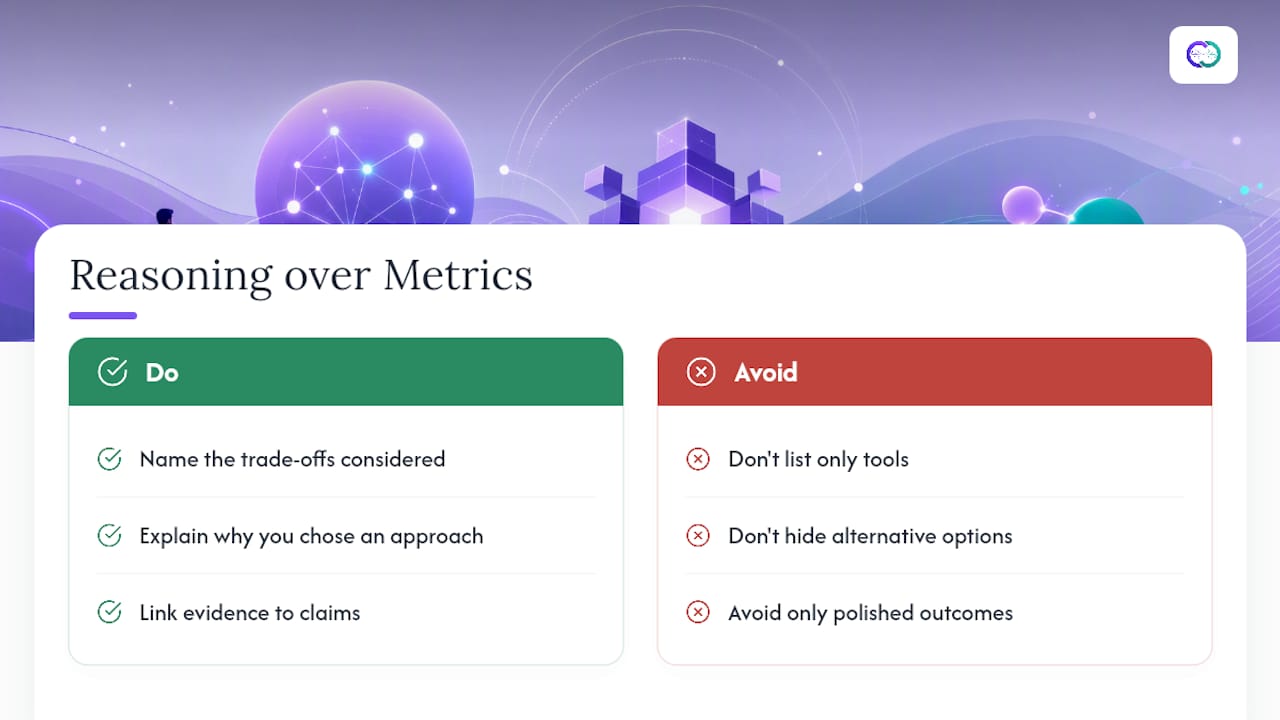
Recruiters weigh the reasoning layer, the decisions you made and rejected, more heavily than a checklist of methodologies you followed. A case study that says “I chose a phased rollout over a full relaunch because the client’s support team couldn’t absorb a spike in tickets” tells a hiring manager more about your judgment than five bullet points listing tools used.
Most portfolios skip this because it’s uncomfortable to admit a decision could have gone another way. That discomfort is exactly why naming it works: it signals you understand trade-offs rather than following a template. The most durable case studies also show what went wrong and how you adjusted, not just the polished outcome (Your Future Career). Verification infrastructure, the kind built into evidence-linked portfolios, exists precisely to let that honesty stand without looking like a liability.
Publish an Evidence-Linked Case Study With Alloquy
Alloquy turns the evidence pack you just built into a live, recruiter-queryable profile instead of a static PDF. Link your Google Drive documents, and Alloquy’s interactive AI-powered portfolio generates a public page where a hiring manager’s AI assistant answers questions against your actual files, not a resume bullet they have to take on faith.
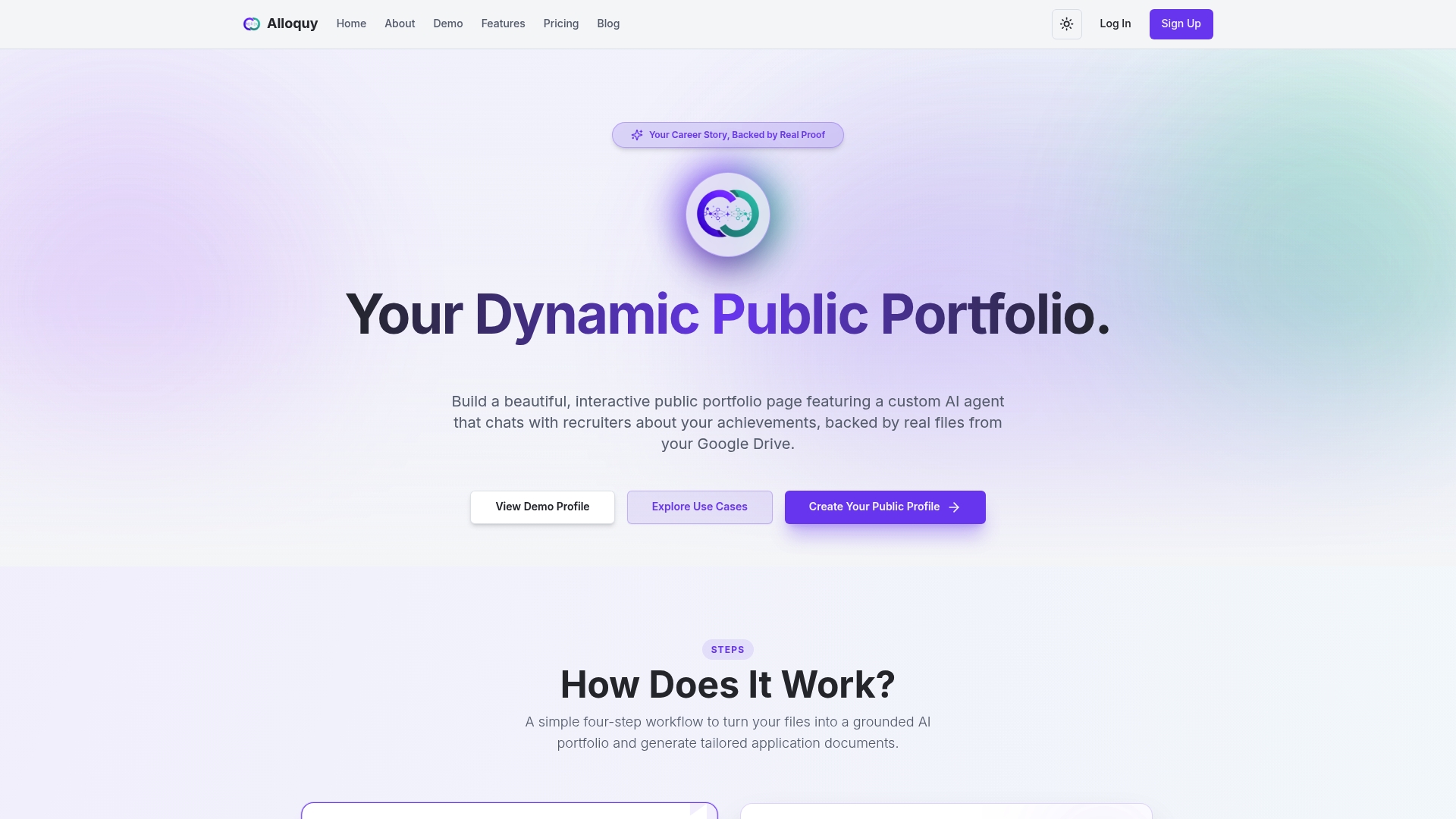
The platform handles the mechanics this guide just walked through: a proof index that organizes your two to four strongest case studies, customizable branding so the page matches your professional identity, and tailored resume and cover letter generation pulled from the same verified evidence. Check the features overview to see how Drive linking and the recruiter chat assistant work together, or review plan options if you’re ready to move your case studies off a static PDF and onto a page recruiters can actually interrogate.
Sources
- UX case study template
- How to write a UX case study that passes the hiring manager’s cold read
- Portfolio case evidence, not hype
FAQ
How Many Case Studies Should a Portfolio Include?
Two to four strong case studies consistently outperform a longer list of thin ones, since hiring managers rarely read past the first few pages in a cold read.
What If I Don’t Have Access to Production Metrics?
Report small-sample usability results instead, such as task completion improving across a stated number of moderated sessions, and always name the measurement method used.
Can I Publish a Case Study Covered by an NDA?
Yes, if you publish an anonymized or illustrative version clearly labeled as such rather than presenting unverifiable specifics as real client data.
What Makes a Case Study Heading Effective?
How Does Alloquy Fit Into Case Study Organization?
Alloquy links your Google Drive evidence to a public, AI-queryable profile, so a recruiter can verify a claim directly against your files instead of taking your summary at face value.
Recommended
- How to Highlight Product Impact When You Aren’t a Product Manager | Alloquy Blog | Alloquy
- How AI Resume Intelligence Transformed Modern Hiring in 2026 | Alloquy Blog | Alloquy
- The Death of Cover Letters: Why AI-Tailored Briefs Get 4x Response Rates | Alloquy Blog | Alloquy
- Understanding LLM Recruiter Bots: How Candidate Scoring Works in 2026 | Alloquy Blog | Alloquy