

Use an outcome-first case study structure: Outcome → Problem → Approach/Decisions → Role → Evidence. Lead with the headline metric, then compress the rest into a 200-word, four-paragraph summary — the format recruiters actually finish reading before they click away.
This structure works because it mirrors how hiring managers scan, not how designers document. The sequence gives you:
- Outcome first — the number or result that earns a second look
- Problem — a diagnosis stated with specifics, not vague pain points
- Approach/Decisions — the judgment calls that produced the outcome
- Role — exactly what you owned versus what the team owned
- Evidence — screenshots, links, and data that back every claim
Alloquy’s evidence-backed portfolio format builds this sequence into the platform itself, pairing a scannable summary with linked, verifiable proof recruiters can query directly.
Key Takeaways
A well-structured case study leads with a measurable outcome, compresses the narrative into a scannable 200-word summary, and backs every claim with linked evidence.
| Point | Details |
|---|---|
| Lead with outcome | State the headline metric or directional result before explaining the problem. |
| Keep the summary short | Cap the main narrative at roughly 200 words across four paragraphs for recruiter scanning. |
| Name a real trade-off | Include one contested decision instead of a full process walkthrough. |
| Curate evidence tightly | Use five to eight images with captions that state what each one proves. |
| Pair with a verified profile | Alloquy links your evidence to a queryable profile so recruiters can confirm claims directly. |
Table of Contents
- What Goes in the Hero Block and Headline Outcome?
- A 200-Word Template You Can Copy Right Now
- How Do You Structure the Full Case Study Anatomy?
- A Step-by-Step Workflow for Publishing One Case Study Fast
- When Does a Static Case Study Need to Become Interactive?
- Our Take on What Actually Makes a Case Study Work
- Turn Your Case Studies Into a Verified, Queryable Profile
- Sources
- FAQ
What Goes in the Hero Block and Headline Outcome?
The hero block is the only part of your case study every recruiter will see. It has to work in under five seconds, before someone decides whether to keep reading or move to the next tab.
Build it with four elements:
- Project title stated as a real name or product, not a generic label like “Redesign Project”
- One-line descriptor that names the problem and the platform in a single clause
- Hero image showing the finished product or a key screen, compressed for fast loading
- Tags covering role, platform, and tools, so recruiters filtering by skill can find it
Below the hero, place two to four headline outcomes as short, number-first labels, inspired by customer stories showing SMB & startup ASO results. Quantifiable results belong up front as headlines — something like “Reduced onboarding drop-off 22%” reads faster and lands harder than a paragraph explaining the same result.
Not every project has a clean metric, and that’s fine. When hard numbers aren’t available, directional outcomes still work: a shipped launch, a client renewal, an award, or adoption across a new market all function as legitimate proof points.
Pro Tip: If you don’t have analytics access to a project’s outcome, ask your former manager or client for a single directional confirmation, even something as simple as “this shipped and is still live.” A confirmed fact beats a vague superlative every time.
A 200-Word Template You Can Copy Right Now
Recruiters scan portfolio pieces in seconds, and a tight 200-word summary in four short paragraphs consistently outperforms the 600 to 1,500-word case studies most portfolio templates encourage. Length signals effort to the writer; it signals friction to the reader.
Here’s the paragraph structure, with one job per paragraph:
- Project and context (about 40 words): what the product was, who it served, and why it existed
- Constraint (about 50 words): the specific limitation, deadline, or business pressure that shaped the work
- Ownership (about 50 words): what you specifically decided or built, stated in first-person active verbs
- Outcome (about 60 words): the metric or directional result, plus one sentence on what it enabled next
A few wording habits make this format hold together:
- Use role tags like “Lead Designer” or “Backend Engineer” rather than vague titles like “Contributor”
- Tag platform and tools explicitly (iOS, React, Figma, Postgres) so the summary doubles as a skills index
- For team projects, name your specific contribution in the ownership paragraph and credit the team explicitly elsewhere rather than implying solo authorship
- For unreleased or confidential work, describe the constraint and decision without disclosing proprietary specifics, and note that supporting detail is available on request
How Do You Structure the Full Case Study Anatomy?
The 200-word summary is what gets read. The expanded anatomy underneath is what gets you hired, because it’s where a recruiter checks whether your claimed skill matches how you actually behaved under pressure.
Problem, stated with numbers. A vague problem statement (“the app was hard to use”) tells a recruiter nothing. A diagnosis with specifics does: “Checkout abandonment sat at 34%, concentrated at the payment step, according to funnel analytics.” A strong case study organizes around problem, approach, and outcome as a connected narrative, not a documentation log listing every meeting and iteration.

Approach and decisions. This is where most case studies go flat, because most people describe process instead of judgment. Naming a contested trade-off is worth more than a full process diagram. If you chose a faster but less elegant technical path because of a launch deadline, say that. A decision log, even three or four lines long, shows a hiring manager exactly how you think when priorities conflict. This is also where framing your specific product impact matters if your title wasn’t “Product Manager” but your decisions still shaped the outcome.
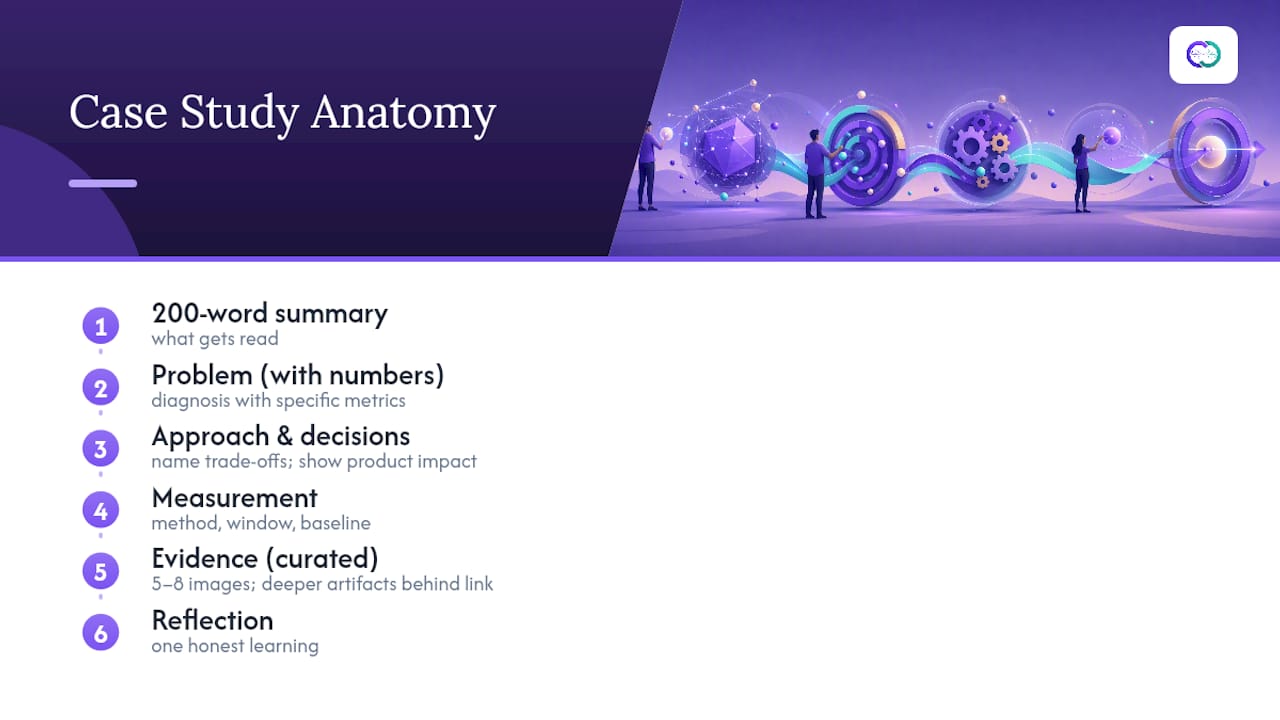
Measurement. Show the method before the number: how was the metric tracked, over what window, against what baseline? “Session recordings and Amplitude funnels over eight weeks, compared to the prior quarter” gives your result credibility a bare percentage doesn’t.
Evidence. Curate five to eight images rather than fifteen, each with a caption that states what it proves, not just what it shows. Page weight under roughly 3MB keeps mobile load times reasonable. Deeper artifacts (full research decks, code repositories, design files) belong behind a “more details” link rather than inline, since visuals should show outcomes or decisions, not every intermediate step.
Reflection. Close with one honest learning, not a highlight reel. “I’d have scoped the second phase earlier” reads as more credible than “this project taught me the value of collaboration.”
A Step-by-Step Workflow for Publishing One Case Study Fast
You don’t need a perfect system to produce a strong case study. You need a sequence that stops you from staring at a blank page.
- Gather evidence first. Pull analytics screenshots, design files, code snippets, and any client or manager confirmation before you write a word. Check permissions now, since publishing only what you can support with proof and consent matters more than covering every project you’ve touched. Two or three well-documented case studies outperform six thin ones.
- Group assets into the three pillars. Sort everything into problem, approach, or outcome piles, then cut anything that doesn’t fit cleanly. Pick your hero image and five to eight supporting visuals.
- Write headings before sentences. Draft section headings that state the point (“Cut checkout time by 40%,” not “Results”), then backfill one or two supporting sentences under each. Label your role explicitly near the top.
- Compress and test. Compress images, check mobile load speed, and confirm the case study links back to your portfolio index with a working navigation path.
- Add an optional depth layer. A “more details” expandable section or a downloadable PDF gives thorough readers somewhere to go without bloating the main scan. Guidance on showcasing sensitive work without exposure applies directly here if any evidence needs redaction first.
Pro Tip: Write the outcome headline before you write anything else. If you can’t state it in one line, the project probably isn’t ready to publish yet.
When Does a Static Case Study Need to Become Interactive?
A written case study is a fixed artifact. It answers the questions you anticipated, in the order you chose, and nothing else. A recruiter comparing candidates across a dozen tabs often has one specific question your paragraph structure didn’t anticipate, and a static page has no way to answer it.
This is the gap an interactive, evidence-backed profile closes. Alloquy converts linked Google Drive documents, deliverables, and case study writeups into a queryable profile: a recruiter can ask a direct question and receive an answer grounded in your actual verified files, not a generic paraphrase.
- The AI assistant draws from your linked evidence, so answers stay tied to documents you actually produced
- Customizable branding and themes keep the profile consistent with how you present your written case studies elsewhere
- Tailored resumes and cover letters can be generated from the same verified data, so your story stays consistent across formats
The two formats aren’t competitors. A static case study, structured the way this guide describes, is what most recruiters will read first. An interactive profile is what handles the follow-up question a static page can never anticipate. Pairing a well-built technical portfolio with an evidence-linked assistant covers both the skim and the deep dive.
The strongest portfolios today aren’t longer. They’re structured so a five-second scan and a five-minute deep dive both land on the same verified facts.
Our Take on What Actually Makes a Case Study Work
Most portfolio advice still treats a case study as a documentation exercise: show the research, show the wireframes, show the final screen. That approach rewards thoroughness over judgment, and it’s exactly backward for how hiring decisions actually get made. A recruiter isn’t auditing your process. They’re checking whether your decisions under real constraints match the skill level on your resume.
The 200-word format isn’t a compromise forced by short attention spans. It’s a discipline that exposes whether you actually understand your own project. If you can’t compress a project into four tight paragraphs with a real outcome and one honest trade-off, you probably haven’t fully processed what happened on it. Length was never the credibility signal. Specificity was.
The bigger shift underway is that static formats are hitting a ceiling regardless of how well they’re written. A page can only answer the questions its author anticipated. Evidence-backed, queryable profiles extend that same rigor into the follow-up conversation a resume page can’t have on its own.
— Alloquy Team
Turn Your Case Studies Into a Verified, Queryable Profile
A written case study proves you can structure a story. Alloquy proves the story holds up when someone asks a question you didn’t anticipate. Instead of hoping a recruiter reads your full 200-word summary and takes your metrics on faith, Alloquy links your actual Google Drive evidence to a public profile with a built-in AI assistant, so recruiters can ask direct questions and get answers grounded in documents you actually produced.
That matters most for candidates whose best work lives across scattered files, client decks, or unreleased projects that don’t compress cleanly into a single page. Customizable branding keeps your profile visually consistent with your written case studies, and the platform can generate tailored resumes and cover letters from the same verified data, so every document you send tells the same accurate story. If your projects deserve more than a static page can hold, explore Alloquy’s plans and build a profile recruiters can actually interrogate.
Sources
These sources shaped the structure and word-count guidance in this piece:
- How to write a portfolio case study that recruiters actually read — DevDazzle
- How to showcase case studies on your portfolio site — APSBay
FAQ
How long should a portfolio case study be?
Aim for a 200-word summary across four short paragraphs for the main narrative recruiters scan first, with deeper detail available behind an optional expandable section or linked document.
What’s the right number of images to include?
Five to eight curated images with specific captions work better than fifteen or more, since each image should prove a decision or outcome rather than just document a step.
What if I don’t have a hard metric for a project?
Use a directional outcome instead, such as a successful launch, a market expansion, or a client renewal. These still function as credible proof when framed clearly.
How do I show my role on a team project?
State your specific ownership explicitly in the summary and decision sections, and credit teammates by function elsewhere rather than letting the phrasing imply solo authorship.
Should I use a static case study or an interactive profile?
Use both. A structured static case study handles the first scan, while a platform like Alloquy handles follow-up questions by letting recruiters query your linked evidence directly.
Recommended
- The Death of Cover Letters: Why AI-Tailored Briefs Get 4x Response Rates | Alloquy Blog | Alloquy
- Understanding LLM Recruiter Bots: How Candidate Scoring Works in 2026 | Alloquy Blog | Alloquy
- Why Multi-Format Resume Assets Are Key to Modern Job Search Success | Alloquy Blog | Alloquy
- How AI Resume Intelligence Transformed Modern Hiring in 2026 | Alloquy Blog | Alloquy