

AI case study examples, in the sense that matters for hiring, are interactive portfolio narratives where a project write-up is paired with an AI assistant that can answer recruiter questions against verified evidence. The recommendation is direct: publish two to five outcome-led case studies, attach real artifacts (screenshots, code, metrics), and structure them so an AI assistant can query the underlying documents rather than just display static text. Alloquy builds this exact workflow around linked Google Drive evidence, and the best-practice consensus across career platforms confirms the core principle: proof-of-work narratives beat resume claims every time.
TL;DR:
- Publishing two to five outcome-focused case studies with verified artifacts enhances credibility over simple resume claims, especially when linked to real data or code.
- Effective case studies should include clear metrics, artifacts like screenshots or datasets, and focus on specific tasks such as UX redesigns, automation, or business decisions.
- Use anonymized or proxy data for NDAs, and structure evidence in a way that allows AI assistants to answer detailed questions directly from source documents.
- The seven-part template, starting with the outcome and including constraints, approach, and lessons learned, makes case studies easily scannable for recruiters.
- Incorporating structured metadata, permission controls, and linking artifacts properly enables AI queryability, boosting verifiability and recruiter trust.
Table of Contents
- Six AI Case Study Examples You Can Adapt This Week
- The Seven-Part Template That Makes Every Case Study Scannable
- Which Artifacts Actually Prove Your Work Happened
- How to Make a Case Study Queryable by an AI Assistant
- Industry-Specific AI Case Study Examples Worth Studying
- Common Challenges in AI Case Studies and How to Solve Them
- Ethical Considerations and Fairness When Using AI in Case Studies
- Emerging AI Technologies Changing What a Case Study Can Show
- Storytelling Tips for Reaching Different Kinds of Readers
- Why Verified Evidence Beats Polished Claims Every Time
- Publishing Your First Queryable Case Study on Alloquy
- Sources
- FAQ
Six AI Case Study Examples You Can Adapt This Week
Every strong case study follows the same DNA regardless of role: a problem, a decision, and a number that proves the decision worked. Below are six role-specific templates, each built around a different kind of evidence.
1. The UX redesign that moved a conversion metric
State the problem in one sentence (checkout abandonment at a high rate), then walk through your research method, wireframe iterations, and the A/B test that validated your final design. Attach usability test recordings or screenshots and the raw analytics export showing before-and-after conversion. Nielsen Norman Group recommends leading with the measured outcome, not the visual polish, since recruiters scan for impact before they scan for aesthetics.
2. The data analysis that changed a business decision
Frame it as a hypothesis about when churn spikes after signup. Show the dataset scope, the method (cohort analysis, SQL, or a specific statistical test), and the resulting policy change. A chart or a cleaned dataset snapshot does more convincing than three paragraphs of description.
3. The automation that eliminated manual hours
Name the task (manual invoice reconciliation), the stack (Python, an API, a scheduling tool), and the time saved. Before-and-after logs, even redacted ones, are the single most persuasive artifact type here because they are nearly impossible to fabricate convincingly.
4. The content campaign that beat its KPI
Lay out the strategy, the channels, and a measurable lift (email open rate, organic traffic, lead volume). Attach the campaign report or an analytics screenshot with the date range visible, since an undated screenshot invites doubt.
5. The developer feature shipped under real constraints
Write it as a user story, note the architectural decision (why you chose event-driven over polling, for instance), and cite test coverage. Link a GitHub diff and a live demo. Alloquy’s guide to developer portfolio examples covers how to structure this without leaking proprietary logic.
6. The product launch with a full funnel view
Detail the go-to-market sequence and adoption curve, from waitlist to activation. Attach funnel metrics and, if available, a short post-launch survey excerpt. This example type works especially well for product managers and founders pitching strategic judgment rather than technical execution.
The Seven-Part Template That Makes Every Case Study Scannable
A recruiter spends seconds, not minutes, on a first pass. Structure fights that constraint instead of losing to it.
- Outcome lead: one sentence stating the result before any context.
- Context and problem: two to three sentences on the situation you inherited.
- Your role: what you specifically owned, not what the team did.
- Constraints: budget, timeline, legacy systems, or approval chains that shaped the work.
- Approach: the method, in bullets, not narrative prose.
- Results with metrics: the number, the baseline it beat, and the timeframe.
- Lessons learned: what you would change, which signals judgment more than any polished win.
Scannability rules matter as much as the template itself: keep the outcome sentence at the very top, use bullets for methods rather than paragraphs, and caption every artifact with a one-line context note. Before publishing, run this checklist:
- Confirm you have permission to share client-identifying details.
- Redact names, account numbers, or proprietary figures that don’t affect the point.
- Write a plain-text summary underneath any image, since ATS and AI parsers can’t read screenshots.
- Add descriptive alt text to every image.
- Assign each case study its own canonical URL rather than burying it in a PDF.
Pro Tip: Write the outcome sentence last, after you’ve drafted the whole case study. You’ll almost always find a sharper, more specific number once you’ve walked back through the details.
Which Artifacts Actually Prove Your Work Happened
Recruiters and AI assistants both need something more durable than your description of events. The strongest artifact types, ranked by how hard they are to fake:
- Annotated screenshots with visible timestamps and filenames, not cropped images with no context.
- Raw metric snapshots pulled directly from analytics tools, showing the date range.
- GitHub links with a clear README explaining what the repository demonstrates and why.
- Test plans or QA documentation that show process, not just final output.
- Client email excerpts, shared only with explicit permission, that confirm scope or feedback.
Presentation matters as much as the artifact itself. Add a short context line above every image explaining what the viewer is looking at, and use read-only Drive links or static snapshots rather than editable files that could be altered later. When an NDA blocks full disclosure, anonymize the dataset, swap real numbers for a proportionally accurate proxy, or generate a demo sequence that preserves the decision logic without exposing the client’s actual data. A one-line redaction note (“client figures anonymized per NDA”) preserves credibility far better than silently omitting the artifact.
How to Make a Case Study Queryable by an AI Assistant
Turning a static write-up into something an AI assistant can actually answer questions about takes a few deliberate steps:
- Consolidate artifacts in one Drive folder or document set rather than scattering them across tools.
- Set read-only permissions so the assistant and any viewer can access evidence without editing risk.
- Add structured metadata: role, date, client industry, and specific metric fields attached to each artifact.
- Configure the assistant to reference canonical URLs rather than paraphrased summaries, which keeps answers traceable to source documents.
- Keep a short decision log per case, noting what you tried, what you abandoned, and why.
Mokaru’s job search portfolio guidance points to the same underlying shift: hiring increasingly rewards a live, shareable proof-of-work page over a static PDF resume.
Here’s what queryability looks like in practice. A recruiter asks an AI assistant on your Alloquy profile: “Has this candidate worked on churn reduction?” A well-tagged case study lets the assistant respond with the specific project, the method used, the churn percentage before and after, and a link to the underlying cohort analysis, rather than a generic “yes, they have relevant experience.”
Industry-Specific AI Case Study Examples Worth Studying
The shape of a strong case study shifts by industry, mostly around what counts as acceptable evidence. In healthcare, a case study might describe a clinical workflow automation, with the metric framed around hours saved per week or error-rate reduction, and artifacts limited to anonymized process diagrams rather than any patient data. In finance, a fraud-detection model or reconciliation automation case study leans on aggregate accuracy figures and a redacted false-positive rate, since raw transaction data almost never clears compliance review.
Retail and e-commerce case studies tend to be the most metric-rich, since conversion, cart abandonment, and average order value are usually shareable without exposing proprietary customer data. A recommendation-engine case study, for instance, can show a lift percentage alongside an anonymized cohort chart. In software and SaaS, developer-facing case studies get the most latitude: public repositories, architecture diagrams, and test coverage reports are often shareable in full.
Marketing and agency work sits in between: campaign reports are usually shareable with client permission, though revenue figures often need to be expressed as percentage lift rather than absolute dollars. Across every industry, the constant is the same: pick the artifact type your field actually allows you to show, and don’t force a screenshot where a redacted summary would be safer and just as convincing.
Common Challenges in AI Case Studies and How to Solve Them
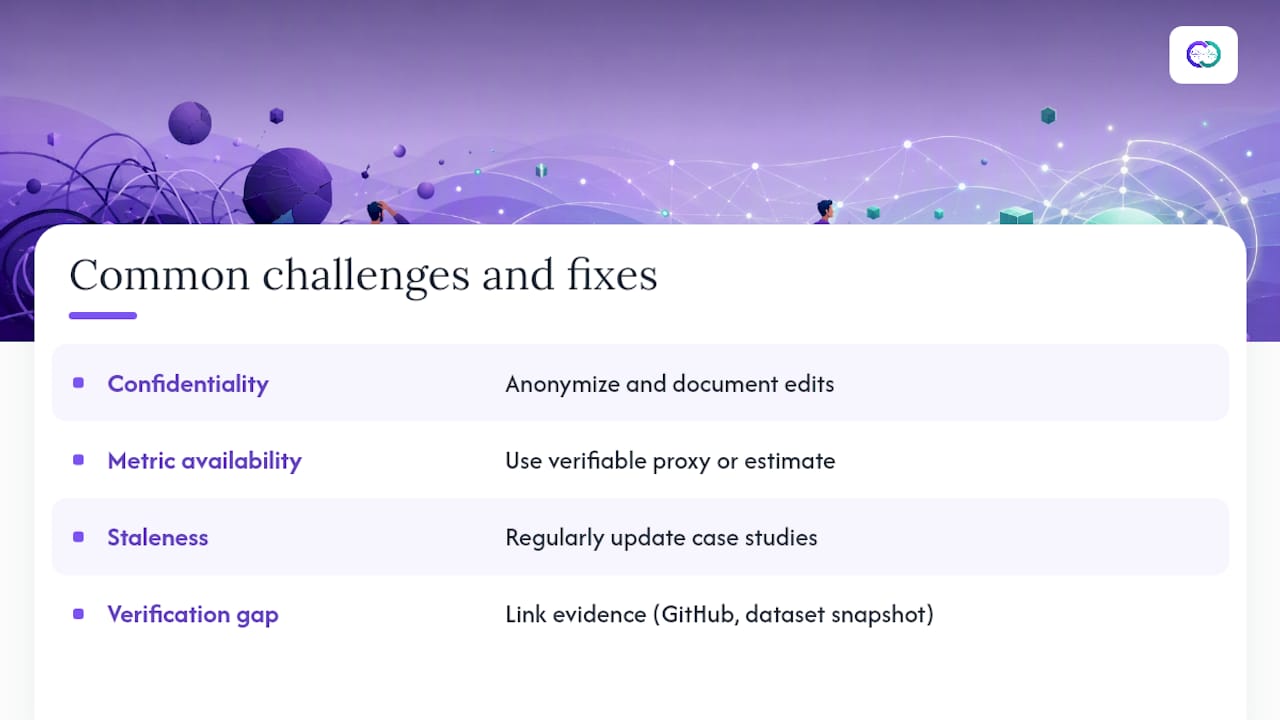
The most frequent obstacle is confidentiality: most meaningful projects involve a client or employer with a stake in what gets shared. The fix isn’t to skip the case study. It’s to anonymize aggressively and document that you did so, which signals professionalism rather than evasion.
A second challenge is metric availability. Not every project ends with a clean before-and-after number, especially early-career work or internal tools with no formal tracking. When a hard metric doesn’t exist, substitute a qualitative outcome tied to a specific, verifiable event: a shipped feature, a passed audit, a client renewal. Vague claims (“significantly improved performance”) should be replaced with the closest measurable proxy available, even an estimate you can defend in an interview.
A third challenge is staleness. Case studies written once and never revisited drift out of sync with your actual skill level and the tools you now use. Treat each one as a living document, not a monument, and revisit it whenever you add a meaningfully better example.
Finally, there’s the verification gap: recruiters have learned to distrust unsubstantiated claims, particularly since AI-generated resumes have flooded applicant pools. The solution is structural, not rhetorical: link the evidence, don’t just describe it. A case study with a live GitHub link and an actual dataset snapshot resolves more skepticism in ten seconds than a paragraph of persuasive writing ever could.
Ethical Considerations and Fairness When Using AI in Case Studies
An AI assistant answering recruiter questions about your work carries a specific risk: it can only be as accurate as the evidence and metadata behind it. If a case study overstates your role, or if the underlying documents are incomplete, the assistant will confidently repeat that inaccuracy to a recruiter, which is a worse outcome than a human reader catching the same gap.
Fairness also cuts toward how you describe team contributions. If a project involved three engineers, and you were responsible for one component, the case study and the assistant’s answers should reflect that scope precisely. Overclaiming a shared win erodes the credibility of an otherwise strong case study the moment a recruiter asks a follow-up question the AI can’t verify.
There’s also a data-handling dimension. Any artifact touching real user data, even anonymized, deserves a redaction note explaining what was removed and why. This matters more in regulated fields like healthcare or finance, where a screenshot casually shared could expose information the reader has no way of knowing was sensitive. Building this discipline into your case study workflow protects both the people whose data appears in your work and your own credibility if a recruiter asks how the artifact was sourced.
Emerging AI Technologies Changing What a Case Study Can Show
The case study format itself is shifting as the underlying technology improves. Retrieval-based AI assistants, the kind Alloquy’s platform runs on, can now answer specific, granular recruiter questions by pulling directly from linked documents rather than a static summary paragraph. This changes what “detail” means in a case study. You no longer need to cram every metric into the visible text. You need the underlying documents structured well enough that the assistant can surface the right one on demand.
Anonymization tooling has also improved enough that generating a realistic proxy dataset, one that preserves statistical patterns without exposing real records, is now a viable alternative to skipping an NDA-protected case study entirely. Code-analysis tools that summarize a repository’s architecture automatically are starting to make developer case studies easier to document accurately, reducing the gap between what a developer actually built and what they remember to describe.
None of this replaces the fundamentals. A queryable AI assistant sitting on top of vague or unverified claims is still a vague, unverified case study. The technology extends the reach of good evidence. It doesn’t manufacture evidence that doesn’t exist.
Storytelling Tips for Reaching Different Kinds of Readers
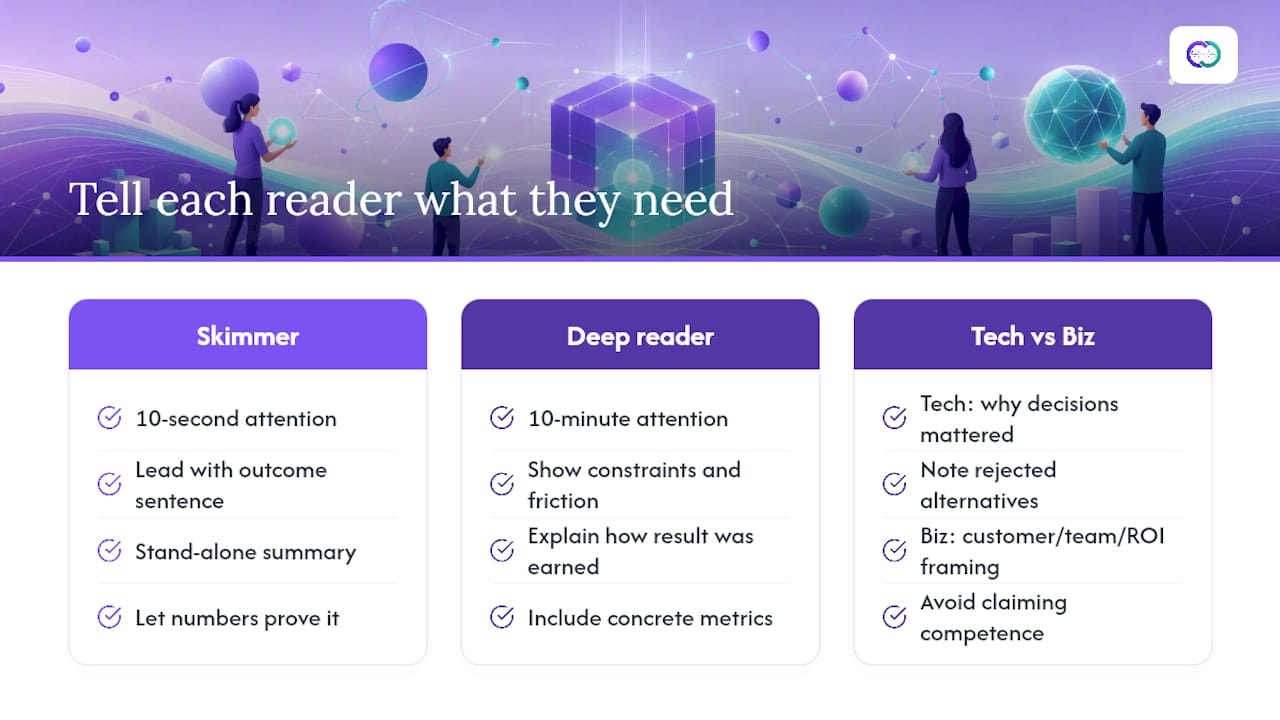
A recruiter skimming for ten seconds and a hiring manager reading closely for ten minutes need the same case study told two different ways. Lead every case study with the outcome sentence so the skimmer gets full value even if they read nothing else. That single sentence should work as a standalone summary.
For the reader who goes deeper, the constraints section is where storytelling earns its keep. Describing the actual friction (a legacy system you couldn’t touch, a two-week deadline, a stakeholder who wanted something different) makes the eventual result feel earned rather than inevitable. Specificity is what separates a memorable case study from a forgettable one.
Technical readers, especially engineering managers, want the “why” behind decisions more than the “what.” A brief note on a rejected alternative approach, and why you didn’t take it, often lands harder than a polished description of the path you did take. Non-technical readers, by contrast, respond better to business framing: what changed for the customer, the team, or the bottom line.
Across every audience, avoid narrating your own competence directly. Let the evidence and the numbers make that case. A case study that says “I’m a strong problem solver” persuades no one; a case study that shows the problem, the fix, and the number attached to it persuades almost everyone.
Why Verified Evidence Beats Polished Claims Every Time
Recruiters have grown numb to confident language on a resume, largely because AI writing tools made confident language free. What hasn’t gotten cheaper is verifiable evidence: a real screenshot, a real repository, a real metric tied to a real date. That asymmetry is the whole argument for building interactive, queryable case studies rather than another static PDF.
Alloquy’s approach, linking Google Drive evidence directly to an AI assistant a recruiter can question, exists because owning the platform and controlling the evidence chain compounds credibility over time rather than resetting with every application cycle.
If you have two hours today: gather three artifacts from your strongest project, write one case study using the seven-part template above, then link the documents and publish a public profile or snapshot. That’s a complete cycle, not a partial one.
— Alloquy Team
Publishing Your First Queryable Case Study on Alloquy
Most professionals default to a resume bullet or a static PDF because that’s what the last decade of hiring trained them to build. Alloquy takes a different route: link your Google Drive documents, and the platform turns your existing project files into an interactive case study with a custom AI assistant that answers recruiter questions directly against your verified evidence, no rewriting or reformatting required.
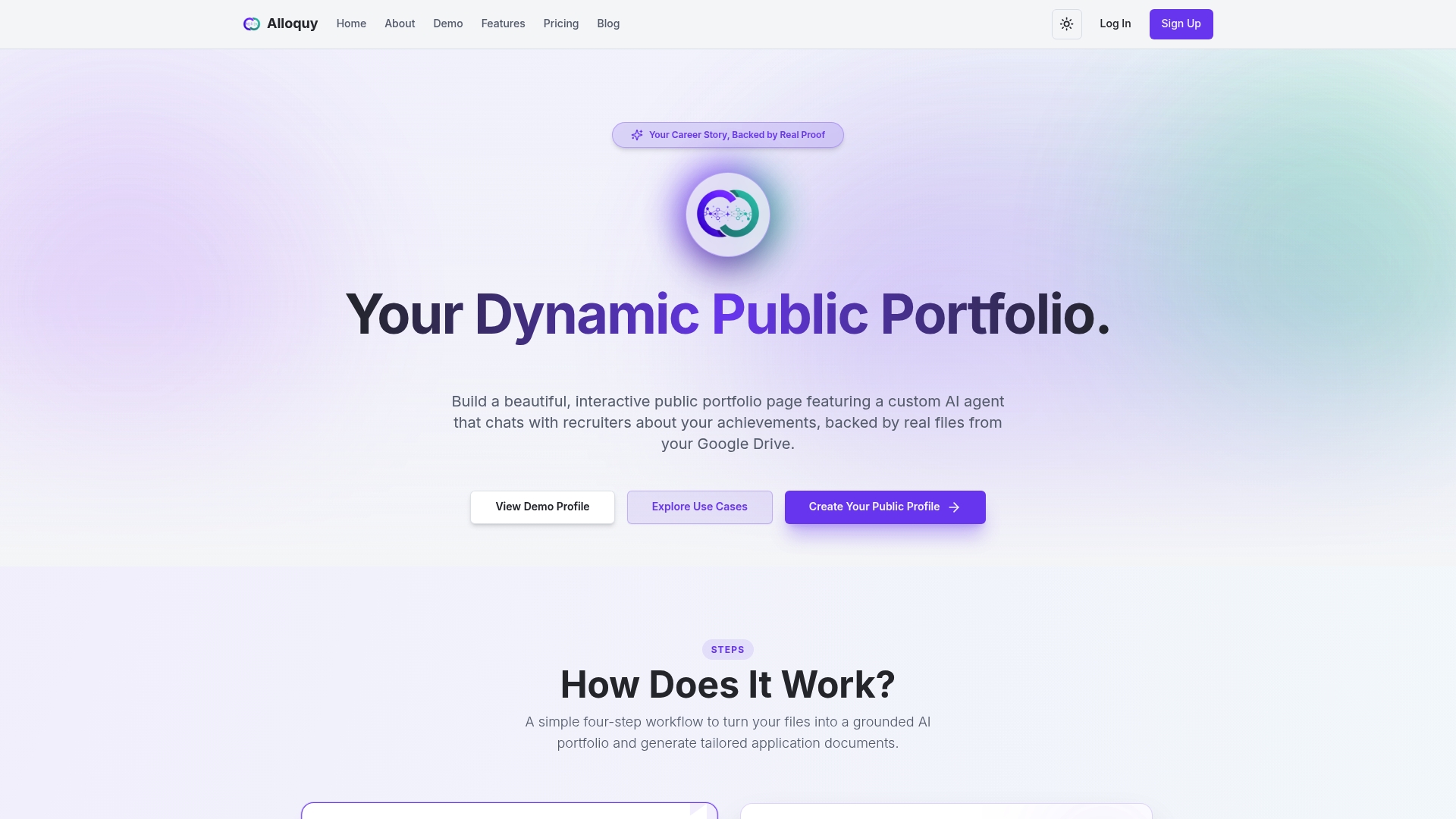
The immediate next step is small: sign up, connect one Drive folder from a recent project, and publish a single case study using the structure outlined above. You can start on the free tier to test the workflow before deciding whether to expand storage or unlock additional AI generation limits. Once your first profile is live, check the feature overview to see how permissions, branding, and tailored resume generation connect to the same verified evidence base. A recruiter querying your assistant about a specific project gets an answer sourced from your actual documents, not a paraphrase you wrote months ago and forgot to update.
Sources
- How to write a business case study | Johnson & Wales Online
- UX design portfolios | Nielsen Norman Group
- How to showcase case studies on your portfolio site | Apsbay
- How to build a job search portfolio in 2026 | Mokaru
FAQ
What Makes a Case Study “AI-Queryable”?
It means the underlying documents (screenshots, metrics, code) are linked and structured so an AI assistant can pull specific answers from them, rather than displaying only a static summary a recruiter has to read in full.
How Many Case Studies Should I Publish?
Two to five well-documented case studies, each with real artifacts and a measured outcome, outperform a longer list of thin, unverified examples.
What if My Best Project Is Under an NDA?
Anonymize the data, use a proxy dataset that preserves the statistical pattern, or describe the decision logic through a generated demo sequence, and add a short note explaining the redaction.
Does Alloquy Require Coding Skills to Set Up?
No. Alloquy connects to your existing Google Drive documents and configures the AI assistant automatically, so publishing a queryable case study doesn’t require any technical setup.
What’s the Single Most Important Metric to Include?
Whichever number most directly ties your specific action to a business or technical outcome, stated with its baseline and timeframe so it reads as verifiable rather than vague.