

If your goal is mass autofill at speed, LazyApply and Jobright AI are the most capable Simplify alternatives. For structured tracking and curated workflow, Huntr is the strongest option. For candidates who need ATS-safe document outputs and verifiable proof of work that recruiters can interrogate, Alloquy is the recommended choice — it addresses the core failure mode of every autofill tool by converting static career artifacts into evidence-backed, interactive profiles.
Here is the shortlist by goal:
- Mass apply fast: LazyApply (high-volume autofill, LinkedIn/Indeed integration)
- Targeted apply with tracking: Huntr (Kanban board, contact management, task reminders)
- Resume optimization before applying: Resume Optimizer Pro (ATS keyword scoring, rewrite suggestions)
- AI-guided job discovery + autofill: Jobright AI (semantic job matching, form-fill assistance)
- Lightweight autofill + tracking: JobWizard (browser extension, basic dashboard)
- Evidence-backed interactive portfolio + ATS-safe outputs: Alloquy (recruiter-queryable AI assistant, tailored resume and cover letter generation from verified artifacts)
Pick the tool that matches your immediate hiring mode: bulk volume, curated targeting, or portfolio-first outreach to high-value roles.
Key Takeaways
The most effective job-search strategy in 2026 combines a lightweight autofill tool for volume applications with an evidence-backed interactive portfolio for high-value targeted outreach.
| Point | Details |
|---|---|
| Autofill tools optimize for speed | LazyApply and Jobright AI handle volume well, but produce generic text that weakens targeted applications. |
| ATS cannot read portfolio URLs | Include inline text describing your artifacts on your resume; the ATS parses text, not the page behind the link. |
| Dual-CV strategy covers both needs | Submit an ATS-safe PDF for machine parsing and share your Alloquy profile link for recruiter review. |
| Tracking prevents follow-up failures | Huntr’s Kanban board is the most reliable way to manage 30+ active applications without losing threads. |
| Alloquy for evidence-backed outreach | Alloquy generates tailored ATS-safe documents from verified artifacts and lets recruiters query your work directly. |
Table of Contents
- What do Simplify Copilot’s core features actually do?
- How do you choose the right alternative to Simplify?
- At-a-glance feature comparison across the top alternatives
- Profiles of the top alternatives: who should use each one?
- Why evidence-backed portfolios often outperform mass autofill
- What customer support and community resources look like across these tools
- How these tools integrate with job boards and platforms
- What customization options do these tools actually offer?
- Mobile app availability across the top tools
- What user reviews and reputation signals reveal
- The most effective tool stack for a 2-week job-search sprint
- Alloquy addresses what autofill tools cannot
- Sources
- FAQ
What do Simplify Copilot’s core features actually do?
TechCrunch reported that Simplify positions itself as an AI-powered job-search copilot, combining autofill, application assistance, and a job discovery feed in a single browser extension. Its core feature set includes:
- Autofill/form-fill: Detects application fields and populates them from a stored profile
- Browser extension: Activates on supported job boards (LinkedIn, Indeed, Greenhouse, Lever, and others)
- Job discovery feed: Aggregates listings from multiple sources into a single dashboard
- Application tracking: Logs submitted applications and their status
In a typical workflow, a job seeker installs the extension, builds a profile once, and then applies to dozens of roles in a single session. The speed advantage is real, particularly for early-career candidates targeting high-volume markets.
The shortcomings are equally concrete. Autofill populates fields generically — the same profile text goes into every application, regardless of role fit. ATS parsing engines at many enterprise employers cannot reliably extract structured data from autofill-generated submissions, particularly when field mapping is imprecise. Privacy is a secondary concern: Simplify’s model requires storing your career data on its servers, and the terms governing how that data is used or shared are not always transparent to users.
Pro Tip: Use autofill for roles where speed matters and the job description is a close match to your stored profile. For senior roles, specialized positions, or companies where you have a referral, write a tailored submission — autofill’s generic output is a liability, not an asset, in those contexts.
How do you choose the right alternative to Simplify?
The decision framework comes down to nine criteria, weighted by your current hiring phase.
Decision criteria to evaluate:
- Best for: Does the tool optimize for volume, quality, or presentation?
- Primary function: Autofill, tracking, resume optimization, or portfolio?
- ATS compatibility: Does it produce an ATS-safe PDF, or does it rely on form-fill that may corrupt field mapping?
- Resume optimization: Does it score or rewrite resume content against a specific job description?
- Application tracking: Can you log status, contacts, and follow-up dates?
- Privacy and data handling: Where is your data stored, and can you delete it?
- Integrations: Which job boards and ATS platforms does it connect to natively?
- Mobile performance: Is the core workflow usable on a phone, or is it desktop-only?
- Pricing shape: Is there a functional free tier, or does the useful feature set sit behind a paywall?
Questions to ask before committing to any tool:
- Does it produce an ATS-safe PDF I can submit independently?
- Can I export my application data if I cancel?
- Does it tailor resume content to each job description, or does it reuse a single stored profile?
- Is there a clear privacy policy that specifies how my career data is used?
- Does it integrate with the specific boards and ATS platforms my target employers use?
Red flags: opaque data-sharing terms, no export function, single-format outputs with no tailoring, and no resume rewriting capability.
Workflow mapping by candidate goal:
- Mass apply fast: Prioritize autofill coverage, browser extension reliability, and volume limits on the free tier.
- Curated targeted apply: Prioritize resume optimization, ATS-safe PDF output, and tracking with contact management.
- Portfolio-first outreach: Prioritize interactive portfolio capability, recruiter-facing AI Q&A, and evidence-backed document generation.
At-a-glance feature comparison across the top alternatives
The G2 alternatives listing and Product Hunt’s alternatives page both confirm that job seekers evaluate these tools across a consistent set of dimensions. The table below reflects those dimensions for each tool covered in this article.
Profiles of the top alternatives: who should use each one?
Simplify (the baseline)
Simplify’s value is speed. Install the extension, build a profile once, and apply to dozens of roles without re-entering data. The job discovery feed aggregates listings usefully. Where it falls short: no resume tailoring per role, no ATS-safe PDF generation, and generic application text that experienced recruiters recognize immediately. Best for early-career candidates in high-volume markets who need to generate initial traction fast.
Alloquy
Alloquy operates on a fundamentally different model. Rather than filling forms, it converts your verified career artifacts — linked from Google Drive or uploaded directly — into a recruiter-queryable AI assistant. Recruiters visiting your public profile can ask the AI specific questions about your work, and it responds with evidence-backed answers drawn from your actual documents. Alloquy also generates tailored resumes and cover letters from those verified artifacts, producing ATS-safe PDFs that reflect real, role-specific positioning rather than a generic stored profile.
A portfolio-first candidate using Alloquy would share their profile link in a targeted outreach email, let the recruiter explore the AI assistant, and attach a tailored ATS-safe PDF. That combination addresses both machine parsing and human judgment in a single workflow. The free tier is functional; paid plans expand AI generation limits and evidence storage.
Pro Tip: Pair Alloquy with a lightweight autofill extension for bulk applications to roles where speed matters. Reserve Alloquy’s tailored document generation for the 10–15 roles per week where fit and presentation are the deciding factors.
Resume Optimizer Pro
Resume Optimizer Pro focuses on a single, well-defined problem: scoring your resume against a specific job description and suggesting rewrites to improve ATS keyword alignment. It does not autofill, track applications, or generate portfolios. For candidates who have identified their target roles and want to maximize ATS pass-through rates before applying, it is a precise tool for that specific task.
Huntr
Huntr is the strongest pure tracking solution in this category. Its Kanban-style board lets you log every application, track status, record contacts, and set follow-up reminders. It does not autofill or optimize resumes, but for candidates managing 30+ active applications simultaneously, the organizational clarity it provides prevents the follow-up failures that cost interviews. The free tier covers most individual use cases.
JobWizard
JobWizard combines a browser extension for autofill with a lightweight dashboard for basic application tracking. It sits between Simplify and Huntr in terms of capability: more tracking than Simplify, less depth than Huntr, and autofill coverage that depends on which boards the extension supports at any given time. A reasonable choice for candidates who want a single tool for both functions without paying for two separate subscriptions.
Jobright AI
Jobright AI applies semantic matching to surface roles that align with your skills and experience, then assists with form-fill on supported boards. The discovery layer is its differentiator: rather than showing you every listing, it filters by fit. Autofill quality varies by board. For candidates who spend significant time sourcing roles before applying, the matching capability reduces that overhead meaningfully.
LazyApply
LazyApply is built for volume. It automates application submission at scale across LinkedIn, Indeed, and other major boards, with configurable filters to narrow the target set. The trade-off is identical to every autofill tool at scale: generic application text, no resume tailoring, and ATS compatibility that depends on how well the extension maps to each employer’s form structure. Best suited to candidates who treat the application funnel as a numbers game and have a strong enough baseline resume that generic submissions still convert.
Why evidence-backed portfolios often outperform mass autofill
ATS systems do not follow portfolio URLs and treat the content behind a link as invisible to parsing engines. A portfolio URL on your resume is parsed as plain text — the ATS reads the URL string, not the page behind it. This means every autofill tool that relies on a portfolio link to represent your work is, from the ATS’s perspective, submitting a blank field for that dimension of your profile.
The practical solution is the Dual-CV approach: submit a text-optimized resume for ATS parsing and include your interactive portfolio link for recruiter review after the initial screen. A proof-of-work page blueprint shows how to build this structure — ATS-safe PDF with inline text describing your artifacts, plus a live portfolio where recruiters can verify those claims directly.
Recruiter skepticism of generic AI-generated application text is a real and growing factor in hiring decisions. When every candidate in a pool has used the same autofill tool with the same stored profile text, differentiation collapses to resume keywords alone. Verifiable artifacts — case studies, documented outcomes, interactive demos — accelerate trust and give recruiters something concrete to reference in hiring discussions.
Pro Tip: When implementing a Dual-CV strategy, write two to three sentences in your resume’s experience section that describe each major artifact in plain text. Then link your Alloquy profile for the interactive version. The ATS parses the text; the recruiter explores the evidence.
For candidates who want to publish portfolio artifacts selectively without exposing sensitive client or employer data, Alloquy’s evidence-sharing controls let you determine exactly which documents are accessible through the public-facing AI assistant.
What customer support and community resources look like across these tools
Support quality varies significantly across this category. Simplify offers in-app help documentation and a community Discord where users share workarounds for ATS compatibility issues — useful for troubleshooting extension behavior on specific boards. User reviews on Trustpilot reflect mixed sentiment, with recurring complaints about autofill accuracy on non-standard application forms and response times from the support team.
Huntr maintains a knowledge base and email support, with an active user community that contributes workflow templates. Jobright AI and LazyApply both offer chat-based support with response times that vary by plan tier. Resume Optimizer Pro’s support is documentation-heavy, which suits its focused use case but can frustrate users who encounter edge cases.
Alloquy provides direct support for portfolio setup and AI assistant configuration, with documentation covering Google Drive linking, evidence upload, and theme customization. For technical candidates, the portfolio pitfalls guide covers common structural errors that reduce recruiter engagement.

How these tools integrate with job boards and platforms
Integration depth is the most variable dimension across this category. Autofill tools — Simplify, LazyApply, JobWizard, Jobright AI — depend on browser extension compatibility with specific job board DOM structures. LinkedIn, Indeed, Greenhouse, and Lever are the most commonly supported. Workday, iCIMS, and Taleo integrations are less reliable across all autofill tools, and updates to those platforms’ form structures can break extension functionality without warning.
Huntr integrates with job boards primarily through a browser extension that lets you save listings to your board from any page, rather than autofilling applications. Resume Optimizer Pro is board-agnostic: you paste a job description, and it scores your resume against it.
Alloquy’s integration model is different. Rather than connecting to job boards directly, it generates tailored application documents you submit through any channel — board, email, or recruiter portal. The 2026 career tech stack guide covers how to combine Alloquy’s document generation with board-specific submission workflows for a hybrid approach.
What customization options do these tools actually offer?
Customization depth separates portfolio-first tools from autofill tools sharply. Autofill tools — Simplify, LazyApply, JobWizard — offer profile-level customization: you edit your stored profile, and that profile populates all future applications. There is no per-application tailoring in the autofill flow itself.
Resume Optimizer Pro customizes at the document level: each optimization pass is specific to a job description. Huntr customizes at the workflow level: you configure columns, tags, and reminder logic to match your process.
Alloquy offers the broadest customization surface. Theme and branding options let you configure the visual presentation of your public profile. The AI assistant’s knowledge base is defined by the artifacts you link or upload, so its responses reflect your specific experience rather than a generic model. Tailored resume and cover letter generation is scoped to each role’s requirements, drawing from your verified artifact set rather than a static stored profile.
Mobile app availability across the top tools
Most tools in this category are desktop-first. Simplify’s core workflow — browser extension autofill — requires a desktop browser. LazyApply and JobWizard share the same constraint. Huntr offers a mobile-responsive web app that covers basic tracking functions, though its full Kanban workflow is more practical on a larger screen.
Jobright AI has invested more in mobile accessibility, with a mobile-friendly interface for job discovery and basic application management. Resume Optimizer Pro is web-based and accessible on mobile, though document editing on a small screen is limited.
Alloquy’s public-facing portfolio is fully mobile-responsive, which matters because recruiters often review profiles on mobile devices. The profile creation and artifact management workflow is optimized for desktop, but the recruiter-facing experience — including the AI assistant — functions on any device.
What user reviews and reputation signals reveal
Review patterns across this category reveal consistent trade-offs. Autofill tools receive strong ratings for time savings and ease of initial setup, with recurring criticism around ATS compatibility failures on enterprise platforms and generic output quality. Trustpilot reviews for Simplify reflect this pattern: positive sentiment around speed, negative sentiment around support responsiveness and data handling transparency.
Huntr consistently receives strong reviews for organizational clarity and reliability — it does one thing well and rarely breaks. Resume Optimizer Pro reviews emphasize the keyword scoring accuracy and the specificity of rewrite suggestions.
Alloquy’s positioning as a portfolio platform rather than an autofill tool means its reviews reflect a different use case: candidates who have moved past the volume phase and are focused on converting recruiter attention into interviews. The evidence-backed AI assistant capability is the most frequently cited differentiator in user feedback.
The most effective tool stack for a 2-week job-search sprint
The conventional wisdom in job-search tech is to pick one tool and commit. That framing misses the structural reality of a modern hiring funnel, which has two distinct phases with different optimization targets.
In the first week of a sprint, volume matters. You need to seed the funnel with enough applications to generate interview flow. An autofill extension handles that efficiently — apply to 20–30 well-matched roles, track them in Huntr, and move on. The mistake most candidates make is treating this phase as the whole strategy.
The second week is where differentiation compounds. The roles worth pursuing — senior positions, companies with strong culture fit, roles where you have a referral or a warm connection — deserve a different approach. Generic autofill text is a liability in those conversations. A tailored ATS-safe resume generated from verified artifacts, paired with an Alloquy profile the recruiter can explore independently, shifts the dynamic from “one of 200 applicants” to “a candidate with documented, verifiable impact.”

The practical daily habits that compound: spend 30 minutes each morning reviewing tracking data and scheduling follow-ups in Huntr, generate one tailored Alloquy document per high-value role, and update your portfolio artifacts whenever you complete a significant project. Career documentation treated as a continuous asset — linked from your LinkedIn profile and email signature — creates a live record that works between active search cycles, not just during them.
For candidates building out a full career tech stack, the 2026 career tech stack guide covers how these tools fit together across the full hiring lifecycle.
Alloquy addresses what autofill tools cannot
Every autofill tool in this comparison solves the same problem: reducing the time cost of form completion. None of them solve the harder problem — giving recruiters a reason to trust what the form says.
Alloquy converts your verified career artifacts into a recruiter-queryable AI assistant that answers specific questions about your work, backed by the documents you choose to share. It also generates ATS-safe resumes and cover letters tailored to each role from that same verified artifact set, so you are not choosing between machine readability and human credibility.
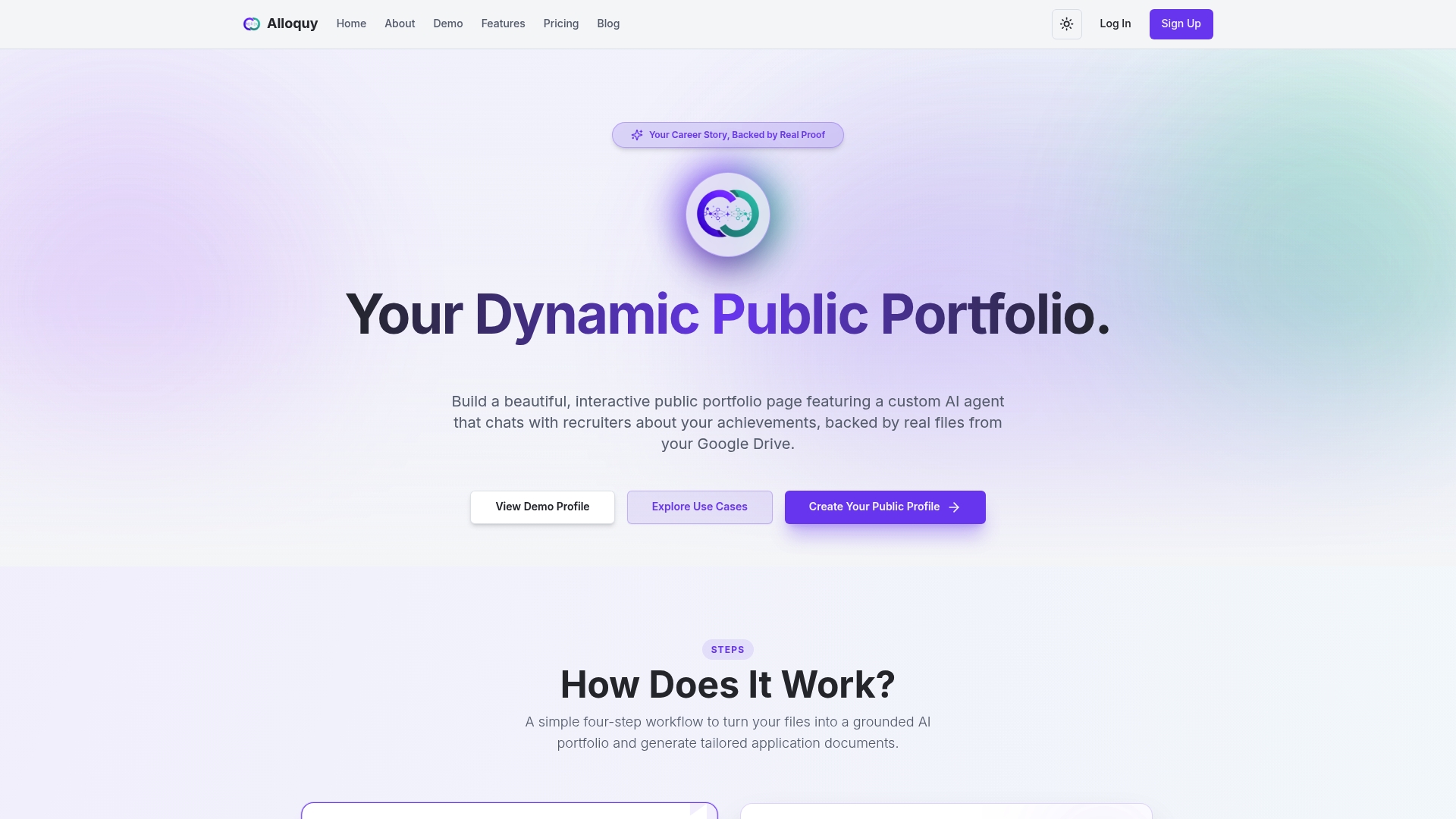
Privacy is user-controlled: you determine which artifacts are accessible through your public profile, and selective sharing means sensitive client or employer data stays private. The free tier is functional for building and sharing a profile; paid plans expand AI generation limits, evidence storage, and customization options. Start with the free tier to build your first interactive profile, then upgrade when you are ready to generate tailored documents at scale.
Sources
- Simplify looks to AI to help with job searches and applications | TechCrunch
- Simplify Competitors & Alternatives (2026)
- 2025 Job Search Portfolio: How to Turn One Resume Into a …
FAQ
What is the best free alternative to Simplify?
Huntr offers the most functional free tier for application tracking, while Jobright AI provides free access to its semantic job discovery and basic autofill features. Alloquy’s free tier covers interactive portfolio creation and recruiter-facing AI assistant access.
Can autofill tools like Simplify pass ATS screening reliably?
Autofill tools vary significantly by board and employer ATS. Enterprise platforms like Workday and iCIMS are less reliably supported, and autofill-generated submissions can corrupt field mapping on non-standard forms. An ATS-safe PDF submitted manually is more reliable for high-stakes applications.
What is the Dual-CV strategy and why does it matter?
The Dual-CV strategy means submitting a text-optimized resume for ATS parsing and sharing an interactive portfolio link for recruiter review. ATS systems cannot read the content behind portfolio URLs, so the resume text must describe your artifacts in plain language.
How does Alloquy differ from resume optimization tools?
Alloquy generates tailored resumes and cover letters from your verified career artifacts, rather than scoring or rewriting a static document. Recruiters can also query your Alloquy profile directly through an AI assistant, which provides evidence-backed answers drawn from your actual work.
Is it worth using multiple job-search tools at once?
Yes, when each tool covers a distinct function. A practical stack for an active search: an autofill extension for volume applications, Huntr for tracking, and Alloquy for tailored document generation and portfolio-first outreach to high-value roles.
Recommended
- Why Multi-Format Resume Assets Are Key to Modern Job Search Success | Alloquy Blog | Alloquy
- The Death of Cover Letters: Why AI-Tailored Briefs Get 4x Response Rates | Alloquy Blog | Alloquy
- How AI Resume Intelligence Transformed Modern Hiring in 2026 | Alloquy Blog | Alloquy
- Generative AI in Hiring: What Job Seekers Need to Know for H2 2026 | Alloquy Blog | Alloquy