

A hiring-ready product manager portfolio is three evidence-backed case studies that demonstrate problem framing, decision logic, and measurable impact. That is the minimum viable version you can publish today. Portfolios increase interview conversion because they give hiring teams tangible work to evaluate, particularly in markets where resumes and interview answers alone produce noisy, unreliable signals.
Before you spend time on design or hosting, confirm you have these launch-critical items:
- A minimum of three case studies, whether real, anonymized, or hypothetical, each presenting a clear problem, your decision process, and an outcome
- A homepage intro (two to three sentences: who you are, what kind of PM you are, what you have shipped)
- Contact information and links to your LinkedIn profile and any public work
That is enough to start applying. Everything else in this guide makes the portfolio stronger, not publishable.
Key Takeaways
A hiring-ready product manager portfolio requires three evidence-backed case studies, a clear homepage intro, and verifiable metrics or artifacts — quality over quantity determines interview conversion.
| Point | Details |
|---|---|
| Minimum to launch | Three case studies, a two-sentence homepage intro, and a contact link are enough to start applying. |
| Quality over quantity | Three to five strong artifacts outperform ten thin ones; recruiters read the first two projects in detail. |
| Anonymize safely | Use directional ranges and percentage changes when exact figures are confidential to preserve credibility. |
| Tailor by role | Adjust your homepage headline and lead case study for each role type: growth, technical, UX-focused, or senior. |
| Alloquy for verification | Alloquy’s AI-powered platform lets recruiters query your evidence directly, adding a verification layer static portfolios cannot provide. |
Table of Contents
- What a product manager portfolio is and how it differs from a resume
- Core components every PM portfolio must include
- A repeatable case-study template you can copy
- How many projects to include and what formats work best
- Real PM portfolio examples and what each one does well
- Where to host your PM portfolio and which platform fits your situation
- Dos and don’ts, plus how to tailor your portfolio by target role
- How to use your portfolio during applications and interviews
- Gathering, anonymizing, and verifying evidence for your portfolio
- What I wish I had shown earlier in my PM career
- An interactive, verifiable portfolio built for how hiring actually works
- Sources
- FAQ
What a product manager portfolio is and how it differs from a resume
A product manager portfolio is a curated collection of evidence that demonstrates product thinking, decision-making, and measurable impact across one or more projects. A resume lists titles and responsibilities. A portfolio shows the reasoning behind the work.
The practical difference matters in hiring. A resume tells a recruiter you launched a feature. A portfolio shows why you prioritized that feature over three alternatives, how you ran the discovery process, and what the retention numbers looked like six weeks post-launch. That invisible reasoning, the tradeoffs, the decision logic, is what hiring managers cannot extract from a resume alone.
Three trust signals separate a credible portfolio from a polished-looking one: metric-driven impact statements (before-and-after numbers or directional ranges), verifiable artifacts (screenshots, PRD excerpts, research summaries), and clear ownership language that specifies your role without overstating it. A PM portfolio is most valuable for career switchers, early-career PMs, and PMs whose internal work is invisible from the outside. Senior PMs can still use one or two external artifacts to demonstrate strategic scope.
Core components every PM portfolio must include
Product managers need a mix of technical, business, and interpersonal skills, and the artifact types you choose signal which of those dimensions you have developed. Each artifact type carries a distinct inference for hiring managers.
- Case studies: Your primary evidence. Each one should show problem framing, your specific role, the process you ran, the decision you made, and the outcome. Hiring managers read these to assess judgment.
- Product teardowns: A structured analysis of an existing product’s strengths, weaknesses, and opportunities. Teardowns demonstrate product sense without requiring access to confidential data.
- PRD excerpts: Even a two-page sample of a requirements document signals clarity of thought, stakeholder awareness, and the ability to write for engineers. Redact company names and proprietary figures.
- Research summaries: A one-page synthesis of user interviews or usability sessions shows discovery discipline. Include the research question, methodology, key findings, and what you decided as a result.
- Roadmap artifacts: A prioritized roadmap or a prioritization framework (RICE, MoSCoW, opportunity scoring) demonstrates strategic thinking and the ability to say no.
- Metrics and dashboards: Screenshots or reconstructed views of the KPIs you owned. Even a simple before/after table with directional numbers is more credible than a claim in prose.
- Side projects: Apps, tools, or analyses you built independently. These are especially useful for career switchers who lack formal PM titles but have shipped real products.
If confidential work prevents you from publishing real artifacts, anonymized case studies, mock PRDs, and hypothetical teardowns are effective substitutes that still demonstrate product thinking.
A repeatable case-study template you can copy
The structure below maps directly to the questions hiring managers ask in interviews, which means building your portfolio this way also prepares your verbal answers.
- Context: What was the product, the team size, and the business stage? (Two to three sentences.)
- Your role: What did you own specifically? Avoid “I was part of a team.” Name your scope.
- Problem: What was the user or business problem? What evidence confirmed it was real?
- Process: What discovery, research, or analysis did you run? What options did you consider?
- Decision: What did you decide, and why did you choose that path over the alternatives?
- Outcome: What changed? Use numbers, ranges, or directional percentages.
- Learnings: What would you do differently? What did this project teach you about the domain or your own process?
Sample paragraph (adapt and replace details):
At a Series B fintech company, I owned the onboarding flow for small-business customers. Drop-off data showed a substantial portion of users abandoned during the bank-linking step. After several discovery interviews and a competitive teardown of comparable products, I proposed replacing the manual credential entry with OAuth-based bank connection. I wrote the PRD, ran usability testing rounds, and coordinated the API integration with engineers. Post-launch, abandonment at that step dropped significantly, and 30-day activation improved directionally across the cohort.
Pro Tip: When exact figures are confidential, report directional ranges or percentage changes rather than precise numbers. Always specify your ownership precisely: “I wrote the PRD and ran usability testing” rather than “we improved the onboarding flow.”
How many projects to include and what formats work best
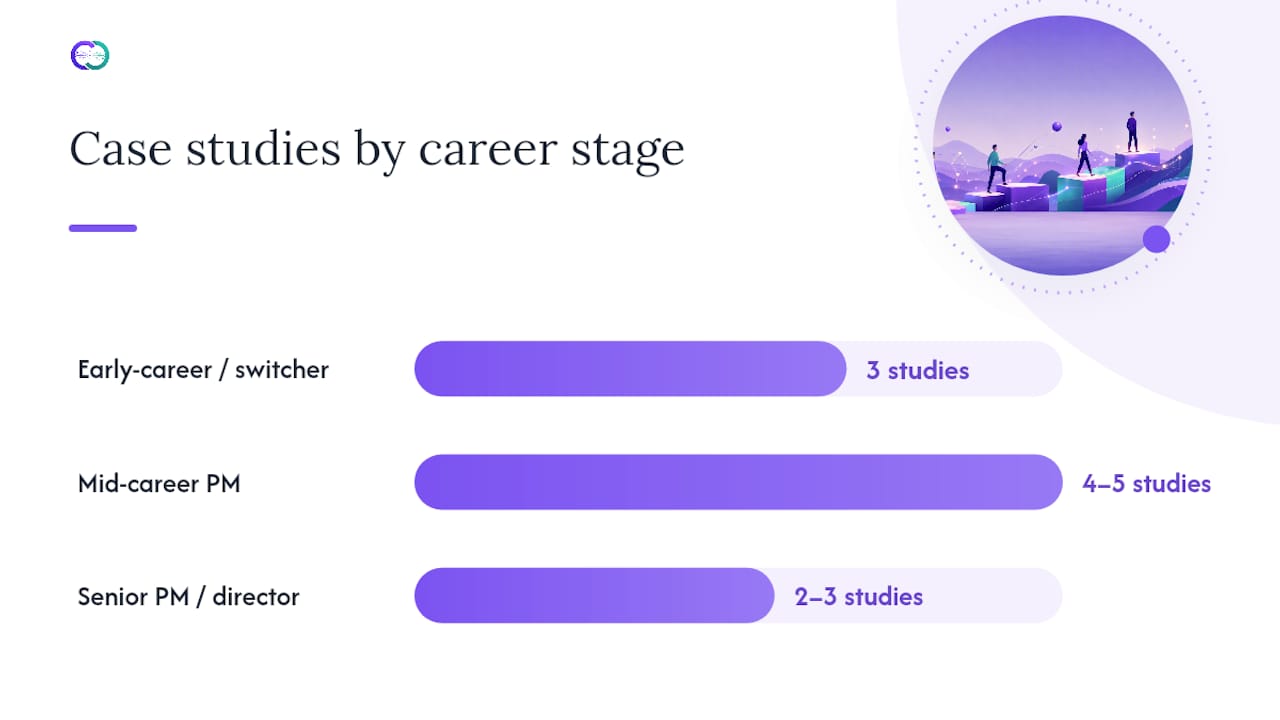
Three to five strong artifacts consistently outperform ten thin ones. Recruiters often read only the first few projects in detail, so depth in the first two case studies matters more than breadth across ten.
Format guidance by career stage:
- Early-career or career switcher: Three case studies (one real, one teardown, one side project or mock PRD). Prioritize showing process over outcomes, since your outcome data is limited.
- Mid-career PM: Four to five case studies with at least two showing measurable business impact. Include one research artifact and one roadmap or prioritization example.
- Senior PM or director: Two to three high-impact case studies with strategic framing (market context, cross-functional influence, organizational tradeoffs), plus one or two external artifacts like a published article or conference talk.
For format and length, a landing-page preview of 150–200 words per case study works well as the entry point, with a full case study of 600–1,000 words behind a “Read more” link or a separate page. A downloadable PDF version is useful for take-home assignments and onsite interviews.
Dos and don’ts:
- Do lead with your strongest case study, not your most recent one.
- Do use real screenshots, wireframes, or data visualizations where possible.
- Do write in first person and name your specific contributions.
- Don’t publish ten thin project summaries that each run two paragraphs.
- Don’t over-design. A clean, readable layout beats a visually complex one that obscures the writing.
- Don’t omit the “why.” Describing what you shipped without explaining the decision logic is the most common PM portfolio mistake.
Real PM portfolio examples and what each one does well
These publicly available portfolios each demonstrate a specific high-signal pattern worth studying.
- W. Jesse Wright (jessewwright.com): Opens with a clear role statement and a single hero case study above the fold. The homepage hook is two sentences, which forces a recruiter to click through rather than skim and leave. Copy the discipline of the short intro.
- Jenny Atkins (jennyatkins.com): Uses a visual decision map within each case study to show how she moved from problem to solution. The artifact makes her reasoning legible without requiring the reader to parse dense prose. Copy the decision-map format.
- Ben Solomon (bensolomon.co): Leads with metrics in the case study previews. Each project card shows a headline outcome number before the reader clicks. Copy the metric-first card structure.
- Lenny Rachitsky’s portfolio archive (lennyrachitsky.com): Not a traditional portfolio, but his published case studies and teardowns demonstrate how written product analysis builds credibility at scale. Copy the teardown format for your own product analyses.
- Shreyas Doshi’s public writing: His threads and essays on product tradeoffs function as a distributed portfolio. Copy the practice of articulating decision frameworks publicly, even outside a formal portfolio site.
- PM Streak’s example gallery (learnanything.pro): Aggregates annotated portfolio examples with notes on what each does well. Use it as a reference when evaluating your own structure.
The pattern across high-performing portfolios: a short homepage hook, a visible hero case study, metric-first previews, and clear ownership language inside each piece. Borrow the structure, not the content.
Where to host your PM portfolio and which platform fits your situation
Hosting choice affects recruiter experience, SEO, and the time you spend maintaining the site. The right option depends on your technical comfort and target employer type.
| Platform | Best for | Key trade-off |
|---|---|---|
| Squarespace | Non-technical PMs targeting established companies | Polished templates, limited customization, monthly cost |
| Webflow | PMs with design sensibility, startup or product-led targets | High design control, steeper learning curve |
| Wix | Fastest setup, early-career PMs | Easy to launch, less recruiter-credible at senior levels |
| WordPress | PMs who want SEO and long-term content | Most flexible, highest maintenance overhead |
| Notion | Career switchers and early-career PMs | Recruiter-friendly link, minimal branding, no custom domain by default |
Notion is the fastest path to a shareable URL and works well for early-career PMs who need something live within a day. Squarespace and Webflow produce more polished results and are better suited to PMs targeting design-forward or product-led companies. WordPress gives the most SEO control for PMs who plan to publish teardowns or articles alongside their case studies.
For templates, Notion’s PM portfolio template provides a pre-structured layout with sections for case studies, skills, and contact information. Webflow’s template marketplace includes several portfolio-specific designs. Whatever platform you choose, confirm the result is mobile-friendly, loads in under three seconds, and produces a shareable link you can paste into a LinkedIn message without friction.
Pro Tip: Align your PM resume keywords with the language you use in your portfolio case studies. Hiring managers and ATS systems both scan for consistent terminology, and a mismatch between your resume and portfolio creates unnecessary doubt.
Dos and don’ts, plus how to tailor your portfolio by target role
Small edits to your homepage headline and first project selection can shift the signal your portfolio sends significantly. The table below shows what to emphasize for four common PM role types.
| Role type | Lead with | De-emphasize |
|---|---|---|
| Growth PM | Funnel metrics, A/B test results, activation and retention data | Deep UX process or technical architecture |
| Technical PM | API design decisions, system constraints, engineering tradeoffs | Soft discovery narratives without technical depth |
| UX-focused PM | Research artifacts, usability findings, design collaboration | Pure business metrics without user context |
| Senior / Staff PM | Strategic framing, cross-functional influence, org-level tradeoffs | Execution-level detail that reads as IC work |
High-impact dos:
- Rewrite your homepage headline for each application batch. “Growth PM with B2C SaaS experience” and “Technical PM with API platform background” are different signals even if the underlying case studies are the same.
- Place your most role-relevant case study first, not your most recent one.
- Use bold text to highlight metric outcomes within case study prose so a skimming recruiter catches the number.
Common mistakes to fix now:
- Listing responsibilities instead of decisions. “Managed the roadmap” says nothing. “Prioritized feature X over Y because of Z evidence” says everything.
- Omitting the problem. A case study that starts with the solution skips the reasoning that hiring managers actually want to see.
- Ignoring common profile credibility mistakes that apply equally to PM portfolios: vague ownership claims, missing metrics, and no evidence of cross-functional work.
How to use your portfolio during applications and interviews
A portfolio that exists but never gets referenced in the hiring process adds no value. The steps below make it an active tool.
- In outreach and applications: Paste the portfolio URL directly into your LinkedIn connection request or cold email. One sentence of context (“Here’s a case study on the onboarding problem I mentioned”) converts better than a generic link.
- In phone screens: Mention the portfolio in the first five minutes. “I have a case study on exactly that problem on my portfolio — I can walk you through it if that’s useful” signals preparation and gives the interviewer a concrete anchor.
- In virtual interviews: Share your screen and navigate to one case study. Walk through the decision section, not the outcome section first. Hiring managers want to see how you think before they see what happened.
- In take-home assignments: Reference your portfolio as supporting evidence. “My approach here mirrors what I did in the onboarding case study linked in my portfolio” ties your assignment answer to verified prior work.
- In onsite or panel interviews: Prepare two to three printed or PDF versions of your strongest case study. Offer them at the start of a case-based interview round.
Templates that map directly to common interview prompts help candidates rehearse and answer faster during live interviews. If your case-study structure mirrors the STAR or DACI frameworks your target company uses, the verbal answer flows from the written artifact with minimal additional preparation.
Gathering, anonymizing, and verifying evidence for your portfolio
Evidence quality separates a credible portfolio from a well-written one. The steps below apply whether you are documenting current work or reconstructing past projects.
- Collect before you leave. Before transitioning out of a role, export analytics screenshots, A/B test summaries, user research write-ups, and roadmap slides. Most companies allow employees to retain work product for portfolio use; confirm with your legal or HR team.
- Anonymize systematically. Replace company names with descriptors (“a Series B fintech company”), remove exact revenue figures, and convert absolute user counts to percentage changes or index numbers. “MAU grew by approximately 28%” is both credible and NDA-safe.
- Use directional ranges for sensitive metrics. When exact figures are confidential, a range like “conversion improved 20–35%” preserves the signal without exposing proprietary data.
- Add a verification note. A short line at the bottom of a case study (“Metrics and artifacts available for verification upon request”) signals that the evidence is real, not fabricated. Recruiters rarely ask, but the note increases credibility.
- Request a written confirmation from a manager. A brief LinkedIn recommendation that references a specific project outcome functions as third-party verification. It does not need to include confidential numbers; directional language (“led the initiative that meaningfully improved activation”) is sufficient.
For guidance on sharing evidence without compromising privacy, the anonymization patterns above apply across industries and seniority levels. The goal is a portfolio where every claim is either publicly verifiable or available for private verification on request.
Pro Tip: Alloquy’s evidence-linking feature lets you attach Google Drive documents to specific portfolio claims, so recruiters can query the AI assistant for verified context without you sharing raw confidential files. This creates a verification layer that static portfolios cannot replicate.

What I wish I had shown earlier in my PM career
The portfolios that generate the most recruiter engagement are not the ones with the most polished design. They are the ones that show judgment under uncertainty.
Three things the Alloquy team consistently sees missing from early-career PM portfolios: explicit tradeoffs (naming the options you did not choose and why), failed or mixed experiments with clear learnings, and evidence of cross-functional influence rather than solo execution. A case study that says “we ran the A/B test, it did not reach significance, and here is what we learned and shipped next” signals more maturity than a clean success story with no friction. Showing tradeoffs and imperfect outcomes signals judgment and maturity to hiring teams. Hiring managers have seen enough polished success narratives to be skeptical of them. What they cannot fake-pattern-match is a PM who can articulate what they got wrong and what they changed as a result.
The second underused element is the “opposite options” frame: for each major decision in a case study, name the two or three alternatives you seriously considered and the specific evidence that ruled them out. This single addition transforms a case study from a story about what happened into a demonstration of how you think. It also gives interviewers a natural follow-up question they can ask, which extends the conversation in your favor.
An interactive, verifiable portfolio built for how hiring actually works
Static portfolio sites show your work. Alloquy lets recruiters verify it. The platform converts your Google Drive documents and evidence files into a dynamic public profile where hiring managers can query a custom AI assistant for context, specifics, and supporting artifacts, without you needing to be in the room.
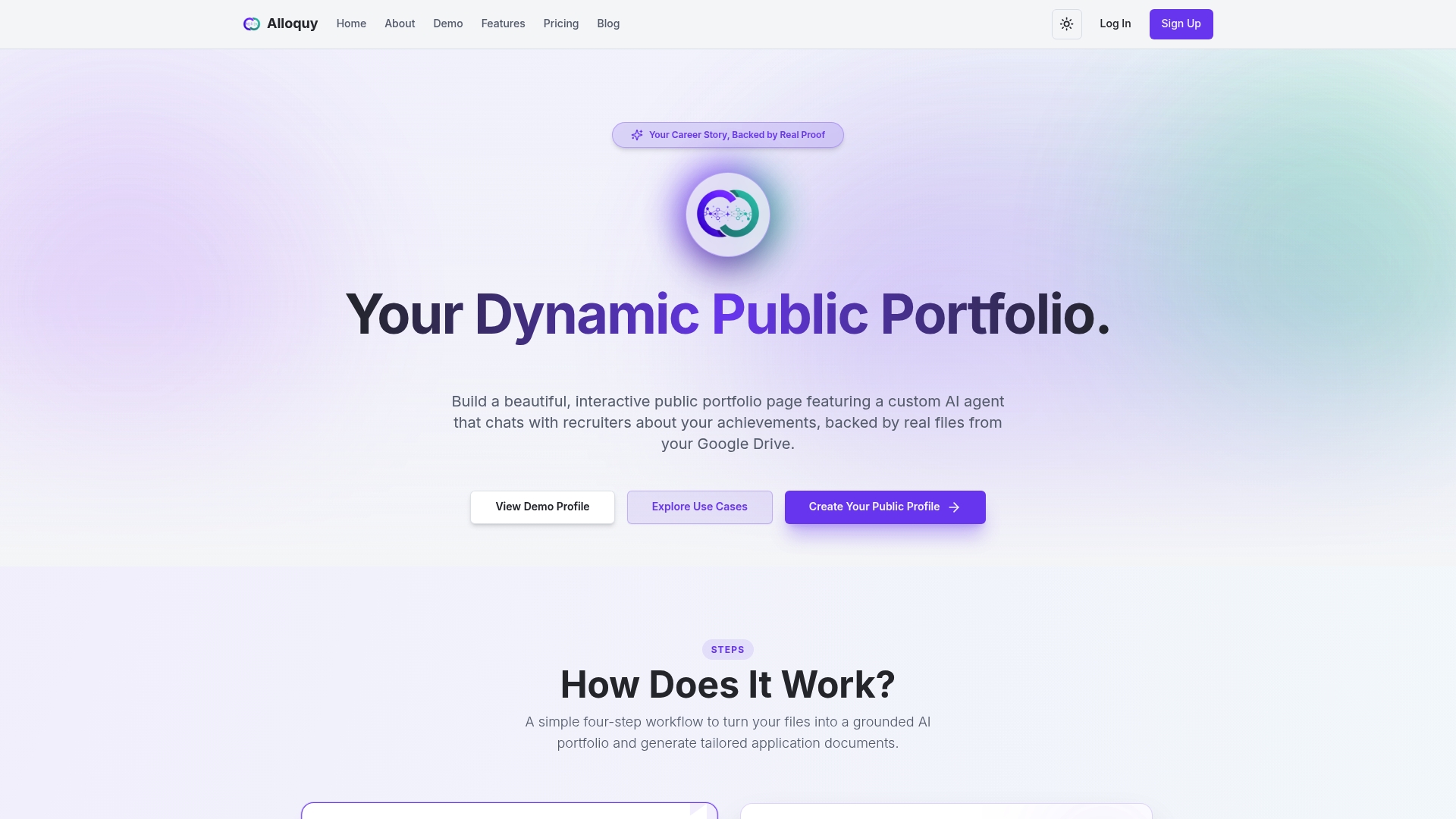
For product managers specifically, Alloquy’s three most relevant capabilities are interactive case studies with linked evidence, a recruiter-accessible AI chat that answers questions about your work in real time, and tailored resume and cover letter generation grounded in your verified portfolio data. The result is a portfolio that functions less like a static document and more like a structured, queryable record of your product decisions.
If you want to move beyond a Notion page or a Squarespace site and give recruiters a verifiable, interactive record of your impact, explore Alloquy’s plans and features to find the tier that fits your current career stage.
Sources
- 10 Essential Product Manager Skills: Technical, Business, and More | Coursera
- Product Manager Portfolio: How to Build One That Actually Gets You Hired | ProductPeople
- How to create a product manager portfolio
- PM Portfolio Guide (2026) — How to Build a Product Portfolio That Gets Interviews | PM Streak
- Product Manager Portfolio Guide: Examples & Templates (2026)
FAQ
What is a product manager portfolio?
A product manager portfolio is a curated set of case studies, artifacts, and evidence that demonstrates how a PM frames problems, makes decisions, and drives measurable outcomes. It differs from a resume by showing reasoning and process, not just titles and responsibilities.
Should a product manager have a portfolio?
Yes, particularly for early-career PMs, career switchers, and anyone whose internal work is not visible from a resume. Senior PMs benefit from one or two external artifacts that demonstrate strategic impact and cross-functional influence.
What are the top three skills a product manager portfolio should demonstrate?
The three highest-signal skills to demonstrate are product judgment (decision logic and tradeoffs), analytical rigor (metric-driven outcomes and research synthesis), and cross-functional influence (evidence of working across engineering, design, and business stakeholders).
How many projects should a PM portfolio include?
Three to five strong, well-documented case studies is the standard recommendation. Recruiters typically read the first two in detail, so depth in the lead projects matters more than total count.
Which platform is best for hosting a PM portfolio?
Notion is the fastest option for early-career PMs who need a shareable link quickly. Squarespace and Webflow produce more polished results for mid-career and senior PMs. Alloquy adds a recruiter-verifiable AI layer that static hosting platforms do not offer.
Recommended
- How to Highlight Product Impact When You Aren’t a Product Manager | Alloquy Blog | Alloquy
- Executive Career Portfolios: How VP & C-Suite Candidates Win Global Roles | Alloquy Blog | Alloquy
- Blog | Alloquy - AI Career & Resume Intelligence | Alloquy
- 5 Critical Pitfalls Senior Engineers Must Avoid on Technical Portfolios | Alloquy Blog | Alloquy