

A hire-ready data scientist portfolio must prove one thing above all: that you can frame an ambiguous real-world problem, work through messy data, and deliver a result with a measurable, reproducible outcome. According to experienced practitioners, projects built on real questions beat certificate stacks every time, and a well-written README paired with a deployed demo or clear write-up are the strongest signals a hiring team can receive.
Portfolio essentials at a glance:
- 2–4 polished projects (one full end-to-end, one focused technique demo, optionally one pipeline and one experiment)
- A GitHub repository per project with a README,
requirements.txtorconda.yml, and asrc/folder - A live demo (Streamlit, Gradio) or published case study (Medium, GitHub Pages)
- Explicit business metrics and measurable impact in every project summary
- Links to dataset provenance and run instructions
- A personal portfolio site or interactive profile (GitHub Pages, Alloquy) that ties everything together
A few polished, reproducible projects with clear stakeholder framing will outperform numerous shallow tutorial notebooks. Depth signals professional judgment; volume signals tutorial consumption.
Key Takeaways
A hire-ready data scientist portfolio requires 2–4 polished, reproducible projects with measurable business impact, clear data provenance, and a case study structure that maps directly to the five-category rubric hiring managers use.
| Point | Details |
|---|---|
| Depth over volume | Two to four polished projects with measurable impact outperform many shallow tutorial notebooks. |
| Case study structure | Every project should follow the eight-section template: summary, problem, data, approach, metrics, results, limitations, run instructions. |
| Avoid tutorial datasets | Titanic, Iris, and MNIST signal learning; use real data from portals like data.gov for front-page projects. |
| Interview readiness | Prepare a two-sentence elevator pitch and two technical deep-dive bullets for every project before any interview. |
| Alloquy for verified portfolios | Alloquy’s AI-queryable interactive profiles let recruiters verify project claims directly, converting static case studies into evidence-backed professional records. |
Table of Contents
- What does a strong data scientist portfolio actually contain?
- Which four project types should you build?
- How do you structure each project as a readable case study?
- Where should you host your portfolio projects?
- How do you make each project interview-ready?
- Common mistakes to fix before you share a project
- What the Alloquy Team does differently when building portfolio projects
- Your portfolio already tells a story. Alloquy makes it verifiable.
- Sources
- FAQ
What does a strong data scientist portfolio actually contain?
A portfolio has two distinct layers: the site level and the project level. Conflating them is one of the most common structural errors early-career candidates make.
Site-level items include a short professional summary (two to three sentences, role-targeting), a prioritized project list with one-line summaries, a contact section, a resume link, and a clear link to your GitHub profile. Navigation must be clean enough that a recruiter can reach any project in one click.
Project-level items follow a tighter discipline. Lead with the TL;DR result, not the methodology. State the problem in one sentence, name the stakeholder or domain, describe data provenance (where it came from, how messy it was), summarize the methodology, and present key metrics with a visual punchline. A limitations section and a “next steps” note signal intellectual honesty, which hiring teams value. Every project page must link to the code repository and include run instructions.
Repo file checklist:
README.mdwith a one-paragraph pitch at the toprequirements.txtorconda.ymlsrc/for production-quality codedata/folder with a provenance note (link to source, not raw data if it’s large)- A smoke-run script or minimal test
Platform guidance:
| Platform | Best for | Notes |
|---|---|---|
| GitHub | Code discoverability, reproducibility | Central hub; every project lives here |
| GitHub Pages | Static case studies, SEO-friendly narrative | Free, version-controlled, no backend needed |
| Kaggle | Community visibility, runnable notebooks | Strong for NLP/tabular competitions |
| Streamlit | Live interactive demos | Deploy in minutes; shareable URL |
| Medium | Long-form technical storytelling | Drives organic traffic to your GitHub |
| Alloquy | Evidence-backed interactive profiles | Verified artifacts, recruiter-queryable AI |
Tutorial datasets like Iris and MNIST are excellent for learning, but featuring them on your front page signals tutorial-level work rather than professional judgment. Reserve them for practice; source real data from portals like Data for portfolio projects.
Pro Tip: The README is the product. A recruiter who spends under two minutes on your portfolio will read that paragraph and nothing else first.
Which four project types should you build?
Career guides consistently recommend 2–4 substantial projects: one full end-to-end plus focused technique demonstrations, and optionally a pipeline or experiment project. The following four types cover the full hiring rubric.
-
End-to-end modeling project. This is your flagship. Use real, messy data from a public portal, define a clear stakeholder (a business, a public agency, a product team), and deploy a working demo or publish a detailed case study. Minimum deliverables: a GitHub repo with a README, run instructions, and either a Streamlit demo URL or a Medium write-up. Project idea resources from university programs can spark domain-focused starting points if you’re stuck on a topic.
-
Focused technique demonstration. Pick one method where you want to signal depth: time series forecasting, NLP with transformer fine-tuning, causal inference with propensity score matching, or Bayesian A/B testing. The goal is to show you understand why you chose the method, not just that you ran the code. Minimum deliverables: a reproducible notebook with a short written explanation of your methodological choices and trade-offs.
-
Data engineering or pipeline project. Most modeling portfolios skip this entirely, which makes it a differentiator. Build an ETL pipeline that ingests data from a public API (weather data, transit feeds, health statistics from the WHO data portal), transforms it, and loads it into a structured store. Minimum deliverables: pipeline code, an architecture diagram, and data provenance notes.
-
Experiment or A/B analysis. Product-facing roles and growth teams hire heavily on experimentation rigor. Simulate or analyze a real experiment: define the hypothesis, choose evaluation metrics, run the analysis, and write a business interpretation. Minimum deliverables: a write-up covering experimental design, metric selection rationale, and a plain-language conclusion a non-technical stakeholder could act on.
How do you structure each project as a readable case study?
Hiring managers evaluate portfolios across five repeatable categories: problem framing, data realism, evaluation rigor, deployment thinking, and communication. A case study structured around those five dimensions will score higher in every review.
The case study template every project page should follow:
1. One-line project summary — result first, then domain. Example: “Built a churn prediction model that identified 74% of at-risk customers 30 days in advance using telecom transaction data.”
2. Problem & stakeholder — one sentence on who cares and why.
3. Dataset & provenance — source URL, size, key quality issues you resolved.
4. Approach — two to three sentences on method selection and why alternatives were rejected.
5. Evaluation & metrics — primary metric, secondary metric, and why you chose them over alternatives.
6. Results & business impact — quantified outcome tied to a business decision.
7. Limitations & next steps — two to three sentences on what the model cannot do and what you’d improve with more time or data.
8. How to run — single-command reproducibility:
pip install -r requirements.txt && python run.py
Reproducibility checklist:
requirements.txtorconda.ymlwith pinned versions- Random seed set and documented
- Sample run command in the README
- Dataset link or download script (never commit large raw files)
For deployment notes, add a “Demo” section immediately after the one-line summary. A Streamlit or Gradio link placed at the top of the README captures attention before a recruiter scrolls. Summarize trade-offs in two to three sentences under “Limitations” rather than burying them in a notebook cell.
Where should you host your portfolio projects?
The practical hosting decision comes down to what you want a recruiter to experience: code inspection, a live demo, a narrative case study, or verified evidence of your work.
GitHub is non-negotiable as the code layer. Every project lives in a public repository with a clean commit history. GitHub Pages extends that into a free static site, giving you an SEO-indexed narrative layer on top of the code without any backend infrastructure.
Streamlit is the fastest path to a shareable live demo. A streamlit run app.py command and a free Streamlit Community Cloud deployment gives you a URL you can paste into a resume or LinkedIn message within minutes. Kaggle notebooks serve a similar function for tabular and NLP work, with the added benefit of community visibility and upvotes that function as social proof.
Medium works best for long-form technical storytelling that drives organic search traffic back to your GitHub. A well-written Medium post explaining your methodology can surface in Google results for niche technical queries, extending your portfolio’s reach beyond direct recruiter visits.
Alloquy occupies a distinct position: rather than hosting static files or running a demo, it creates an evidence-backed interactive profile where verified artifacts (linked from Google Drive or uploaded directly) are queryable by recruiters through a custom AI assistant. For candidates who need to demonstrate project provenance, show verified outputs, or handle sensitive data carefully, sharing verified evidence without compromising privacy is a material advantage over a public GitHub repo.
Hosting comparison:
Quick deploy commands:
- GitHub Pages:
git push origin mainwith adocs/folder or agh-pagesbranch configured in repo settings - Streamlit:
streamlit run app.pylocally; push to GitHub and connect via Streamlit Community Cloud - Alloquy: link your Google Drive folder containing project artifacts and configure your public profile theme
How do you make each project interview-ready?
A portfolio project that impresses on screen must also survive a 20-minute technical interview. The gap between “looks good on GitHub” and “I can defend every decision in real time” is where most early-career candidates lose offers.
Pro Tip: Prepare a two-sentence elevator pitch for every project before any interview. Practice saying it aloud until it takes under 30 seconds. Recruiters and hiring managers often ask “walk me through your portfolio” as an opener, and a rehearsed pitch signals professional communication, not just technical skill.
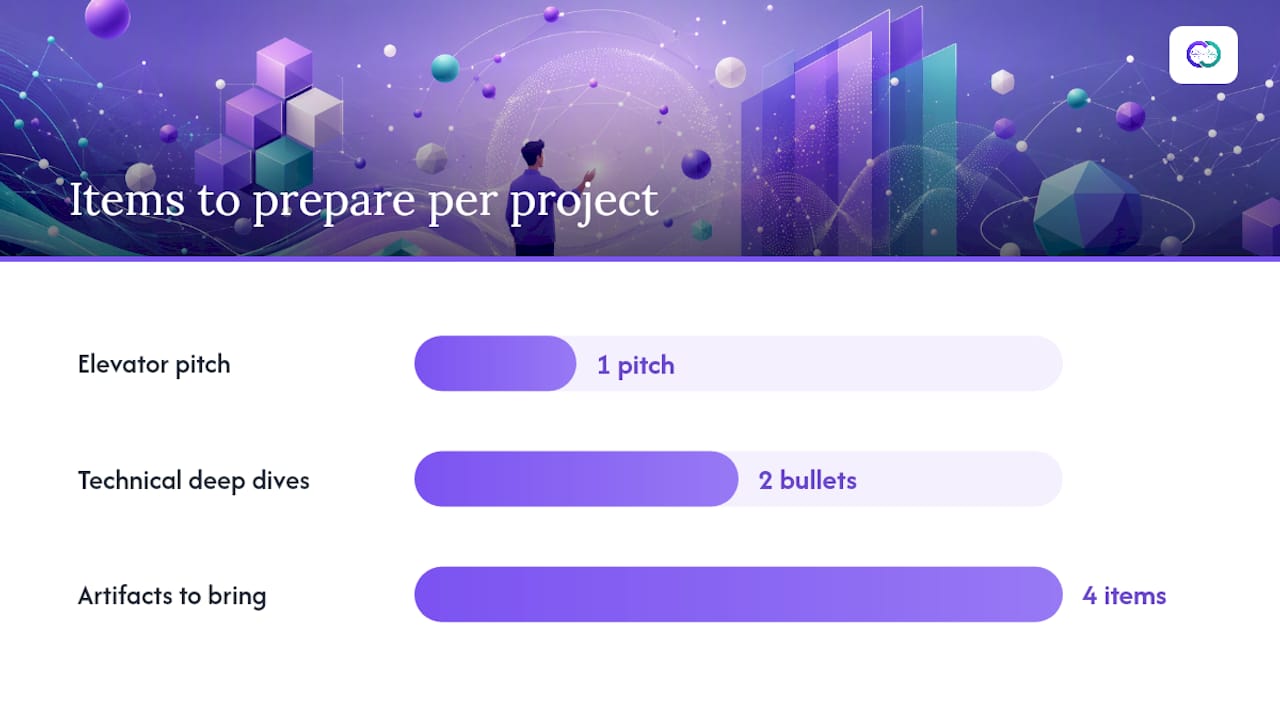
For each project, prepare the following:
-
Elevator pitch (2–3 sentences): Problem → action → result. Example: “I built a demand forecasting model for a retail dataset with 18 months of sales history. I used LightGBM with lag features and calendar variables, achieving a 12% reduction in MAPE over the baseline. The model was deployed as a Streamlit app that a non-technical stakeholder could query by SKU.”
-
Two technical deep-dive bullets: One on a methodological decision (“I chose LightGBM over ARIMA because the dataset had 400+ SKUs with irregular seasonality, and tree-based models handle that heterogeneity without per-series tuning”) and one on an evaluation choice (“I used MAPE rather than RMSE because the business cared about percentage error across SKUs with very different sales volumes”).
-
What to bring to the interview:
- A live demo URL (Streamlit or Kaggle) open on your phone or laptop
- The GitHub repo link with the README visible
- One screenshot of the key result chart
- A one-slide summary if the role involves presenting to non-technical stakeholders
The hiring rubric that evaluators use rewards deployment thinking and communication as heavily as technical correctness. A candidate who can explain why they chose a metric, not just what it was, consistently outperforms one who can only describe what they did.
Common mistakes to fix before you share a project
Most portfolio problems are surface-level and fixable in under 30 minutes. The following checklist covers the errors that cause recruiters to close a tab.
Common mistakes:
- Unfinished notebooks with empty cells or
TODOcomments left in - No data provenance (where did the data come from? how was it cleaned?)
- Missing run instructions (a repo with no README or no
requirements.txtis effectively unusable) - No business metric (accuracy alone is not a business outcome; tie it to a decision or a cost)
- Tutorial datasets (Titanic, Iris, MNIST) as front-page projects signal learning, not professional capability
- Inconsistent or missing version pinning in dependency files
Pre-publish checklist (15–30 minutes):
- README leads with a one-sentence result, not a methodology description
- At least one screenshot or chart is embedded in the README
requirements.txtorconda.ymlis present and tested- A single-command smoke test runs without errors on a clean environment
- Dataset source is linked or a download script is provided
- A limitations section exists (two to three sentences minimum)
- A demo link or write-up link is visible in the first screen of the README
- No
TODO,WIP, or empty cells remain in any notebook
For a broader view of technical portfolio mistakes that apply across engineering disciplines, the Alloquy blog covers patterns that show up at every career stage.
What the Alloquy Team does differently when building portfolio projects
The most persistent gap in early-career data science portfolios is not technical depth. It is the absence of verifiable evidence. A GitHub repository shows code; it does not prove that the model ran on real data, that the business metric was measured, or that a stakeholder actually used the output. Static portfolios ask recruiters to take claims on faith.
The Alloquy Team’s position is that evidence-backed storytelling changes the dynamic entirely. When a portfolio links verified artifacts, such as a model output file, a stakeholder sign-off document, or a recorded demo, to the project narrative, the recruiter’s cognitive load drops. They are not evaluating plausibility; they are reading confirmed facts. That shift from “this candidate claims X” to “this candidate demonstrates X” is where hiring decisions accelerate.
The practical implication: treat every project as a data API for your career. Each artifact you produce during a project (a cleaned dataset, a confusion matrix, a deployment log, a Streamlit screenshot with a timestamp) is a verification node. Linking those nodes to your portfolio narrative converts a static case study into a queryable professional graph. Recruiters who can ask your portfolio a question and receive a sourced answer will spend more time engaging with your work than those who must infer your capabilities from a README alone.
*— Alloquy Team
Your portfolio already tells a story. Alloquy makes it verifiable.
Static GitHub repos and PDF resumes describe what you built. Alloquy proves it. By linking your Google Drive documents and project artifacts to an Alloquy interactive profile, you create a public portfolio where recruiters can query a custom AI assistant for verified answers about your work, your metrics, and your methodology. Every claim is backed by a source the recruiter can inspect.
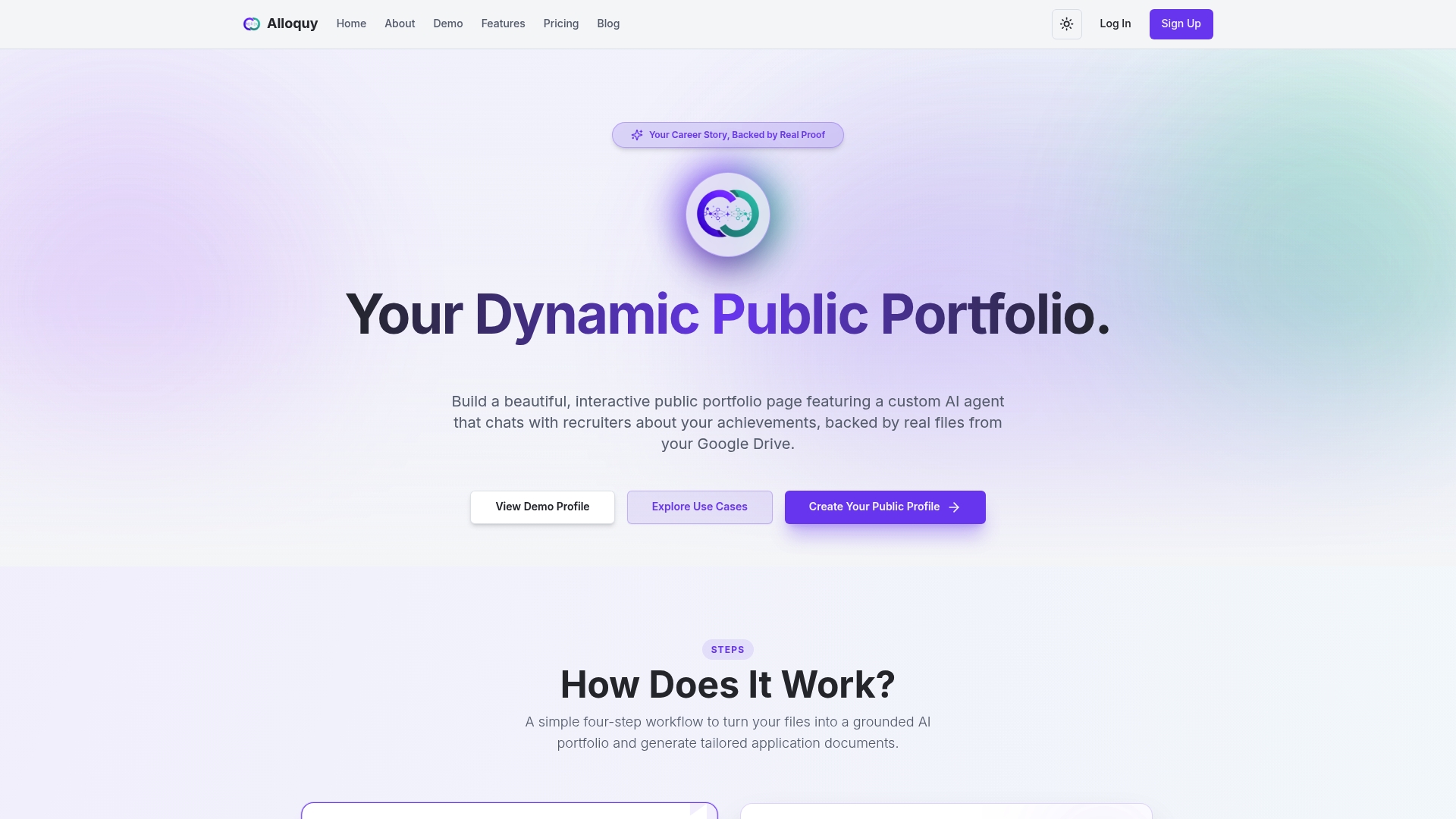
For early-career data scientists, this means your churn model’s confusion matrix, your pipeline architecture diagram, and your A/B test write-up are no longer buried in a repo. They are surfaced on demand, in context, with verification weight that a static README cannot carry. Alloquy also generates tailored resumes and cover letters from your verified project data, so every application document reflects the same evidence your portfolio does.
Review Alloquy’s plans and publish your first evidence-backed project profile today.
Sources
FAQ
How many projects should a data scientist portfolio include?
Two to four substantial projects is the recommended range. One full end-to-end project plus one or two focused technique demonstrations covers most hiring rubrics without diluting quality with shallow work.
What makes a portfolio project stand out to hiring managers?
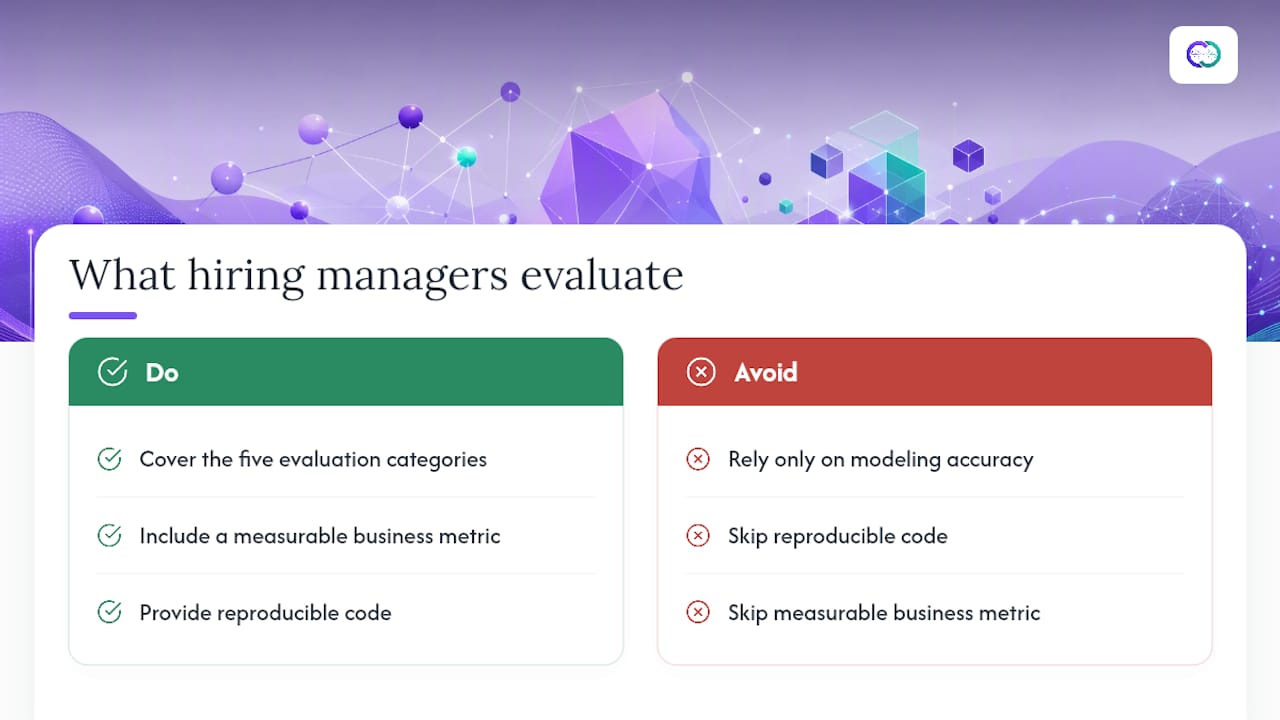
Hiring managers evaluate five categories: problem framing, data realism, evaluation rigor, deployment thinking, and communication. A project that addresses all five, with a measurable business metric and reproducible code, scores consistently higher than one that only demonstrates modeling accuracy.
Should you use Kaggle competition notebooks as portfolio projects?
Kaggle notebooks demonstrate technical skill but often lack stakeholder framing and business impact. Use them as technique demonstrations (project type 2), not as your flagship end-to-end project.
What is the best platform to host a data scientist portfolio?
GitHub is the baseline for code discoverability. GitHub Pages or a personal site handles narrative storytelling. Streamlit or Kaggle works for live demos. Alloquy is the strongest option for evidence-backed interactive profiles where recruiters can verify claims through a custom AI assistant.
How do you tailor a portfolio for different data science roles?
Lead with the project type most relevant to the target role: end-to-end modeling for ML engineer roles, A/B analysis for product analytics roles, and pipeline projects for data engineering positions. Reorder your portfolio’s front page to surface the most relevant project first rather than building separate portfolios from scratch.