

A consulting portfolio that actually wins engagements needs six components, and most portfolios online are missing at least three of them. Start with a one-sentence value proposition naming your problem, method, and industry. Add a home page snapshot with a headline result and one or two case-study titles. Build at least three case studies, each 300 to 600 words, structured as Problem, Solution, Result, with anonymization where NDAs require it. Include a services page with a clear engagement model or pricing shape. Layer in trust signals, quantified metrics, client titles, a testimonial or two, and a visible contact path. Then pick one discoverability channel (LinkedIn is the default for consultants) and one hosting format, whether that’s a personal site, a Notion page, a PDF one-sheet, or an interactive evidence platform like Alloquy.
That’s the floor. What separates a portfolio that converts a prospect into a discovery call from one that gets a polite “thanks, we’ll be in touch” is how well those six pieces work together. The rest of this guide breaks each one down with templates, real structural examples, and platform trade-offs, so you can build something that reflects the caliber of work you actually deliver.
Key Takeaways
A consulting portfolio wins engagements when it proves quantified impact through three or more anonymized-safe case studies, clear positioning, and a verifiable evidence trail buyers can question directly.
| Point | Details |
|---|---|
| Write your UVP first | One sentence naming your problem, method, and industry anchors every other page. |
| Publish 3+ case studies before launch | Use PSR/CSO structure at 300-600 words each, with quantified results up front. |
| Add a real contact intake | A short form or calendar link converts more than a bare email address. |
| Match hosting to your stage | Start with a PDF or Notion page, move to Squarespace or Wix, then WordPress for SEO. |
| Consider Alloquy for verifiable proof | Link Drive evidence and let an AI assistant answer buyer questions directly on your profile. |
Table of Contents
- Consulting Portfolio Examples: What They Must Accomplish
- The Five Essential Pages Every Portfolio Needs
- How to Write a Consulting Case Study That Actually Converts
- Three Ready-to-Copy Consulting Portfolio Examples
- Where to Host Your Consulting Portfolio
- How to Get Your Portfolio Actually Seen
- How Alloquy Makes Your Consulting Evidence Verifiable
- Building a Portfolio at the Senior Level
- Try Alloquy for an Evidence-Backed Consulting Profile
- Sources
- FAQ
Consulting Portfolio Examples: What They Must Accomplish
A portfolio’s primary job is to lower the buyer’s perceived risk fast. Hiring a consultant is a bet on someone the buyer has usually never worked with before, and every unanswered question about your track record adds friction to that decision. Your portfolio’s job is to answer the questions a prospect would otherwise ask on a discovery call, before that call ever happens.
That means proving impact, not describing skills. “I helped a mid-market retailer improve inventory turnover” says nothing. Executives increasingly weigh documented, metric-led experience over credentials alone when evaluating who to hire, which means the portfolio itself has become the credential.
Beyond trust, your portfolio has three secondary jobs:
- Prove independence. Show you can scope, run, and close an engagement without hand-holding, which matters more for freelance and fractional consultants than for anyone applying to a firm.
- Demonstrate method, not just outcomes. Buyers want to know how you got the result, because that tells them whether your process fits their organization.
- Generate a qualified inquiry, not just admiration. A visitor who reads your portfolio and thinks “impressive” but never contacts you has cost you nothing and given you nothing.
Three case studies is the practical minimum for a senior consultant, and more than five starts to dilute attention rather than build it. SeniorGigGuide’s structure for senior expert portfolios recommends exactly this range, paired with a five-page site structure that keeps the whole experience scannable in under three minutes.
Place your primary call to action above the fold on the home page and again at the bottom of every case study. Don’t make them hunt for a way to reach you.
Pro Tip: Put your CTA button text in the voice of the buyer’s next step, not yours. “See if we’re a fit” converts better than “Contact me,” because it frames the click as low-commitment.
The Five Essential Pages Every Portfolio Needs
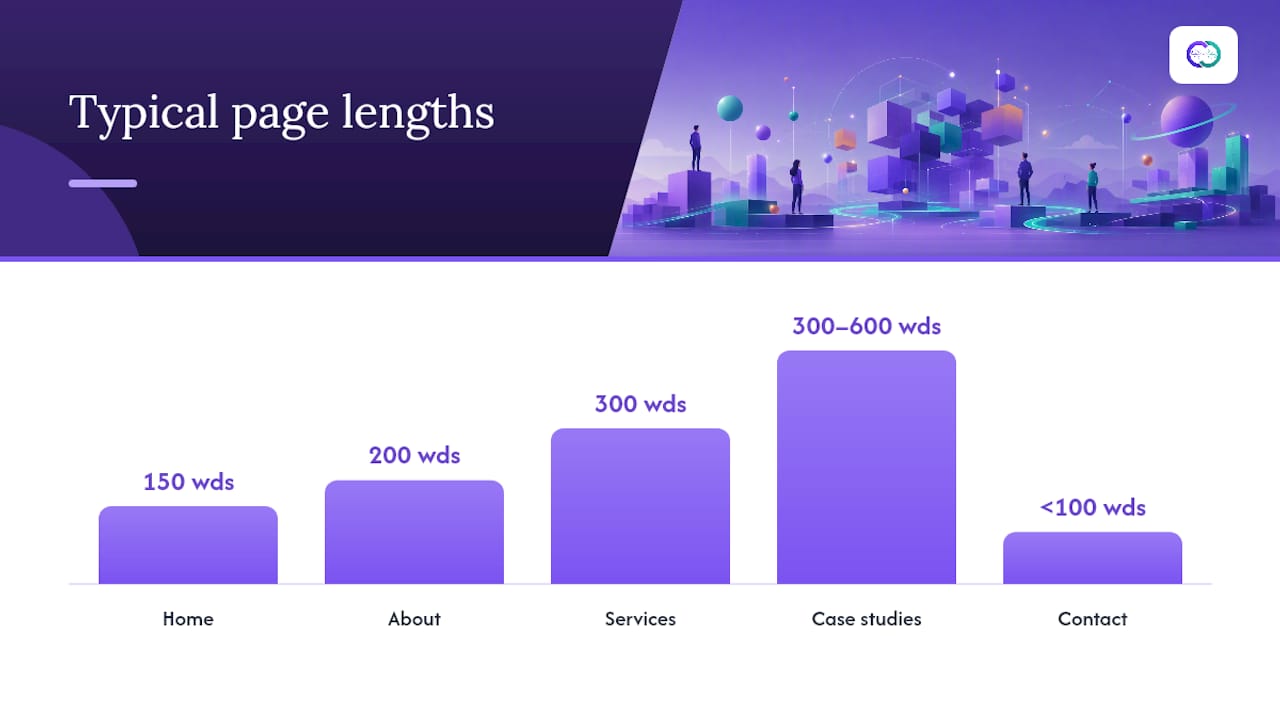
Every effective consultant portfolio, whether it’s a full website or a five-slide PDF, breaks down into the same five functional pages. Business Talent Group’s guidance on building a consulting portfolio frames this as the core difference between a portfolio and a resume: a resume lists roles, a portfolio proves outcomes page by page.
Home. This is your fifteen-second pitch. It needs your headline result (the single most impressive number you have), your value proposition in one sentence, and one or two case-study teasers with enough specificity to make someone click through.
About. Keep the biography short. What matters here is your method (how you actually work with clients), your credibility signals (certifications, years in a specific industry, notable former employers), and a value statement that answers “why you, specifically.”
Services. List discrete offerings rather than a vague “strategy consulting” catchall. Name the engagement types you run (audit, interim leadership, project-based transformation), give a rough scope or pricing shape for each, and link directly to the case study that proves you can deliver it.
Case studies. This is where the real conversion work happens, covered in depth in the next section.
Contact. A short form beats a long one. Ask for name, email, company, and one field describing what they need. If your work often involves NDA-sensitive discussions, say so explicitly: “Have confidentiality requirements? Mention it and we’ll set up a call before sharing anything in writing.”
| Page | Core Element | Typical Length / Visual |
|---|---|---|
| Home | Headline result + UVP + case teasers | 150 words, 1 hero image or result badge |
| About | Bio, method, credibility signals | 200 words, professional headshot |
| Services | Offerings, scope, pricing shape | 300 words, 3 service blocks |
| Case studies | PSR/CSO structure, metrics summary | 300-600 words per study, 1 chart per study |
| Contact | Short form or calendar link, NDA note | Under 100 words, embedded form or link |
How to Write a Consulting Case Study That Actually Converts
Every strong consulting case study follows one of two near-identical templates: PSR (Problem, Solution, Result) or CSO (Challenge, Solution, Outcome). The labels differ, but the logic is the same. You state what was broken, what you did about it, and what changed because of it, with numbers doing most of the persuading.
Luniq’s research on case-study structure for consulting websites recommends a slightly fuller version: client context, challenge, approach, and results, with at least three quantified wins per case study and a stakeholder quote to humanize the numbers. That extra “context” beat matters more than it seems. A result means little without knowing the company’s size, region, and market position.
Here’s how to budget your word count across a 450-word case study:
- Context (60-80 words): Industry, company size, region, and market position, anonymized if needed.
- Challenge (80-100 words): The specific problem, framed in the client’s language, not consulting jargon.
- Approach (150-180 words): What you actually did, including any named frameworks or methods.
- Results (80-100 words): Three or more quantified outcomes, plus a one-line stakeholder quote.
When picking which outcome to lead with, financial results tend to outperform time or quality metrics for executive buyers, but that’s not universal. A compliance-focused consultant should lead with risk reduction or audit pass rates; a product consultant should lead with adoption or retention. If you can’t disclose an exact dollar figure, present it as a percent range or dollar band (“reduced fulfillment costs by 15-20%”) rather than dropping the number entirely.
The Anonymized Authority method for NDA-restricted work
Most senior consultants have their best work locked behind an NDA, and that’s exactly the work that would sell hardest if you could share it. The Anonymized Authority method solves this: replace the client’s name with an industry descriptor (“a mid-market logistics provider with operations across three states”) and present outcomes as verified ranges or percentages instead of exact figures pulled from a client’s financials. SeniorGigGuide’s approach to NDA-safe evidence treats this as standard practice for senior-level portfolios, not a workaround.
You can still use a senior stakeholder quote under this method. Ask the client for permission to quote them without attribution (“VP of Operations, Fortune 500 logistics company”) rather than by name and title combined with the company name. Most clients will approve this even when they wouldn’t approve a named case study.
Before you write a single word, gather your sourcing: project reports, final deliverables, any GA or BI dashboard exports showing before/after metrics, and email or Slack threads confirming outcomes. Document where each number came from, even in your own private notes. If a prospect later asks “how do you know that 22%,” you want an answer ready, not a guess.
Statistic callout: Case studies structured around client context, challenge, approach, and at least three quantified results shorten sales cycles for consulting buyers, according to Luniq’s analysis of B2B case-study conversion.
Pro Tip: *Put your single best number in the case-study title or subheading, not buried in paragraph three.
Three Ready-to-Copy Consulting Portfolio Examples
These three examples are built to be adapted, not copied verbatim. Swap in your own numbers, industry, and voice, but keep the structural bones. Each one demonstrates a slightly different case-study shape depending on your specialty.
Example A: Senior supply-chain consultant
A national distribution company with multiple regional warehouses was losing margin due to inefficient pick-and-pack routing and inconsistent inventory counts. Over a few months, the consultant audited fulfillment workflows at representative sites, redesigned pick paths using a slotting model based on order frequency, and implemented a standardized cycle-count process supported by the client’s existing WMS software.
Following the engagement, fulfillment costs dropped significantly, average pick time decreased markedly, and inventory accuracy improved substantially. “This was the first operational project in several years that paid for itself before the invoice was due,” said the client’s VP of Logistics.
- Lead with the percentage in the title.
- Name the specific tool or framework used (slotting model, cycle counts) to show method, not just outcome.
- Close with a quote that ties the result to speed of payback, which resonates with financially cautious buyers.
Example B: Product and launch consultant for SaaS
A Series B SaaS company had launched three features in the prior year with weak adoption. The consultant ran a six-week discovery sprint, rebuilt the launch playbook around in-app onboarding sequences and lifecycle email triggers, and coached the product team through the next release.
The next launch saw a significantly higher feature adoption within the first month compared to historical averages. Support tickets related to onboarding confusion dropped notably. Net revenue retention for accounts using the new feature increased over the following quarter. “We’d been guessing at launch mechanics for two years. This gave us a repeatable playbook,” said the client’s Head of Product.
Example C: Digital transformation interim manager
A regional healthcare network needed to migrate three legacy scheduling systems into one platform without disrupting patient intake. Serving as interim director of operations for four months, the consultant managed the migration, retrained 60 front-desk staff across nine locations, and built a post-migration monitoring dashboard.
Before the engagement, average patient wait time for scheduling and call abandonment rates were elevated. After migration, these metrics improved significantly. The dashboard now automatically flags anomalies, reducing IT tickets related to scheduling errors substantially, a maintenance win worth noting for buyers who care about what happens after you leave.
For early-career consultants adapting these templates, keep the same structure but scale down the scope descriptors, an engagement with a 20-person department reads differently than one spanning nine locations.
Each example benefits from a simple visual: a before/after bar chart for the metrics, or a result badge (a small graphic highlighting the headline number) placed near the top of the case study. Tools like Visme are commonly used for building these charts and one-sheets without design experience, and reviewers on G2 consistently point to its templates as a fast way to produce polished visuals.

| Point | Details |
|---|---|
| Lead with the number | Put your strongest metric in the case-study title, not the closing paragraph. |
| Anonymize without vagueness | Use industry descriptors and percentage ranges instead of client names under NDA. |
| Vary structure by specialty | Supply-chain leans on operational metrics; SaaS leans on adoption and retention. |
| Include one visual per case study | A before/after chart or result badge increases scan-ability significantly. |
Where to Host Your Consulting Portfolio
The right hosting format depends less on your budget and more on how often you’ll update it and whether you need it to rank in search results. Here’s how the common options actually compare.
Squarespace and Wix are the fastest way to get a polished-looking site live, often within a day, with no coding required. Their SEO capability is limited compared to a fully self-hosted setup, but for a consultant who mainly shares links directly rather than relying on organic search, that’s a minor trade-off.
WordPress.org (self-hosted) takes longer to set up and requires more comfort with plugins and hosting management, but it offers the strongest SEO capability of the group, along with full control over page structure, schema markup, and site speed. This is the right move once your portfolio starts drawing organic traffic from search and you want to capture it.
Notion works well as a lightweight, fast-to-update portfolio, especially for consultants early in building out their case-study library. It’s nearly free, requires zero technical skill, but has almost no SEO discoverability since Notion pages rarely rank well in search.
PDF or Google Docs one-sheets aren’t a full portfolio replacement, but they’re essential companions for outreach and proposals, where you want a document, not a link, that a prospect can forward internally.
LinkedIn functions as a distribution channel and a lightweight portfolio simultaneously. Your featured section can host case-study excerpts, and your profile itself often ranks in search for your name plus your specialty.
Interactive evidence platforms like Alloquy sit in a different category entirely: instead of a static page describing your work, they let a recruiter or buyer query an AI assistant directly about your verified achievements, pulling from linked source documents rather than a paragraph you wrote yourself.
A practical rollout sequence for most consultants:
- Start with a PDF one-sheet and a Notion page in your first week, since both require zero technical setup.
- Move to Squarespace or Wix once you have three full case studies ready, so the site launches with substance rather than placeholders.
- Migrate to WordPress.org only once you’re seeing meaningful organic search interest worth optimizing for, migrating a site prematurely wastes effort you could spend on case studies instead.
Pro Tip: When migrating from Squarespace or Wix to WordPress, set up 301 redirects for every old URL before you switch. Skipping this step is the single most common reason consultants lose their search rankings during a platform move.
How to Get Your Portfolio Actually Seen
A portfolio nobody finds doesn’t convert anyone, regardless of how good the case studies are. Distribution deserves as much attention as writing.
On the SEO side, keep it straightforward: place your target terms (your specialty plus “consultant” or “consulting”) in your services headings and case-study titles, write unique meta descriptions for each page instead of leaving them blank, add descriptive alt text to every image and chart, and check your page load speed, since a slow-loading case study page loses readers before the numbers even render.
LinkedIn does most of the heavy lifting for distribution. A short case-study highlight, following a hook, a brief narrative of what you did, the quantified result, and a link to the full write-up, consistently outperforms a plain link drop. Add UTM parameters to every link you share so you can see which case study actually drives clicks to your site.
- Post one case-study highlight per week rather than saving them all for a single announcement.
- Tag the client’s industry or role type (not the company, if anonymized) so the post surfaces in relevant feeds.
- Track which post drove the most profile visits using LinkedIn’s native analytics plus your UTM data.
Beyond LinkedIn, build a single-page PDF one-sheet with your two or three headline metrics and a direct CTA. Use it as an email attachment in outreach and as the first page of any proposal; buyers skim, and a one-sheet respects that.
- Set up simple form-conversion tracking so you know how many portfolio visitors actually submit a contact request.
- Run a 90-day tracking window across your case studies to see which one is driving the most inquiries, then feature that one more prominently.
- Decide deliberately between gated PDFs (behind an email capture) and fully public case-study pages; gate the ones tied to your highest-fee offerings, keep the rest open for organic reach.
How Alloquy Makes Your Consulting Evidence Verifiable
Every format covered so far shares one limitation: it’s still you describing your own work. A static case study, however well written, asks the reader to take your word for the numbers. Alloquy approaches this differently by linking your portfolio directly to the underlying evidence, project reports, client deliverables, performance dashboards, stored in Google Drive, and letting a custom AI assistant answer a recruiter’s or buyer’s specific questions against that verified source material.

This matters most at the exact moment a buyer is deciding whether to trust your case study. Instead of reading a paragraph and hoping it’s accurate, they can ask the AI assistant a follow-up question, “What was the timeline on the fulfillment project?” or “What tools did you use for the cycle-count redesign?”, and get an answer grounded in the documents you’ve actually linked, not just prose you wrote to sound persuasive. That shortens the qualification cycle considerably, because it removes the back-and-forth email exchange buyers usually need before they’ll commit to a call.
For NDA-sensitive work, Alloquy supports permissioned document sharing and anonymized evidence summaries, so you can grant evidence access selectively without exposing a client’s identifiable data. That fits the Anonymized Authority method directly: you keep the client’s name out of it while still letting the underlying verification exist behind the scenes.
This setup suits a few consultant profiles particularly well:
- Senior consultants juggling multiple NDA-restricted engagements who need one credible profile that still shows verifiable range and depth.
- Interim managers whose engagements are short but intensive, and whose value is easier to prove through documents than through a resume line.
- Consultants pursuing high-fee retained engagements, where a buyer’s due diligence bar is higher and static case studies alone may not clear it.
Pro Tip: Feature your Alloquy profile link in your LinkedIn featured section, your services page, and the closing line of your proposal one-sheets. A single verified profile referenced consistently across channels builds more trust than three separate static documents that all say slightly different things.
- Link your Google Drive project folders (with appropriate permissions) rather than copying content manually.
- Let the AI assistant surface achievement narratives you might undersell in your own writing.
- Use Alloquy’s generated resume and cover letter outputs when a specific opportunity calls for a tailored document rather than your full portfolio.
For more on how AI-driven evaluation is changing what recruiters expect from a portfolio, Alloquy’s analysis of how machine intelligence evaluates senior technical talent breaks down the shift in more detail, and its guide to structuring achievements for AI citation is worth a read before you start linking documents.
Building a Portfolio at the Senior Level
Most senior consultants overbuild their portfolios. They try to document every engagement from the last decade, and the result is a wall of undifferentiated work history that reads like a resume with better formatting. What actually moves a buyer is the opposite: fewer case studies, each with more depth, anchored by a headline metric that’s impossible to ignore.
Three deep case studies beat eight shallow ones almost every time. A buyer skimming your site in ninety seconds isn’t building a complete picture of your career, they’re deciding whether the one or two proof points in front of them are compelling enough to warrant a call. Give them three strong ones and let the conversation surface the rest.
The tension every senior consultant has to manage is discretion versus proof. Your best work is often your most confidential work, and the instinct to protect client relationships can tip into over-caution that strips your case studies of anything persuasive. The Anonymized Authority method exists precisely to resolve this: it’s not a compromise on credibility, it’s a deliberate structure that keeps the numbers sharp while keeping the client unnamed.
On maintenance, resist the urge to rebuild your portfolio every few months. Once a year, do a fuller refresh: retire your weakest case study, promote a stronger recent one, and re-check that your value proposition still matches the work you actually want more of.
Try Alloquy for an Evidence-Backed Consulting Profile
Static case studies ask a buyer to trust your word. Alloquy replaces that leap of faith with a direct answer: link your project documentation, and let prospects ask your AI assistant specific questions about your engagements instead of taking your prose at face value.
Setting one up starts with connecting a Google Drive folder or manually adding evidence for a single case study, no need to migrate your entire history at once. The free tier lets you build a working profile and test how it presents; paid plans unlock expanded evidence storage, custom branding, and higher AI generation limits for tailored resumes and cover letters when a specific opportunity calls for them. Permissioned sharing and anonymized evidence summaries mean NDA-restricted work stays protected while its value still comes through.
If you’re ready to see how your best engagement looks as a verifiable, queryable profile instead of a static paragraph, check Alloquy’s pricing and start with your strongest case study first.
Sources
For deeper guidance on specific parts of the process, these resources are worth bookmarking:
- Consulting portfolio for senior experts (2026) — SeniorGigGuide
- How to create a consulting portfolio — Business Talent Group resources
FAQ
How Many Case Studies Should a Consulting Portfolio Have?
Three is the practical minimum for a senior consultant, with each one running 300 to 600 words using a Problem, Solution, Result structure. More than five tends to dilute attention rather than build credibility.
Can I Show Client Work if I Signed an NDA?
Yes, using the Anonymized Authority method: replace the client’s name with an industry descriptor and present results as verified percentages or ranges instead of exact confidential figures.
Where Should I Host My Consulting Portfolio?
Start with a PDF one-sheet or Notion page for speed, move to Squarespace or Wix once you have three case studies ready, and migrate to WordPress.org when you need stronger SEO. Interactive platforms like Alloquy add a verifiable, recruiter-facing layer on top of any of these.
What’s the Difference Between a Consulting Portfolio and a Resume?
A resume lists roles and responsibilities; a portfolio proves outcomes through case studies, testimonials, and evidence. Buyers hiring consultants increasingly weigh documented, quantified results over credentials alone.
How Do I Make My Portfolio Verifiable Instead of Just Persuasive?
Link the actual project documentation behind your claims. Alloquy does this by connecting Google Drive evidence to an AI assistant that answers recruiter or buyer questions directly from your verified source material, rather than relying solely on written prose.